


The Trans Agenda: Supreme Court ruling sends papers into a frenzy
News you need, the perspective you won't find anywhere else. The trans community's guide to UK news, media and politics and our place in it.
The Trans Agenda
Support The Trans Agenda via PayPal
[20 April 2025]
One year ago, almost to the day, I had an idea. What if I stopped clipping articles at random and instead began collecting them in a more structured way? Thus, The Trans Agenda was born. This past week, I passed a full year of tracking how many articles appeared in each publication. You should have been able to read about that milestone in more detail in another post, but I haven’t quite finished it yet because, like every trans person I know, this week hit me like a train.
There is, of course, one story dominating The Trans Agenda in the UK right now: the appallingly bigoted ruling from the Supreme Court, which defines a person by biological sex. The judgment reads as though it were written by Sex Matters, and, indeed, they contributed to it significantly. No trans people were allowed to, however.
The gloating from the media and gender-critical figures in response to this ruling has been as vicious as the judgment itself is compromised. How can justice claim to speak in its own name when it explicitly excludes the minority it is set to impact, while eagerly accepting submissions from groups whose only purpose is to target that same minority? I will never understand.
In the wake of the ruling, gender-critical activists and their allies in the press have moved swiftly to pressure institutions into adopting their interpretation of the decision. Their urgency is telling. They are, as usual, aware that much of what they are saying does not stand up to scrutiny, but they are banking on intimidation and confusion to prevent others from realising it.
Due to the ruling this week and how much I’ve had to do, I had to cut a few sections but they will be back next week as usual.
Follow me on Bluesky - @HLeeHurley.substack.com
UK & IRELAND NEWS
For Women Scotland verdict shocks everyone who isn’t a bigot [QueerAF]
The UK Supreme Court has ruled that under the Equality Act 2010, the legal definition of sex refers exclusively to biological sex, effectively excluding trans people from legal recognition as their true gender. The judgment allows trans people to be excluded from single-sex spaces regardless of circumstance, significantly weakening existing protections. It also removes equal pay rights for trans women with Gender Recognition Certificates. The ruling relied heavily on submissions from gender-critical groups and excluded trans voices entirely. It enforces a legal limbo on trans people, contradicts European human rights law, and aims to erode our ability to participate in public life. I encourage you to read Jess O’Thomson’s coverage, linked above in the header, for a much better explainer.
Further reading
The overwhelming coverage of this, as you’d expect, has come from cis people who hate us. But, there are many brilliant trans writers out there working their arses off to bring clarity to a frightened community.
These are some of the best pieces you might have missed:
UK Supreme Court Rules That Trans Women Aren’t Women under the Equality Act 2010 - Jess O’Thomson
'Trans People Woke Up To A Bleak New World Today. How Did We Get Here?' - jane fae
It's not about defining Woman - Mallory Moore
Please tag me on Bluesky with others you have seen.
Thousands turn out across UK to support trans rights
Protests broke out across the UK over the weekend in defence of trans rights, with the largest taking place in London, drawing an estimated 25,000 people, not that you would know that from the lack of media coverage.
That number deserves a moment of reflection, especially considering it came just days after the Supreme Court ruling on Wednesday. Now, compare it to the largest gender-critical demonstration you’ve ever seen, one planned for months in advance. They can only dream of such numbers. Their power lies not in popular support, but in access. Their support comes from elite institutions, the media, and political networks. Ours comes from the people. Even those who do not actively support trans rights largely believe we should be left alone.
That is why we will win. The challenge is to survive and resist the damage they are determined to do in the meantime.
Labour Ministers co-ordinate response to protect trans rights
Following the UK Supreme Court ruling, leaked WhatsApp messages show Labour ministers privately discussing how to protect trans rights and counteract the judgment’s impact, according to the Mail on Sunday.
The ruling has been interpreted by some officials, including the EHRC chair Baroness Falkner, as justifying the exclusion of trans women from single-sex spaces and sports. Labour MPs, including Dame Angela Eagle and Sir Chris Bryant, expressed concern over how public bodies might overreact to the decision and agreed to meet to coordinate a response. Eagle emphasised continuing with Labour’s manifesto promises to protect gender identity and LGBTQ+ rights. Bless.
Wes Streeting’s office ‘egged’
Questions grow over withheld trans suicide data by NHS England and Wes Streeting
Jolyon Maugham has accused NHS England and Health Secretary Wes Streeting of politically motivated delays in releasing completed suicide data on trans youth. A 2024 analysis by the National Child Mortality Database was finished over a year ago, yet NHS England says it won’t be published until 2026. The delay, Maugham argues, prevents progress on suicide prevention and shields Streeting from political fallout, despite the lives at stake.
Petitions
Legally enshrine the right of adults to physically transition using NHS services
Allow transgender people to self-identify their legal gender

SPORT
UK ice hockey clubs challenge new gender participation policy [source]
Six UK ice hockey clubs, including Streatham Storm and Caledonia Steel Queens, have issued a joint statement challenging the newly published Sex and Gender Participation Policy from Ice Hockey UK. The clubs raise “a number of concerns over the policy’s implications, design, implementation and legal permissibility,” and have formally requested an urgent meeting with Ice Hockey UK and England Ice Hockey. The statement is also signed by the Cambridge Kodiaks, Haringey Greyhounds, Lee Valley Vampires, and Solent Amazons and Valkyries.
Athletes to sue England Hockey over new participation ban [Pink News]
Three trans players will launch a legal challenge against England Hockey’s decision to exclude trans women and non-binary players from female teams. The new policy, effective from 1 September, places them in an "open" category, replacing the men's league. The rule is clearly discriminatory and unsupported by evidence. Legal experts say the case could set a UK precedent.
ANY OTHER BUSINESS
THE WEEK AHEAD
Full parliament business can be viewed here.
Tuesday 22 April
Report: Tesla results
Wednesday 23 April
Prime Minister’s Questions, House of Commons, 12pm
Sentencing of man who attempted to murder Salman Rushdie
20th anniversary of first YouTube clip being posted
Thursday 24 April
Westminster Hall debate, Lesbian Visibility Week, 1.30pm
Keir Starmer meets European Commission President Ursula von der Leyen
Ofcom Protection of Children Codes guidance published
Friday 26 April
Former Liverpool mayor Joe Anderson in court on bribery charges.
Saturday 26 April
Just Stop Oil stage final action in London
White House Correspondents’ Association Dinner
World’s first sperm racing competition in Los Angeles
Sunday 27 April
Report due on Trump executive order on DEI programs in military
THE PAPERS
Well, that was a week, huh? In the year that I’ve been tracking the papers, there hasn’t been one like it for coverage in terms of numbers and there were even some months that had fewer. It was, in short, brutal.
As a result of the sheer volume, I have not read every piece and therefore not noted who was quoted. It looked to be mostly the same people over and over and over again.
So, what do you want first, the last year’s totals, or the week? Let’s do the year.
On 15 April, I finished a full year of tracking these papers. At the start I merely recorded numbers, so the data is a bit basic. Since the start of 2025 I have been recording bylines, sentiment, front pages and the GCs quoted, so more in-depth data will be along when I’ve got some more. I’ve also added Northern Ireland’s News Letter to my list since the start of the year.
Over the course of the first year of tracking there were 1,075 articles printed in the papers I monitor and I don’t remember a trans byline on any of them.
This breaks down as:
Telegraph/Sunday Telegraph 478
Times/Sunday Times 262
Mail/Mail on Sunday 256
Guardian/Observer 79
Over the course of the last week there were 79 articles printed, one of which had five bylines.
On Thursday, the day after the ruling, there were 28 in total with the Telegraph printing 11 of them.
The Telegraph, in total, printed 25, the Mail 22, Times 19 and Guardian/Observer 13, one of which was a full page covering the protests at the weekend which didn’t even quote a GC for balance. Instead, they printed two anti-trans opinion pieces.
This is the last edition of the Observer that will be printed under the Guardian’s banner and, you will all be delighted to know, Sonia Sodha managed to squeeze out her one column for the last time.
I knew she could do it!
Whose bylines were on all these articles? Aidan Radnedge, Albert Tait, Alyson Rudd, Amelia Gentleman, Amy Gibbons (2), Andrew Billen, Andrew Gregory, Aubrey Allegretti, Ben Rumsby, Blower, Cameron Charles, Caroline Davies (2), cartoonist, comment (5), Daisy Eastlake, Daniel Martin (3), Daniel Sanderson, Debbie Hayton, Dominc Hauschild, Elizabeth Haigh, Ethan Croft (2), Fiona Parker, Freya Barnes, Geraldine Scott (2), Gerladine Scott, Glen Owen (2), Hadley Freeman (2), Harriet Line (3), Harry Yorke, Hayley Dixon (3), Jacinta Taylor, Jack Hardy, Jada Bas, James Tapper, Janet Eastham (5), Janice Turner (2), Jessica Murray, Jo Phoenix, Joe Phoenix, Jonathan Ames, Julie Bindel, Kathleen Stock, Kemi Badenoch, letters, Libby Brooks (3), Liz Hull, Lottie Hayton, Martin Evans, Michael Searles, Oliver Brown, Patrick Sawer, Paul Goodman, Peter Walker, Phoebe Hennell, Poppy Wood, Rajeev Syal, Rosamund Urwin, Ruth Hallows (2), Sam Merriman (5), Samuel Montgomery (2), Sanchez Manning (6), Sarah Vine, Severin Carrell (6), Shaun Wooller, Sonia Sodha, Suzanne Moore, Telegraph reporters (2), Tom Morgan, William Turvill.
Spotted or know something you think I should include in the Trans Agenda?
THE PAPERS Monday 14 April - Sunday 20 April
All article text is in the alt text. If it is not there, it is because the article text is in the image above.
Monday Total: 2
Daily Mail [1]

Telegraph [1]
![GPS pressured ‘to prescribe trans drugs by rogue clinics’ NHS issues new guidance telling family doctors to refuse requests for puberty blockers for under-18s The Daily Telegraph14 Apr 2025By Michael Searles and Patrick Sawer TRANS activists and unregulated clinics are pressuring GPS into illegally prescribing puberty blockers, the NHS has said. Health leaders issued new guidance to GPS that orders them to stop prescribing trans drugs to children, after requests for clarification from doctors. GPS have been told that they “must refuse” requests to prescribe puberty blockers because it is a criminal offence and should refuse cross-sex hormone requests to children unless carefully considered. It is understood a number of GPS have felt pressured into prescribing the drugs to children or entering agreements to supply the drugs on behalf of transgender clinics. ‘This advice will give GPS much-needed support to refuse [to prescribe] in the interests of patient safety’ The NHS guidance specifically singles out two unregulated clinics to be avoided – Gendergp and Anne Transgender Healthcare Ltd – both of which have “published statements that oppose the restrictions that have been put in place” by the NHS and the Government. There is no suggestion either organisation has broken any laws. The clarification comes after The Telegraph disclosed GPS’ fears that they are caught in a battle over a condition they are not trained to treat. The guidance empowers GPS to turn away requests to prescribe the drugs to under 18s. Previously, GPS would enter “sharedcare agreements” and continue a regular prescription for a child taking the drugs after they had initially been given them by a transgender clinic. Last month, the Royal College of GPS updated its “position statement” to argue that the profession should not be prescribing gender-affirming hormones to anyone under 18 because they did not have the specialist skills needed for this group of patients. Wes Streeting, the Health Secretary, announced last year that a Uk-wide ban on puberty blockers would be made indefinite, outside of a clinical trial, although crosssex drugs are still available to 16 and 17-year-olds. The guidance from the NHS tells doctors they “must refuse” to prescribe puberty blockers to under-18s to treat gender dysphoria. It also states that “a GP should refuse to support an unregulated provider in the prescribing or supply of alternative medications that may be used to suppress pubertal development”. Regulated clinics are limited to those registered by a UK regulator, such as the Care Quality Commission and does not include any based abroad or online. The guidance stops short of telling GPS not to prescribe cross-sex hormones at all. The NHS says they should not be used in children under 16 but has resisted calls for a ban for under-18s. Dr Louise Irvine, a GP and co-chairman of the Clinical Advisory Network on Sex and Gender, said, “the advice will give GPS much-needed support to refuse in the interests of patient safety”, but added that it did “not go far enough” and that some GPS are “operating outside NHS prescribing protocols”. The NHS said advice issued to pharmacists recently by the General Pharmaceutical Council (GPC) was “equally relevant to GPS who are asked to agree a shared care arrangement”. The GPC had said: “It is not enough for a prescription to be legally valid; that is just one consideration alongside others, including judgement as to whether a prescription is clinically appropriate.” The Cass Review, led by paediatrician Baroness Cass, said cross-sex hormones should not be given to under-16s and only ever prescribed for 16 and 17-year-olds when the “clinician… can demonstrate extreme caution”. It comes amid various legal challenges attempting to ban the use of cross-sex drugs in children, including one led by Kiera Bell, a de-transitioner who regretted trans surgery. An NHS spokesman said: “In response to concerns put to NHS England by GPS about named unregulated providers who arrange for puberty blockers, hormone drugs and other medications to be given to children for gender incongruence, contrary to NHS policy, NHS England has advised GPS not to cooperate in this unsafe practice.” Article Name:GPS pressured ‘to prescribe trans drugs by rogue clinics’ Publication:The Daily Telegraph Author:By Michael Searles and Patrick Sawer Start Page:6 End Page:6](https://substackcdn.com/image/fetch/$s_!JweK!,f_auto,q_auto:good,fl_progressive:steep/https%3A%2F%2Fsubstack-post-media.s3.amazonaws.com%2Fpublic%2Fimages%2F2a1964a6-c7e9-4b7d-9f2f-9410506e616e_259x645.png "GPS pressured ‘to prescribe trans drugs by rogue clinics’ NHS issues new guidance telling family doctors to refuse requests for puberty blockers for under-18s The Daily Telegraph14 Apr 2025By Michael Searles and Patrick Sawer TRANS activists and unregulated clinics are pressuring GPS into illegally prescribing puberty blockers, the NHS has said. Health leaders issued new guidance to GPS that orders them to stop prescribing trans drugs to children, after requests for clarification from doctors. GPS have been told that they “must refuse” requests to prescribe puberty blockers because it is a criminal offence and should refuse cross-sex hormone requests to children unless carefully considered. It is understood a number of GPS have felt pressured into prescribing the drugs to children or entering agreements to supply the drugs on behalf of transgender clinics. ‘This advice will give GPS much-needed support to refuse [to prescribe] in the interests of patient safety’ The NHS guidance specifically singles out two unregulated clinics to be avoided – Gendergp and Anne Transgender Healthcare Ltd – both of which have “published statements that oppose the restrictions that have been put in place” by the NHS and the Government. There is no suggestion either organisation has broken any laws. The clarification comes after The Telegraph disclosed GPS’ fears that they are caught in a battle over a condition they are not trained to treat. The guidance empowers GPS to turn away requests to prescribe the drugs to under 18s. Previously, GPS would enter “sharedcare agreements” and continue a regular prescription for a child taking the drugs after they had initially been given them by a transgender clinic. Last month, the Royal College of GPS updated its “position statement” to argue that the profession should not be prescribing gender-affirming hormones to anyone under 18 because they did not have the specialist skills needed for this group of patients. Wes Streeting, the Health Secretary, announced last year that a Uk-wide ban on puberty blockers would be made indefinite, outside of a clinical trial, although crosssex drugs are still available to 16 and 17-year-olds. The guidance from the NHS tells doctors they “must refuse” to prescribe puberty blockers to under-18s to treat gender dysphoria. It also states that “a GP should refuse to support an unregulated provider in the prescribing or supply of alternative medications that may be used to suppress pubertal development”. Regulated clinics are limited to those registered by a UK regulator, such as the Care Quality Commission and does not include any based abroad or online. The guidance stops short of telling GPS not to prescribe cross-sex hormones at all. The NHS says they should not be used in children under 16 but has resisted calls for a ban for under-18s. Dr Louise Irvine, a GP and co-chairman of the Clinical Advisory Network on Sex and Gender, said, “the advice will give GPS much-needed support to refuse in the interests of patient safety”, but added that it did “not go far enough” and that some GPS are “operating outside NHS prescribing protocols”. The NHS said advice issued to pharmacists recently by the General Pharmaceutical Council (GPC) was “equally relevant to GPS who are asked to agree a shared care arrangement”. The GPC had said: “It is not enough for a prescription to be legally valid; that is just one consideration alongside others, including judgement as to whether a prescription is clinically appropriate.” The Cass Review, led by paediatrician Baroness Cass, said cross-sex hormones should not be given to under-16s and only ever prescribed for 16 and 17-year-olds when the “clinician… can demonstrate extreme caution”. It comes amid various legal challenges attempting to ban the use of cross-sex drugs in children, including one led by Kiera Bell, a de-transitioner who regretted trans surgery. An NHS spokesman said: “In response to concerns put to NHS England by GPS about named unregulated providers who arrange for puberty blockers, hormone drugs and other medications to be given to children for gender incongruence, contrary to NHS policy, NHS England has advised GPS not to cooperate in this unsafe practice.” Article Name:GPS pressured ‘to prescribe trans drugs by rogue clinics’ Publication:The Daily Telegraph Author:By Michael Searles and Patrick Sawer Start Page:6 End Page:6")
Tuesday Total: 1
Daily Mail [1]
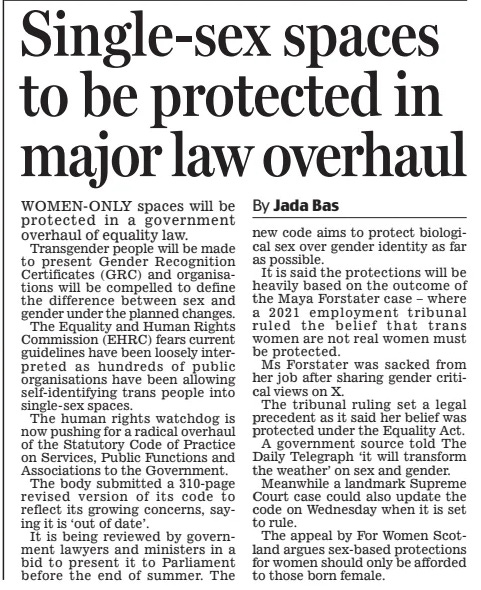
Wednesday Total: 2
The Guardian [2]

Thursday Total: 28
The Guardian [3]

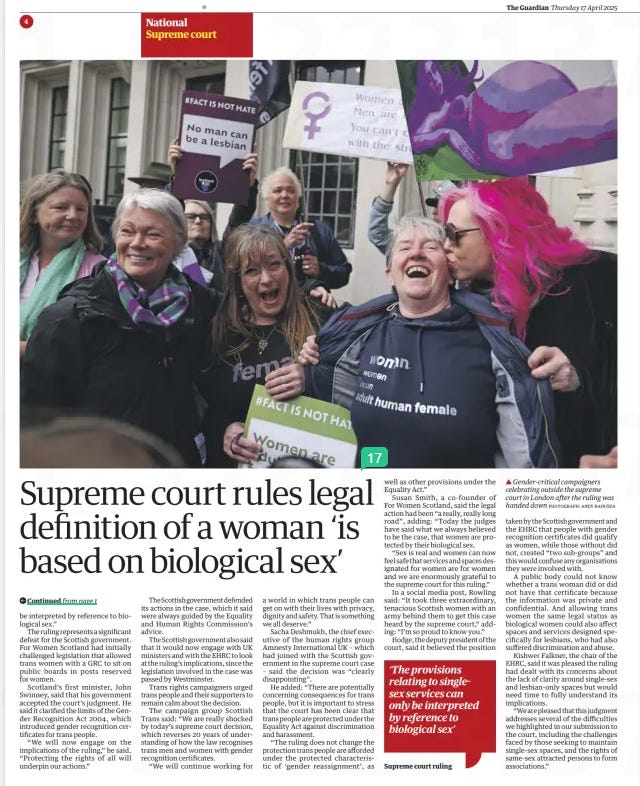
![‘Real issues now start’ New battle lines formed as judgment sinks in The Guardian17 Apr 2025Jessica Murray Social affairs correspondent PHOTOGRAPH: TAYFUN SALCI/SHUTTERSTOCK ▲ Susan Smith and Marion Calder of For Women Scotland. Smith said the judgment ‘felt like a massive relief ’ For gender-critical campaigners, the supreme court’s ruling on the definition of a woman in the Equality Act was a “huge reset” that left them feeling “vindicated and relieved”. For transgender rights campaigners, it was a “damaging attack on their rights”, signalling the start of “real issues” in their fight for legal recognition. “I think this will be the kicking off point for a very enhanced push for overt restrictions on the rights of trans people,” said Victoria McCloud, Britain’s first transgender judge. She applied as an intervener in the supreme court appeal but was refused. Last year, she quit her job as a judge, saying her position had become “untenable” because her trans identity was viewed as a “lifestyle choice or an ideology”. She now lives in Ireland. McCloud said the supreme court ruling came during “a scary time” for transgender people in Britain, and would mark the start of a more intense fight for rights. “The rest has been phoney war. The real issues now start,” she said. “If I was a trans person in the UK today, I would steer clear of using any loo in a public space unless it was a single-sex or combined-sex loo, because I personally cannot, as of this moment, judge whether I should use the male loo or the female loo,” she said. “I haven’t got my head around the complexities of the judgment, and its repercussions will be ongoing for some time. But I’m happy I live in the Republic of Ireland where this is not an issue. They know where I’m allowed to pee here.” Outside the supreme court on Wednesday morning, Susan Smith, a co-director of the gender-critical campaign group For Women Scotland, which brought the appeal, was one of several women jubilantly celebrating the result. “It was quite something to walk out into banks of photographers and loads of people cheering and clapping. It was very emotional,” she said. “We’ve all given up a lot to fight this and we’ve all had to put up with a lot of abuse, a lot of misrepresentation of our motives and our position and our beliefs. “We’ve finally got clarity on the law, and we know now that when spaces and services are provided under the Equality Act and they’re single-sex, it means exactly that. That feels like a massive relief.” Smith said the ruling would help women feel safe if there was a man in a female-only space – “they will know that they are well within their rights to object to that”. “Gender reassignment is a protected characteristic, and it is still protected,” she said. “But saying that women were just some amorphous collection of people and it was an identity anyone could have, it was really downplaying the very real and different issues that affect men and women.” Maya Forstater, who founded the campaign group Sex Matters after she won an employment tribunal that found she had been unfairly discriminated against because of her gender-critical beliefs, said the ruling brought “relief, vindication, happiness and pride”. “This judgment has been so clear and it’s from the highest court in the land,” she said. “There are dozens and dozens of women who have had to bring employment tribunal cases because they’ve been victimised for just saying what they think the law says. Now we know that we were right.” She said the judgment was about “recognising rules and reality”. “If you’re a man, you can call yourself what you like, you can dress how you like, but you cannot work in a rape crisis centre, you cannot go into a women’s changing room,” she said. McCloud said she shared concerns about protecting women’s spaces – “I don’t want men in the women’s loos myself, thank you”. But she said people with extreme views “regard someone like me as dangerous” simply because of her transgender identity. “Gender-critical ideology is on the ascendancy, and this is obviously a success for them,” McCloud said. “But the struggle starts now, both for them and for us, because they are going to want to enhance this success and we are going to want to clarify and protect the rights that we thought we had.” Ellie Gomersall, a trans woman and activist for the Scottish Greens, said she was “gutted” when she saw the news and described it as “yet another attack on the rights of trans people to live our lives in peace”. She said: “This will only impact trans people who have got a gender recognition certificate, which actually the vast majority of trans people don’t. But I don’t want to underplay how damaging it is. “It sets the idea that even if you jump through all of the hoops, you go through that dehumanising and stigmatising process to get a [gender recognition certificate], you’ll still never be recognised in law for who you truly are.” She added: “Some individuals and organisations will see this result and use it as justification or vindication to discriminate further against trans people and that makes me really worried for my community.” Article Name:‘Real issues now start’ Publication:The Guardian Author:Jessica Murray Social affairs correspondent Start Page:5 End Page:5Politicians may be breathing a sigh of relief as clear ruling lets them dodge difficult questions The Guardian17 Apr 2025Peter Walker and Severin Carrell For all the negative stereotypes, many politicians are thoughtful, diligent and caring. But they are also human, and it is their more self-serving instincts that may have caused some to breathe a sigh of relief at the supreme court ruling on gender recognition. After a challenge by the gender-critical group For Women Scotland – which started out as a dispute over Scottish government legislation about female representation on public boards – judges ruled that the terms “woman” and “sex” in the Equality Act refer to biological women and biological sex. The verdict will be heavily contested, and could bring serious and perhaps unforeseen repercussions for transgender women. But such an unexpectedly definitive view allows leaders in both Scotland and Westminster to (and there is no gentle way of putting this) dodge responsibility over one of the most contentious and toxic debates of our age. The Scottish government’s response was particularly eloquent. While stressing that no one should see the ruling as cause for triumph, it otherwise talked blandly about “engaging with the UK government to understand the full implication of this ruling”. There is logic to this. The Equality Act and the Gender Recognition Act, the legislative focus of the deliberations, are both UK-wide and thus not something the Holyrood administration can decide unilaterally. But beneath this reassuring constitutional hum lurks the sound of quiet footsteps, as the SNP’s first minister, John Swinney, shuffles his party away from an era when Nicola Sturgeon’s government was very proudly at the vanguard of transgender rights. It is little more than two years ago that Sturgeon’s government was openly seeking a battle with Westminster over a plan to make it easier for transgender people in Scotland to get gender recognition certificates – a move blocked by Rishi Sunak. We are in a very different political climate now, and not just with the open hostility of the Donald Trump administration, which is purging transgender people from the military on the stated basis that their very identity makes them unfit to serve. Scotland’s government has been on the receiving end of pushback from other controversies – for example, the decision to initially send Isla Bryson, a transgender woman convicted of double rape, to a women’s prison. To yet again frame it in slightly unpalatable political terms, this is no longer seen as a vote-winner for the SNP. For Keir Starmer and the Westminster administration, there had been an unspoken worry about a fudged or unclear court ruling, one that placed the impetus on politicians to decide. Instead, as a UK government spokesperson said, it gave “clarity and confidence”, both for women and for those who run single-sex spaces. Clarity and confidence, perhaps. Political cover? Most definitely. Starmer has spent his five years as Labour leader having TV and radio interviewers intermittently ask him to declare, yes or no, whether a woman can have a penis. Starmer’s standard dual response – under the law a tiny number of trans people are recognised as women but might not have completed gender reassignment surgery – prompted an inevitable and arguably damaging wave of attacks from political opponents. Kemi Badenoch has been relentless in this, despite having served as equalities minister in a government that did not amend or clarify the Equality Act to reflect her view that, as she tweeted on Wednesday, “saying ‘trans women are women’ was never true in fact”. This was not just a Conservative obsession. Starmer faced criticism from inside Labour– notably from the now-independent MP Rosie Duffield for, as she saw it, failing to stand up for women – as well as reproach from others who felt he was edging away from trans rights. From a nakedly political-management perspective, the court decision was ideal, making the decision judicial rather than political. No 10 officials believe there will be no need to tweak the Equality Act, leaving their role as little more than a neutral voice in helping organisations adjust to the new reality. Starmer’s aides deny he has been on a political journey from a few years ago, when as Labour leadership candidate he signed up to a pledge from the LGBT Labour group “that trans women are women, that trans men are men”, or 18 months later when he criticised Duffield for saying that only women could have a cervix. This is perhaps disingenuous. But in a debate where niceties and nuance are so often trampled on, Starmer is very much not the first politician to try to fudge things. Article Name:Politicians may be breathing a sigh of relief as clear ruling lets them dodge difficult questions Publication:The Guardian Author:Peter Walker and Severin Carrell Start Page:5 End Page:5](https://substackcdn.com/image/fetch/$s_!lqOx!,f_auto,q_auto:good,fl_progressive:steep/https%3A%2F%2Fsubstack-post-media.s3.amazonaws.com%2Fpublic%2Fimages%2Fe528d590-4120-48f1-ad9f-641c35341486_636x752.png "‘Real issues now start’ New battle lines formed as judgment sinks in The Guardian17 Apr 2025Jessica Murray Social affairs correspondent PHOTOGRAPH: TAYFUN SALCI/SHUTTERSTOCK ▲ Susan Smith and Marion Calder of For Women Scotland. Smith said the judgment ‘felt like a massive relief ’ For gender-critical campaigners, the supreme court’s ruling on the definition of a woman in the Equality Act was a “huge reset” that left them feeling “vindicated and relieved”. For transgender rights campaigners, it was a “damaging attack on their rights”, signalling the start of “real issues” in their fight for legal recognition. “I think this will be the kicking off point for a very enhanced push for overt restrictions on the rights of trans people,” said Victoria McCloud, Britain’s first transgender judge. She applied as an intervener in the supreme court appeal but was refused. Last year, she quit her job as a judge, saying her position had become “untenable” because her trans identity was viewed as a “lifestyle choice or an ideology”. She now lives in Ireland. McCloud said the supreme court ruling came during “a scary time” for transgender people in Britain, and would mark the start of a more intense fight for rights. “The rest has been phoney war. The real issues now start,” she said. “If I was a trans person in the UK today, I would steer clear of using any loo in a public space unless it was a single-sex or combined-sex loo, because I personally cannot, as of this moment, judge whether I should use the male loo or the female loo,” she said. “I haven’t got my head around the complexities of the judgment, and its repercussions will be ongoing for some time. But I’m happy I live in the Republic of Ireland where this is not an issue. They know where I’m allowed to pee here.” Outside the supreme court on Wednesday morning, Susan Smith, a co-director of the gender-critical campaign group For Women Scotland, which brought the appeal, was one of several women jubilantly celebrating the result. “It was quite something to walk out into banks of photographers and loads of people cheering and clapping. It was very emotional,” she said. “We’ve all given up a lot to fight this and we’ve all had to put up with a lot of abuse, a lot of misrepresentation of our motives and our position and our beliefs. “We’ve finally got clarity on the law, and we know now that when spaces and services are provided under the Equality Act and they’re single-sex, it means exactly that. That feels like a massive relief.” Smith said the ruling would help women feel safe if there was a man in a female-only space – “they will know that they are well within their rights to object to that”. “Gender reassignment is a protected characteristic, and it is still protected,” she said. “But saying that women were just some amorphous collection of people and it was an identity anyone could have, it was really downplaying the very real and different issues that affect men and women.” Maya Forstater, who founded the campaign group Sex Matters after she won an employment tribunal that found she had been unfairly discriminated against because of her gender-critical beliefs, said the ruling brought “relief, vindication, happiness and pride”. “This judgment has been so clear and it’s from the highest court in the land,” she said. “There are dozens and dozens of women who have had to bring employment tribunal cases because they’ve been victimised for just saying what they think the law says. Now we know that we were right.” She said the judgment was about “recognising rules and reality”. “If you’re a man, you can call yourself what you like, you can dress how you like, but you cannot work in a rape crisis centre, you cannot go into a women’s changing room,” she said. McCloud said she shared concerns about protecting women’s spaces – “I don’t want men in the women’s loos myself, thank you”. But she said people with extreme views “regard someone like me as dangerous” simply because of her transgender identity. “Gender-critical ideology is on the ascendancy, and this is obviously a success for them,” McCloud said. “But the struggle starts now, both for them and for us, because they are going to want to enhance this success and we are going to want to clarify and protect the rights that we thought we had.” Ellie Gomersall, a trans woman and activist for the Scottish Greens, said she was “gutted” when she saw the news and described it as “yet another attack on the rights of trans people to live our lives in peace”. She said: “This will only impact trans people who have got a gender recognition certificate, which actually the vast majority of trans people don’t. But I don’t want to underplay how damaging it is. “It sets the idea that even if you jump through all of the hoops, you go through that dehumanising and stigmatising process to get a [gender recognition certificate], you’ll still never be recognised in law for who you truly are.” She added: “Some individuals and organisations will see this result and use it as justification or vindication to discriminate further against trans people and that makes me really worried for my community.” Article Name:‘Real issues now start’ Publication:The Guardian Author:Jessica Murray Social affairs correspondent Start Page:5 End Page:5Politicians may be breathing a sigh of relief as clear ruling lets them dodge difficult questions The Guardian17 Apr 2025Peter Walker and Severin Carrell For all the negative stereotypes, many politicians are thoughtful, diligent and caring. But they are also human, and it is their more self-serving instincts that may have caused some to breathe a sigh of relief at the supreme court ruling on gender recognition. After a challenge by the gender-critical group For Women Scotland – which started out as a dispute over Scottish government legislation about female representation on public boards – judges ruled that the terms “woman” and “sex” in the Equality Act refer to biological women and biological sex. The verdict will be heavily contested, and could bring serious and perhaps unforeseen repercussions for transgender women. But such an unexpectedly definitive view allows leaders in both Scotland and Westminster to (and there is no gentle way of putting this) dodge responsibility over one of the most contentious and toxic debates of our age. The Scottish government’s response was particularly eloquent. While stressing that no one should see the ruling as cause for triumph, it otherwise talked blandly about “engaging with the UK government to understand the full implication of this ruling”. There is logic to this. The Equality Act and the Gender Recognition Act, the legislative focus of the deliberations, are both UK-wide and thus not something the Holyrood administration can decide unilaterally. But beneath this reassuring constitutional hum lurks the sound of quiet footsteps, as the SNP’s first minister, John Swinney, shuffles his party away from an era when Nicola Sturgeon’s government was very proudly at the vanguard of transgender rights. It is little more than two years ago that Sturgeon’s government was openly seeking a battle with Westminster over a plan to make it easier for transgender people in Scotland to get gender recognition certificates – a move blocked by Rishi Sunak. We are in a very different political climate now, and not just with the open hostility of the Donald Trump administration, which is purging transgender people from the military on the stated basis that their very identity makes them unfit to serve. Scotland’s government has been on the receiving end of pushback from other controversies – for example, the decision to initially send Isla Bryson, a transgender woman convicted of double rape, to a women’s prison. To yet again frame it in slightly unpalatable political terms, this is no longer seen as a vote-winner for the SNP. For Keir Starmer and the Westminster administration, there had been an unspoken worry about a fudged or unclear court ruling, one that placed the impetus on politicians to decide. Instead, as a UK government spokesperson said, it gave “clarity and confidence”, both for women and for those who run single-sex spaces. Clarity and confidence, perhaps. Political cover? Most definitely. Starmer has spent his five years as Labour leader having TV and radio interviewers intermittently ask him to declare, yes or no, whether a woman can have a penis. Starmer’s standard dual response – under the law a tiny number of trans people are recognised as women but might not have completed gender reassignment surgery – prompted an inevitable and arguably damaging wave of attacks from political opponents. Kemi Badenoch has been relentless in this, despite having served as equalities minister in a government that did not amend or clarify the Equality Act to reflect her view that, as she tweeted on Wednesday, “saying ‘trans women are women’ was never true in fact”. This was not just a Conservative obsession. Starmer faced criticism from inside Labour– notably from the now-independent MP Rosie Duffield for, as she saw it, failing to stand up for women – as well as reproach from others who felt he was edging away from trans rights. From a nakedly political-management perspective, the court decision was ideal, making the decision judicial rather than political. No 10 officials believe there will be no need to tweak the Equality Act, leaving their role as little more than a neutral voice in helping organisations adjust to the new reality. Starmer’s aides deny he has been on a political journey from a few years ago, when as Labour leadership candidate he signed up to a pledge from the LGBT Labour group “that trans women are women, that trans men are men”, or 18 months later when he criticised Duffield for saying that only women could have a cervix. This is perhaps disingenuous. But in a debate where niceties and nuance are so often trampled on, Starmer is very much not the first politician to try to fudge things. Article Name:Politicians may be breathing a sigh of relief as clear ruling lets them dodge difficult questions Publication:The Guardian Author:Peter Walker and Severin Carrell Start Page:5 End Page:5")
The Times [7]
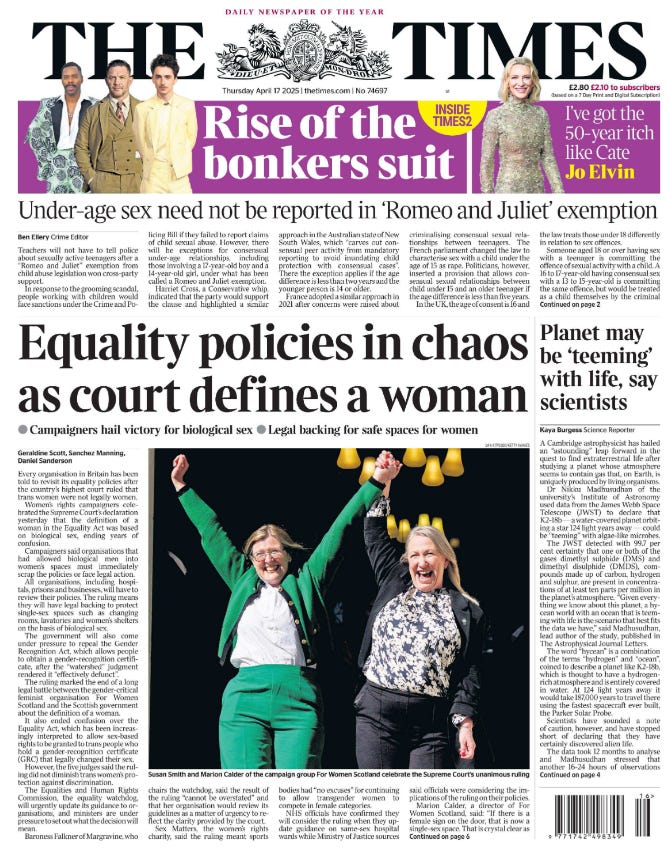
![Landmark ruling to affect work, sport, the NHS and education Sanchez Manning Susan Smith, left, and Marion Calder, centre, of the For Women Scotland campaign group, celebrate after the success of their long battle to show that only biological women can legally be women Next image › The Supreme Court has ruled that the legal definition of “woman” relies on biological sex. The decision has wide-ranging implications, from maternity care to competitive sport. SINGLE-SEX SERVICES The sex-based rights campaign group Sex Matters said that the Equalities and Human Rights Commission would be able to produce much “clearer, simpler” guidance on single-sex services as a result of the judgment. Naomi Cunningham, barrister and chairwoman of Sex Matters, said: “It is now clear that in any situation in which it is lawful to operate a single-sex or separate-sex service for women, it is not merely lawful but compulsory to exclude all men. “And ‘men’ for these purposes includes trans women, whether or not they hold gender recognition certificates [GRCs — a legal document that recognises an individual’s gender]. The same is true in reverse of single-sex or separate-sex services for men.” Jo Moseley, an employment law specialist at the law firm Irwin Mitchell, agreed that the decision would make it easier for employers to understand the rules on providing single-sex and separate-sex services. She said: “Ultimately this decision gives employers much needed legal certainty and will help them to make legally compliant decisions.” CLUBS AND ASSOCIATIONS Equally, Sex Matters believes that the judgment will allow single-sex clubs and associations to operate clearly and lawfully. Cunningham, who specialises in employment and discrimination law, said: “The judgment confirms that singlesex associations are lawful and must exclude everyone of the opposite sex whether or not they hold a GRC.” Bev Jackson, co-founder of LGB Alliance, said the ruling removed “any semblance” of doubt about whether men could enter women’s spaces and groups. She said: “The legal definition of ‘woman’ is clear now. This means that any club, association or other group of any size — for example, a lesbian social club — can now legally operate on a single-sex basis.” SEX DISCRIMINATION Sex Matters said that in the wake of the judgment “the comparators in sex discrimination will be clear” and the “definition of sexual orientation will make sense”. Moseley said that the potential impact was best explained using the example of a current tribunal — Peggie v Fife Health Board and Dr Beth Upton. In this case a female nurse objected to a biologically male doctor, who identified as female, using the female changing rooms and is suing her employer for sexual harassment, harassment related to a protected belief and indirect sex discrimination. Explaining how the judgment could affect this dispute, Moseley said: “The NHS’s arguments that the correct comparator for the indirect sex discrimination claim should be a woman — rather than a man — will no longer hold water. “The question in that case is how a biological man using the female changing rooms would be treated, not how another woman would be treated.” COMPETITIVE SPORT Campaigners for single-sex sport said that the judgment had made it “crystal clear” that males who identified as female — with or without a GRC — were not permitted in women’s sports. Su Wong, from Seen in Sport, said: “This applies to all women and girls, not just at elite level, so this should mark the end of ‘two-tier’ sports policies. This ruling means that women will no longer be sanctioned and punished if they raise concerns that there is a male in the female category.” DATA COLLECTION The legal opinion is that organisations will now be more likely to collect data on biological sex rather than “gender”, without fearing that this is unlawful. Professor Alice Sullivan, who recently led a review for the government of data on sex and gender, said: “The judgment provides absolute clarity for organisations collecting data to fulfil their public sector equality duty that they must collect data on biological sex.” SCHOOLS AND COLLEGES Sarah Phillimore, a barrister who has represented clients in a number of gender-critical legal cases, said that one important effect of the ruling would be that it would allow single sex schools to have a clear admissions policy. PREGNANCY AND MATERNITY Milli Hill, a childbirth campaigner and author, said that the ruling would help clarify women’s maternity rights. She said: “I think the judgment will make clear, for example, that pregnant women are entitled to care from a biological female not a male person with a GRC.” EQUAL PAY According to Sex Matters, in lieu of the judgment equal pay rules will now specifically track biological sex. Cunningham said: “The judgment means that employers can’t skew their gender pay gap figures by including some high-earning trans-identifying men as ‘women’, even if they have GRCs. It also means that a female employee can claim equal pay by reference to a higher-paid male comparator even if he has a GRC.” SEX-SPECIFIC EMPLOYMENT Legal experts said that the judgment would make it clearer and simpler for employers to advertise roles for people of one particular sex when that was a requirement of the job. Moseley said that the ruling would help remove the ambiguity of whether employers can exclude men, who identify as women with a GRC, from a list of candidates they wish to hire.](https://substackcdn.com/image/fetch/$s_!Jreq!,f_auto,q_auto:good,fl_progressive:steep/https%3A%2F%2Fsubstack-post-media.s3.amazonaws.com%2Fpublic%2Fimages%2Ff9d2d3fb-cec1-4d52-93fb-216493df34f7_1395x856.png "Landmark ruling to affect work, sport, the NHS and education Sanchez Manning Susan Smith, left, and Marion Calder, centre, of the For Women Scotland campaign group, celebrate after the success of their long battle to show that only biological women can legally be women Next image › The Supreme Court has ruled that the legal definition of “woman” relies on biological sex. The decision has wide-ranging implications, from maternity care to competitive sport. SINGLE-SEX SERVICES The sex-based rights campaign group Sex Matters said that the Equalities and Human Rights Commission would be able to produce much “clearer, simpler” guidance on single-sex services as a result of the judgment. Naomi Cunningham, barrister and chairwoman of Sex Matters, said: “It is now clear that in any situation in which it is lawful to operate a single-sex or separate-sex service for women, it is not merely lawful but compulsory to exclude all men. “And ‘men’ for these purposes includes trans women, whether or not they hold gender recognition certificates [GRCs — a legal document that recognises an individual’s gender]. The same is true in reverse of single-sex or separate-sex services for men.” Jo Moseley, an employment law specialist at the law firm Irwin Mitchell, agreed that the decision would make it easier for employers to understand the rules on providing single-sex and separate-sex services. She said: “Ultimately this decision gives employers much needed legal certainty and will help them to make legally compliant decisions.” CLUBS AND ASSOCIATIONS Equally, Sex Matters believes that the judgment will allow single-sex clubs and associations to operate clearly and lawfully. Cunningham, who specialises in employment and discrimination law, said: “The judgment confirms that singlesex associations are lawful and must exclude everyone of the opposite sex whether or not they hold a GRC.” Bev Jackson, co-founder of LGB Alliance, said the ruling removed “any semblance” of doubt about whether men could enter women’s spaces and groups. She said: “The legal definition of ‘woman’ is clear now. This means that any club, association or other group of any size — for example, a lesbian social club — can now legally operate on a single-sex basis.” SEX DISCRIMINATION Sex Matters said that in the wake of the judgment “the comparators in sex discrimination will be clear” and the “definition of sexual orientation will make sense”. Moseley said that the potential impact was best explained using the example of a current tribunal — Peggie v Fife Health Board and Dr Beth Upton. In this case a female nurse objected to a biologically male doctor, who identified as female, using the female changing rooms and is suing her employer for sexual harassment, harassment related to a protected belief and indirect sex discrimination. Explaining how the judgment could affect this dispute, Moseley said: “The NHS’s arguments that the correct comparator for the indirect sex discrimination claim should be a woman — rather than a man — will no longer hold water. “The question in that case is how a biological man using the female changing rooms would be treated, not how another woman would be treated.” COMPETITIVE SPORT Campaigners for single-sex sport said that the judgment had made it “crystal clear” that males who identified as female — with or without a GRC — were not permitted in women’s sports. Su Wong, from Seen in Sport, said: “This applies to all women and girls, not just at elite level, so this should mark the end of ‘two-tier’ sports policies. This ruling means that women will no longer be sanctioned and punished if they raise concerns that there is a male in the female category.” DATA COLLECTION The legal opinion is that organisations will now be more likely to collect data on biological sex rather than “gender”, without fearing that this is unlawful. Professor Alice Sullivan, who recently led a review for the government of data on sex and gender, said: “The judgment provides absolute clarity for organisations collecting data to fulfil their public sector equality duty that they must collect data on biological sex.” SCHOOLS AND COLLEGES Sarah Phillimore, a barrister who has represented clients in a number of gender-critical legal cases, said that one important effect of the ruling would be that it would allow single sex schools to have a clear admissions policy. PREGNANCY AND MATERNITY Milli Hill, a childbirth campaigner and author, said that the ruling would help clarify women’s maternity rights. She said: “I think the judgment will make clear, for example, that pregnant women are entitled to care from a biological female not a male person with a GRC.” EQUAL PAY According to Sex Matters, in lieu of the judgment equal pay rules will now specifically track biological sex. Cunningham said: “The judgment means that employers can’t skew their gender pay gap figures by including some high-earning trans-identifying men as ‘women’, even if they have GRCs. It also means that a female employee can claim equal pay by reference to a higher-paid male comparator even if he has a GRC.” SEX-SPECIFIC EMPLOYMENT Legal experts said that the judgment would make it clearer and simpler for employers to advertise roles for people of one particular sex when that was a requirement of the job. Moseley said that the ruling would help remove the ambiguity of whether employers can exclude men, who identify as women with a GRC, from a list of candidates they wish to hire.")


Daily Mail [7]


Telegraph [11]
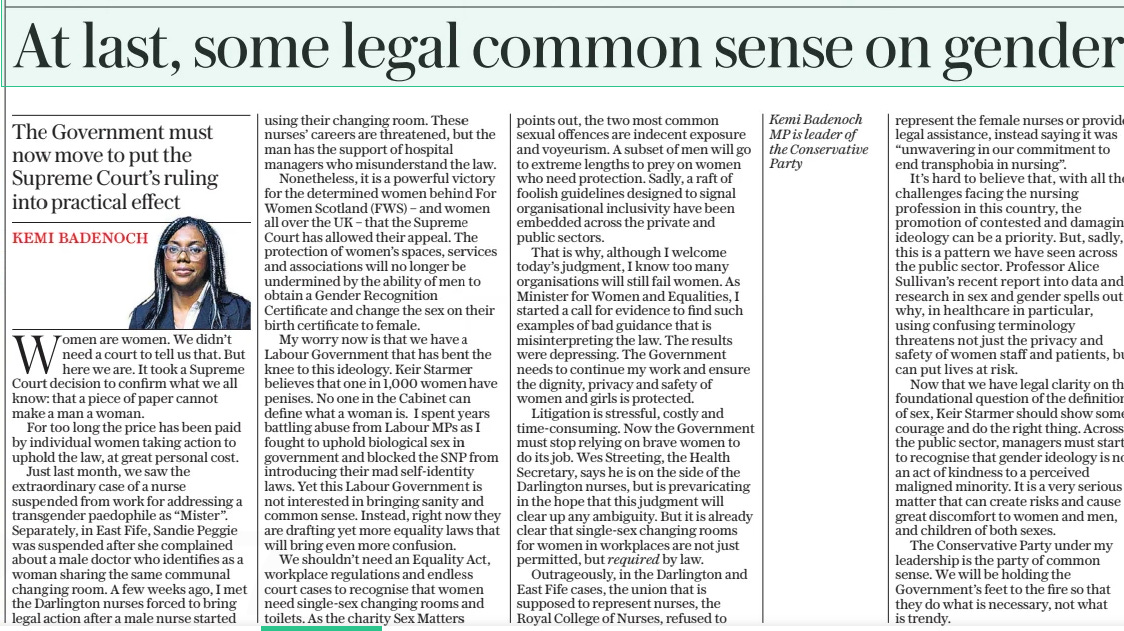
![Trans women are not women Supreme Court’s ruling will see huge changes to public and private sector gender guidance The Daily Telegraph17 Apr 2025By Daniel Martin, Janet Eastham and Hayley Dixon Susan Smith (left) and Marion Calder, co-directors of For Women Scotland, celebrate outside the Supreme Court after the verdict PUBLIC bodies are under pressure to tear up pro-trans guidance after a ruling that only biological women are women. The decision by the Supreme Court that laws against sex-based discrimination should only apply to biological women will lead to a raft of changes. They are expected to include who can access single-sex NHS wards, which police officers can carry out strip searches, and who can join female teams in elite sport. Previously, trans women were given the same rights as biological women, allowing them access to female-only spaces and groups. Although the judges said that trans women could not be discriminated against, the ruling means they will no longer be treated the same as people born female.last night, the Equality and Human Rights Commission (EHRC), the government watchdog, promised to rewrite its guidance to public bodies by the summer. The NHS, National Police Chief ’s Council and other bodies are also expected to update guidance soon. The Supreme Court’s judgment was welcomed by JK Rowling, the Harry Potter author and prominent women’s rights campaigner, who said it would “protect the rights of women and girls across the UK”. She added: “Spare a thought today for the UK employers, government departments, health boards, academic institutions and sporting bodies who’ve been breaking equality law to appease activist groups. So many HR manuals to pulp. So many outof-court settlements to pay.” Judges unanimously ruled that the terms “woman” and “sex” in the 2010 Equality Act referred to biological sex, not the gender with which a person identifies. The justices said that for the purpose of equality laws, transgender women were not legally women even if they have obtained a gender recognition certificate. They found that blurring the boundary of sex would also create “confusion and impracticability” around the provision of “single sex characteristic associations and charities, women’s fair participation in sport, the operation of the public sector equality duty, and the Armed Forces”. Judges also ruled that sex was binary, meaning that the central tenet of gender ideology – that there is a spectrum of gender identities – has no basis in law. The ruling means that people who were born male can lawfully be excluded from women’s sports, changing rooms, lavatories, women-only support groups and women-only shortlists. It will require a rewriting of rules across the public and private sectors. Handing down the court’s judgment on whether sex-based protections should only apply to people who were born female, Lord Hodge, the court’s deputy president, said: “The unanimous decision of this court is that the definition of the terms woman and sex in the Equality Act 2010 refer to a biological woman and biological sex”. The justices made clear that their decision made no difference to protections against discrimination for transgender people, and insisted it should not be interpreted as “a triumph of one or more groups in our society at the expense of another”. Lord Hodge said: “Interpreting sex as certificated sex would cut across the definitions of ‘man’ and ‘woman’ in the [Equality Act 2010] – and thus the protected characteristic of sex – in an incoherent way.” It followed a years-long legal battle between For Women Scotland, a campaign group, and the Scottish Government over the definition of a woman. Rowling said yesterday: “It took three extraordinary, tenacious Scottish women with an army behind them to get this case heard by the Supreme Court and, in winning, they’ve protected the rights of women and girls across the UK.” Kemi Badenoch, the Tory leader, said the ruling meant that the “era of Keir Starmer telling us women can have penises has come to an end”. A government spokesman said: “We have always supported the protection of single-sex spaces based on biological sex. This ruling brings clarity and confidence, for women and service providers such as hospitals, refuges, and sports clubs. Single-sex spaces are protected in law and will always be protected by this Government.” Labour Women’s Declaration, a gender-critical group, called on Sir Keir Starmer, the Prime Minister, to take concrete action to ensure the judgment is fully reflected in all public sector guidance. It said: “The Government now needs to instruct all government departments to bring their policies, training and guidance into line with the judgment. “The ‘clarity and confidence’ the ruling brings must also be applied to all positive action initiatives and associations for women within the Labour Party, such as women’s branches and committees.” In February, Wes Streeting told the Darlington nurses – eight nurses suing their trust after being forced to share a changing room with a transgender colleague – that he would wait until the Supreme Court ruling before issuing new guidance on single-sex spaces. In a letter to them, seen by The Telegraph, he said: “Given the sensitivity of the issue, it is important to me that any changes made are credible and enduring… When I have the benefit of the Supreme Court’s decision on this matter, I will consider what steps to take.” A Whitehall source said the Government’s legal department would now ‘We will work at pace to incorporate implications of this into the updated [human rights] code’ consider the ruling in full before publishing new guidance. It is understood that the NPCC will consider the ruling before bringing out new guidance for the police. It follows criticism that some forces are allowing trans women – that is biological men – to strip search vulnerable females. Richard Dawkins, the evolutionary biologist, said: “The Supreme Court rules that a woman is legally defined as a woman and that the concept of sex is binary… Yes, the science was settled in the Precambrian. Nice that the law has finally caught up.” Baroness Falkner of Margravine, the chairman of the EHRC, said: “We will take the outcome of this appeal into account in our ongoing work as the regulator of the Equality Act. That includes the development of our revised Code of Practice which, subject to ministerial approval, is expected to be laid before Parliament before the summer recess. “We will be working at pace to incorporate the implications of this judgment into the updated code, which supports service providers, public bodies and associations to understand their duties under the Equality Act and put them into practice. “Where this judgment impacts upon our other advice for duty-bearers, we will review it as a matter of urgency and alert users to where guidance has been withdrawn or needs to be updated.”](https://substackcdn.com/image/fetch/$s_!SO4b!,f_auto,q_auto:good,fl_progressive:steep/https%3A%2F%2Fsubstack-post-media.s3.amazonaws.com%2Fpublic%2Fimages%2F668973f5-06cf-4784-9a4e-acf66e044753_524x828.png "Trans women are not women Supreme Court’s ruling will see huge changes to public and private sector gender guidance The Daily Telegraph17 Apr 2025By Daniel Martin, Janet Eastham and Hayley Dixon Susan Smith (left) and Marion Calder, co-directors of For Women Scotland, celebrate outside the Supreme Court after the verdict PUBLIC bodies are under pressure to tear up pro-trans guidance after a ruling that only biological women are women. The decision by the Supreme Court that laws against sex-based discrimination should only apply to biological women will lead to a raft of changes. They are expected to include who can access single-sex NHS wards, which police officers can carry out strip searches, and who can join female teams in elite sport. Previously, trans women were given the same rights as biological women, allowing them access to female-only spaces and groups. Although the judges said that trans women could not be discriminated against, the ruling means they will no longer be treated the same as people born female.last night, the Equality and Human Rights Commission (EHRC), the government watchdog, promised to rewrite its guidance to public bodies by the summer. The NHS, National Police Chief ’s Council and other bodies are also expected to update guidance soon. The Supreme Court’s judgment was welcomed by JK Rowling, the Harry Potter author and prominent women’s rights campaigner, who said it would “protect the rights of women and girls across the UK”. She added: “Spare a thought today for the UK employers, government departments, health boards, academic institutions and sporting bodies who’ve been breaking equality law to appease activist groups. So many HR manuals to pulp. So many outof-court settlements to pay.” Judges unanimously ruled that the terms “woman” and “sex” in the 2010 Equality Act referred to biological sex, not the gender with which a person identifies. The justices said that for the purpose of equality laws, transgender women were not legally women even if they have obtained a gender recognition certificate. They found that blurring the boundary of sex would also create “confusion and impracticability” around the provision of “single sex characteristic associations and charities, women’s fair participation in sport, the operation of the public sector equality duty, and the Armed Forces”. Judges also ruled that sex was binary, meaning that the central tenet of gender ideology – that there is a spectrum of gender identities – has no basis in law. The ruling means that people who were born male can lawfully be excluded from women’s sports, changing rooms, lavatories, women-only support groups and women-only shortlists. It will require a rewriting of rules across the public and private sectors. Handing down the court’s judgment on whether sex-based protections should only apply to people who were born female, Lord Hodge, the court’s deputy president, said: “The unanimous decision of this court is that the definition of the terms woman and sex in the Equality Act 2010 refer to a biological woman and biological sex”. The justices made clear that their decision made no difference to protections against discrimination for transgender people, and insisted it should not be interpreted as “a triumph of one or more groups in our society at the expense of another”. Lord Hodge said: “Interpreting sex as certificated sex would cut across the definitions of ‘man’ and ‘woman’ in the [Equality Act 2010] – and thus the protected characteristic of sex – in an incoherent way.” It followed a years-long legal battle between For Women Scotland, a campaign group, and the Scottish Government over the definition of a woman. Rowling said yesterday: “It took three extraordinary, tenacious Scottish women with an army behind them to get this case heard by the Supreme Court and, in winning, they’ve protected the rights of women and girls across the UK.” Kemi Badenoch, the Tory leader, said the ruling meant that the “era of Keir Starmer telling us women can have penises has come to an end”. A government spokesman said: “We have always supported the protection of single-sex spaces based on biological sex. This ruling brings clarity and confidence, for women and service providers such as hospitals, refuges, and sports clubs. Single-sex spaces are protected in law and will always be protected by this Government.” Labour Women’s Declaration, a gender-critical group, called on Sir Keir Starmer, the Prime Minister, to take concrete action to ensure the judgment is fully reflected in all public sector guidance. It said: “The Government now needs to instruct all government departments to bring their policies, training and guidance into line with the judgment. “The ‘clarity and confidence’ the ruling brings must also be applied to all positive action initiatives and associations for women within the Labour Party, such as women’s branches and committees.” In February, Wes Streeting told the Darlington nurses – eight nurses suing their trust after being forced to share a changing room with a transgender colleague – that he would wait until the Supreme Court ruling before issuing new guidance on single-sex spaces. In a letter to them, seen by The Telegraph, he said: “Given the sensitivity of the issue, it is important to me that any changes made are credible and enduring… When I have the benefit of the Supreme Court’s decision on this matter, I will consider what steps to take.” A Whitehall source said the Government’s legal department would now ‘We will work at pace to incorporate implications of this into the updated [human rights] code’ consider the ruling in full before publishing new guidance. It is understood that the NPCC will consider the ruling before bringing out new guidance for the police. It follows criticism that some forces are allowing trans women – that is biological men – to strip search vulnerable females. Richard Dawkins, the evolutionary biologist, said: “The Supreme Court rules that a woman is legally defined as a woman and that the concept of sex is binary… Yes, the science was settled in the Precambrian. Nice that the law has finally caught up.” Baroness Falkner of Margravine, the chairman of the EHRC, said: “We will take the outcome of this appeal into account in our ongoing work as the regulator of the Equality Act. That includes the development of our revised Code of Practice which, subject to ministerial approval, is expected to be laid before Parliament before the summer recess. “We will be working at pace to incorporate the implications of this judgment into the updated code, which supports service providers, public bodies and associations to understand their duties under the Equality Act and put them into practice. “Where this judgment impacts upon our other advice for duty-bearers, we will review it as a matter of urgency and alert users to where guidance has been withdrawn or needs to be updated.”")



Friday Total: 18
The Guardian [3]
![NHS told it must act after ruling on gender The Guardian18 Apr 2025Andrew Gregory Severin Carrell Rajeev Syal NHS chiefs are working to overhaul guidelines for single-sex spaces in thousands of hospitals and GP surgeries after the equality watchdog warned they would be pursued if they failed to do so. The British Transport Police (BTP) became the first to change policies yesterday amid the fallout from the supreme court ruling on the legal definition of a woman, piling pressure on the health service and other organisations to revamp their guidance. Current NHS guidance in England says transgender people should be accommodated based on how they dress, their names and their pronouns. Under Wednesday’s ruling that a woman is defined by biological sex under the Equality Act 2010, this would be scrapped. Senior NHS legal officials and estates and facilities managers are now racing to draw up proposals for how hospitals, community care centres and GP practices should reflect the ruling, sources have told the Guardian. The judgment poses a challenge for the NHS, which has an estate spanning 25m sq metres in England alone, where infrastructure repair bills top £14bn. The issue is further complicated by the fact that health policy and spending are devolved in Wales and Scotland. Kishwer Falkner, the chair of the Equality and Human Rights Commission (EHRC), told BBC Radio 4’s Today programme yesterday: “They [the NHS] have to change it. They now have clarity. There is no confusion as of yesterday, at 10.30 in the morning, and they can start to implement the new legal reasoning and produce their exceptions forthwith, but they have to change it. We will be having conversations with them to update that guidance.” Asked if the EHRC would pursue the case if it did not, Lady Falkner replied: “Yes, we will.” An NHS England spokesperson said: “The NHS is currently reviewing guidance on same sex accommodation and as part of this process, will consider and take into account all relevant legislation and today’s ruling.” Meanwhile, the BTP, which patrols the railways in Great Britain, announced that male officers would conduct any intimate searches of trans women “in accordance with the biological birth sex of the detainee”, while trans men would be searched by female officers. Under the force’s previous policy, officers had been told that anyone in custody with a gender recognition certificate would be searched by an officer matching a detainee’s acquired gender. The update comes during a legal battle between gender-critical campaigners and the force over its guidance that allowed officers who are trans women to strip-search women, so long as the officer held a gender recognition certificate. The rapid change of approach came after Falkner said the ECHR would be issuing updated and legally binding codes of practice on singlesex spaces and services in the wake of the “enormously consequential” court ruling. “We are going to have a new statutory code of practice [meaning] it will be interpreted by courts as the law of the land. We’re hoping we’re going to have that by the summer,” she told Today. The judgment meant only biological women could use single-sex changing rooms and women’s toilets, or participate in women-only sporting events and teams, or be placed in women’s wards in hospitals. Even so, the commission would “not tolerate” discrimination or harassment of trans people, which remained unlawful under the Equality Act, and would support trans women taking out equal pay claims under sex discrimination laws. Falkner said the supreme court ruling was “a victory for common sense” but “only if you recognise that trans people exist, they have rights and their rights must be respected”. The UK government has avoided making any substantial comment on the ruling, but a strong indication of Labour’s approach came from Anas Sarwar, the Scottish Labour leader, who swung the party behind the supreme court and ECHR’s stance. Previously a supporter of selfidentification for trans people, Sarwar said there was now a need for an “urgent” update of Scotland’s policies on single-sex spaces. Scottish ministers are expected to update Holyrood next week on their response to the ruling. Most of the reaction from Westminster politicians continued to be from the Conservatives. Speaking during a local elections campaign visit to Cambridgeshire, Kemi Badenoch, the Tory leader, said the court ruling was a vindication of the party’s stance. She said she would support changes to the Equality Act and Gender Recognition Act to cement the court’s view. “These laws were written 20 years ago plus, when the world was different,” she said. There was little sign of how ministers will help institutions navigate the new framework. Rachel Reeves, the chancellor, speaking on a visit to Scunthorpe, dodged questions on the issue, saying only that more advice would come in “due course”. Among the issues that will need to be addressed is provision of toilet facilities for trans people, given the EHRC said the ruling means they will not be able to use single-sex toilets. ‘They [the NHS] have to change it. We will be having conversations with them to update that guidance’ Kishwer Falkner EHRC chair Article Name:NHS told it must act after ruling on gender Publication:The Guardian Author:Andrew Gregory Severin Carrell Rajeev Syal Start Page:1 End Page:1](https://substackcdn.com/image/fetch/$s_!V95N!,f_auto,q_auto:good,fl_progressive:steep/https%3A%2F%2Fsubstack-post-media.s3.amazonaws.com%2Fpublic%2Fimages%2F1aaff906-1663-4665-b9e6-4d8c93348773_238x663.png "NHS told it must act after ruling on gender The Guardian18 Apr 2025Andrew Gregory Severin Carrell Rajeev Syal NHS chiefs are working to overhaul guidelines for single-sex spaces in thousands of hospitals and GP surgeries after the equality watchdog warned they would be pursued if they failed to do so. The British Transport Police (BTP) became the first to change policies yesterday amid the fallout from the supreme court ruling on the legal definition of a woman, piling pressure on the health service and other organisations to revamp their guidance. Current NHS guidance in England says transgender people should be accommodated based on how they dress, their names and their pronouns. Under Wednesday’s ruling that a woman is defined by biological sex under the Equality Act 2010, this would be scrapped. Senior NHS legal officials and estates and facilities managers are now racing to draw up proposals for how hospitals, community care centres and GP practices should reflect the ruling, sources have told the Guardian. The judgment poses a challenge for the NHS, which has an estate spanning 25m sq metres in England alone, where infrastructure repair bills top £14bn. The issue is further complicated by the fact that health policy and spending are devolved in Wales and Scotland. Kishwer Falkner, the chair of the Equality and Human Rights Commission (EHRC), told BBC Radio 4’s Today programme yesterday: “They [the NHS] have to change it. They now have clarity. There is no confusion as of yesterday, at 10.30 in the morning, and they can start to implement the new legal reasoning and produce their exceptions forthwith, but they have to change it. We will be having conversations with them to update that guidance.” Asked if the EHRC would pursue the case if it did not, Lady Falkner replied: “Yes, we will.” An NHS England spokesperson said: “The NHS is currently reviewing guidance on same sex accommodation and as part of this process, will consider and take into account all relevant legislation and today’s ruling.” Meanwhile, the BTP, which patrols the railways in Great Britain, announced that male officers would conduct any intimate searches of trans women “in accordance with the biological birth sex of the detainee”, while trans men would be searched by female officers. Under the force’s previous policy, officers had been told that anyone in custody with a gender recognition certificate would be searched by an officer matching a detainee’s acquired gender. The update comes during a legal battle between gender-critical campaigners and the force over its guidance that allowed officers who are trans women to strip-search women, so long as the officer held a gender recognition certificate. The rapid change of approach came after Falkner said the ECHR would be issuing updated and legally binding codes of practice on singlesex spaces and services in the wake of the “enormously consequential” court ruling. “We are going to have a new statutory code of practice [meaning] it will be interpreted by courts as the law of the land. We’re hoping we’re going to have that by the summer,” she told Today. The judgment meant only biological women could use single-sex changing rooms and women’s toilets, or participate in women-only sporting events and teams, or be placed in women’s wards in hospitals. Even so, the commission would “not tolerate” discrimination or harassment of trans people, which remained unlawful under the Equality Act, and would support trans women taking out equal pay claims under sex discrimination laws. Falkner said the supreme court ruling was “a victory for common sense” but “only if you recognise that trans people exist, they have rights and their rights must be respected”. The UK government has avoided making any substantial comment on the ruling, but a strong indication of Labour’s approach came from Anas Sarwar, the Scottish Labour leader, who swung the party behind the supreme court and ECHR’s stance. Previously a supporter of selfidentification for trans people, Sarwar said there was now a need for an “urgent” update of Scotland’s policies on single-sex spaces. Scottish ministers are expected to update Holyrood next week on their response to the ruling. Most of the reaction from Westminster politicians continued to be from the Conservatives. Speaking during a local elections campaign visit to Cambridgeshire, Kemi Badenoch, the Tory leader, said the court ruling was a vindication of the party’s stance. She said she would support changes to the Equality Act and Gender Recognition Act to cement the court’s view. “These laws were written 20 years ago plus, when the world was different,” she said. There was little sign of how ministers will help institutions navigate the new framework. Rachel Reeves, the chancellor, speaking on a visit to Scunthorpe, dodged questions on the issue, saying only that more advice would come in “due course”. Among the issues that will need to be addressed is provision of toilet facilities for trans people, given the EHRC said the ruling means they will not be able to use single-sex toilets. ‘They [the NHS] have to change it. We will be having conversations with them to update that guidance’ Kishwer Falkner EHRC chair Article Name:NHS told it must act after ruling on gender Publication:The Guardian Author:Andrew Gregory Severin Carrell Rajeev Syal Start Page:1 End Page:1")
![‘It does bring clarity’ What decision means for public organisations The Guardian18 Apr 2025Amelia Gentleman Wednesday’s supreme court judgment on the legal definition of a woman will have significant implications across policy areas from sport, to prisons and the NHS. It will also impact how smaller organisations manage single-sex spaces and services. The Equality and Human Rights Commission (EHRC) has said it will publish a new statutory code of practice by the summer so that it can offer advice to public bodies and organisations about how they may need to revise their policies. The supreme court was asked to decide on the proper interpretation of the 2010 Equality Act, which applies across Britain. The unanimous judgment that a woman is defined by biological sex under equalities law should add clarity to a number of ongoing disputes over single-sex spaces. Sport Kishwer Falkner, a member of the House of Lords and the chair of the EHRC, said the impact of the ruling on sport was “enormously consequential” and confirmed that it was the “correct interpretation” to conclude that those born as men could not take part in women’s sport. She said sports organisations should read the judgment. “It does bring clarity, and helps them decide what they should do,” she said. Sebastian Coe, the president of World Athletics, welcomed the ruling, adding that it removed legal uncertainty. “It protects women in places that really matter in sport, whether it’s safe spaces, changing rooms or conduct in and around the field of play,” Lord Coe said. In the ruling, Lord Hodge, the deputy president of the court, made it clear that some of Equality Act’s provisions would only function properly if sex is interpreted as biological sex, and he named “women’s fair participation” in sport as one relevant area. The use of people’s “certificated sex”, acquired by a gender recognition certificate (GRC), rather than their biological sex in sport had led to an “absence of coherence”, he said. The ruling looked at how women would be disadvantaged because of their sex in a sport that is “gender affected”, such as boxing, if they found themselves competing against biological males. “Women’s average physical strength, stamina and/or physique will disadvantage them as competitors against average men in a boxing match,” the judgment noted. Many UK sport governing bodies have adopted clear policies banning athletes who were born male from participating in female events. But some sports, including football, allow trans women to compete against and alongside biological women if they meet reduced testosterone level requirements. Refuges and rape crisis centres Elizabeth McGlone, an employment discrimination solicitor at didlaw, said refuges would have to review their policies if they wanted to state that they were offering single-sex services and spaces to clients. “There has been a dilution of single-sex services by virtue of organisations having trans inclusion policies. This ruling will give organisations the confidence to say that we are offering this service only to biological women,” McGlone said. The charity Refuge said it would not be changing its policies. “We remain firmly committed to supporting all survivors of domestic abuse, including trans women,” Gemma Sherrington, Refuge’s CEO, said in a statement. NHS A review of NHS services will be required because previous guidance advised that trans patients should be accommodated according to their gender identity. NHS managers will now need to ensure they are recording patients’ biological sex. Lady Falkner expressed impatience at the NHS’s sluggish response. “We’ve been talking to the health service for an inordinately long time, and they keep telling us they’re going to produce new guidance. We will now be asking them when they expect to produce that new guidance,” she said. “They now have clarity.” The health minister Karin Smyth said trans patients should feel reassured that their rights “remain enshrined in the Equality Act” and that they would “have their dignity and privacy respected” in healthcare settings, but she added: “This law was about women’s rights and rights under the Equality Act for sex and for service providers making sure they are compliant with that.” An NHS spokesperson said: “The NHS is currently reviewing guidance on same-sex accommodation and as part of this process will consider and take into account all relevant legislation and today’s ruling.” Changing rooms Falkner said the ruling made it clear that single-sex services such as changing rooms must be based on biological sex but that there was no legal requirement for organisations to provide single-sex services. “If a male person is allowed to use a women-only service or facility, it isn’t any longer single sex, then it becomes a mixed-sex space. But there’s no law that forces organisations and service providers to provide a single-sex space, and there is no law against them providing a third, additional space, such as unisex toilets, for example, or changing rooms.” Sandie Peggie, a nurse working for NHS Fife, is taking legal action against her employers, saying she was subject to unlawful harassment under the Equality Act when she was expected to share a changing room with a trans woman. A Newcastle employment tribunal is currently examining a claim filed by five nurses at Darlington Memorial hospital who have complained about the use of a single-sex changing room by a trans colleague. It is not clear whether the supreme court ruling will have an impact on either case. Michael Foran, a lecturer in public law at Glasgow University, said that although the supreme court ruling had no direct legal bearing on the case, it might encourage NHS Fife to consider settling the claim. Toilets Falkner said: “I think the law is quite clear that if a service provider says ‘we’re offering a women’s toilet’, trans [women] should not be using that single-sex facility.” Peter Byrne, the head of employment law at Slater and Gordon, said trans employees might now find that they were asked to use disabled toilets in organisations where there were no gender-neutral facilities. He said that while previously an employee might have been asked which toilet they felt comfortable using, “that option is probably going to disappear”. Emma Bartlett, a partner and diversity, equality and inclusion lead at law firm CM Murray, said many organisations had been guided by the LGBTQ+ charity Stonewall on being trans inclusive and might now have to revisit their policies. In business settings there is no legislative framework dictating how toilets should be organised, she added. “It’s about common sense and politeness. There’s nothing that now requires an employer to say: ‘only women can use that toilet, and only men can use this toilet, and trans people cannot use either of those toilets,’” she said. But she acknowledged that trans women might worry that they could be challenged. “You might find people who are against trans women using a female designated toilet in public places being emboldened by the decision of the supreme court to speak out, and that will create a very difficult situation for a trans woman.” Lesbian-only organisations Hodge said the judgment recognised the concerns of lesbian women who he said “have historically suffered marginalisation because of their sexual orientation”, and who had highlighted the anomalies that would adversely affect them if the word sex was “interpreted as certificated sex rather than biological sex”. Kate Barker, the chief executive of the LGB Alliance, a charity for same-sex attracted people, which intervened in the case, said the ruling marked a “watershed for women and, in particular, lesbians who have seen their rights and identities steadily stolen from them over the last decade”. She added: “The ruling confirms the words ‘gay’ and ‘lesbian’ refer to same-sex sexual orientation and makes it absolutely clear that lesbians wishing to form associations of any size are lawfully entitled to exclude men – whether or not they possess a GRC.”. Prisons Prison services will have to revise their policies on where trans prisoners are held as a result of the supreme court ruling. In recent decades, prison policy has evolved in recognition that some trans prisoners who present as women can be vulnerable when they are held in male prisons. Some feminist campaigners have argued that the parallel vulnerability of women in prisons has not been prioritised. In some cases, prisons have allowed inmates to self-identify their gender without requiring a GRC, opening up the potential for exploitation of the system. Decisions to house violent sex offenders in the female estate have periodically sparked national debate. In 2018 the convicted paedophile and rapist Karen White, a 52-year-old trans woman, sexually assaulted two inmates at the female prison where she was being held. In 2023 Isla Bryson, a transgender double rapist, was initially sent to a female prison in Scotland before being moved to a male facility less than 72 hours later. Last week it was reported a trans prisoner, Paris Green, who is serving a life sentence for murder, was still being housed in the women’s wing at Polmont jail in Falkirk after admitting assaulting a female officer. A Scottish Prison Service spokesperson said: “We have received the supreme court’s judgment and are considering any potential impact it may have.” Prison policy is different in England and Wales. Sources said that Ministry of Justice officials were still digesting the judgment. A solution may be to house particularly vulnerable trans identifying prisoners separately from the general prison population. Article Name:‘It does bring clarity’ Publication:The Guardian Author:Amelia Gentleman Start Page:6 End Page:6](https://substackcdn.com/image/fetch/$s_!5Kxu!,f_auto,q_auto:good,fl_progressive:steep/https%3A%2F%2Fsubstack-post-media.s3.amazonaws.com%2Fpublic%2Fimages%2Ffd171d75-3d0c-4740-aebf-29cf4e36e403_1274x772.png "‘It does bring clarity’ What decision means for public organisations The Guardian18 Apr 2025Amelia Gentleman Wednesday’s supreme court judgment on the legal definition of a woman will have significant implications across policy areas from sport, to prisons and the NHS. It will also impact how smaller organisations manage single-sex spaces and services. The Equality and Human Rights Commission (EHRC) has said it will publish a new statutory code of practice by the summer so that it can offer advice to public bodies and organisations about how they may need to revise their policies. The supreme court was asked to decide on the proper interpretation of the 2010 Equality Act, which applies across Britain. The unanimous judgment that a woman is defined by biological sex under equalities law should add clarity to a number of ongoing disputes over single-sex spaces. Sport Kishwer Falkner, a member of the House of Lords and the chair of the EHRC, said the impact of the ruling on sport was “enormously consequential” and confirmed that it was the “correct interpretation” to conclude that those born as men could not take part in women’s sport. She said sports organisations should read the judgment. “It does bring clarity, and helps them decide what they should do,” she said. Sebastian Coe, the president of World Athletics, welcomed the ruling, adding that it removed legal uncertainty. “It protects women in places that really matter in sport, whether it’s safe spaces, changing rooms or conduct in and around the field of play,” Lord Coe said. In the ruling, Lord Hodge, the deputy president of the court, made it clear that some of Equality Act’s provisions would only function properly if sex is interpreted as biological sex, and he named “women’s fair participation” in sport as one relevant area. The use of people’s “certificated sex”, acquired by a gender recognition certificate (GRC), rather than their biological sex in sport had led to an “absence of coherence”, he said. The ruling looked at how women would be disadvantaged because of their sex in a sport that is “gender affected”, such as boxing, if they found themselves competing against biological males. “Women’s average physical strength, stamina and/or physique will disadvantage them as competitors against average men in a boxing match,” the judgment noted. Many UK sport governing bodies have adopted clear policies banning athletes who were born male from participating in female events. But some sports, including football, allow trans women to compete against and alongside biological women if they meet reduced testosterone level requirements. Refuges and rape crisis centres Elizabeth McGlone, an employment discrimination solicitor at didlaw, said refuges would have to review their policies if they wanted to state that they were offering single-sex services and spaces to clients. “There has been a dilution of single-sex services by virtue of organisations having trans inclusion policies. This ruling will give organisations the confidence to say that we are offering this service only to biological women,” McGlone said. The charity Refuge said it would not be changing its policies. “We remain firmly committed to supporting all survivors of domestic abuse, including trans women,” Gemma Sherrington, Refuge’s CEO, said in a statement. NHS A review of NHS services will be required because previous guidance advised that trans patients should be accommodated according to their gender identity. NHS managers will now need to ensure they are recording patients’ biological sex. Lady Falkner expressed impatience at the NHS’s sluggish response. “We’ve been talking to the health service for an inordinately long time, and they keep telling us they’re going to produce new guidance. We will now be asking them when they expect to produce that new guidance,” she said. “They now have clarity.” The health minister Karin Smyth said trans patients should feel reassured that their rights “remain enshrined in the Equality Act” and that they would “have their dignity and privacy respected” in healthcare settings, but she added: “This law was about women’s rights and rights under the Equality Act for sex and for service providers making sure they are compliant with that.” An NHS spokesperson said: “The NHS is currently reviewing guidance on same-sex accommodation and as part of this process will consider and take into account all relevant legislation and today’s ruling.” Changing rooms Falkner said the ruling made it clear that single-sex services such as changing rooms must be based on biological sex but that there was no legal requirement for organisations to provide single-sex services. “If a male person is allowed to use a women-only service or facility, it isn’t any longer single sex, then it becomes a mixed-sex space. But there’s no law that forces organisations and service providers to provide a single-sex space, and there is no law against them providing a third, additional space, such as unisex toilets, for example, or changing rooms.” Sandie Peggie, a nurse working for NHS Fife, is taking legal action against her employers, saying she was subject to unlawful harassment under the Equality Act when she was expected to share a changing room with a trans woman. A Newcastle employment tribunal is currently examining a claim filed by five nurses at Darlington Memorial hospital who have complained about the use of a single-sex changing room by a trans colleague. It is not clear whether the supreme court ruling will have an impact on either case. Michael Foran, a lecturer in public law at Glasgow University, said that although the supreme court ruling had no direct legal bearing on the case, it might encourage NHS Fife to consider settling the claim. Toilets Falkner said: “I think the law is quite clear that if a service provider says ‘we’re offering a women’s toilet’, trans [women] should not be using that single-sex facility.” Peter Byrne, the head of employment law at Slater and Gordon, said trans employees might now find that they were asked to use disabled toilets in organisations where there were no gender-neutral facilities. He said that while previously an employee might have been asked which toilet they felt comfortable using, “that option is probably going to disappear”. Emma Bartlett, a partner and diversity, equality and inclusion lead at law firm CM Murray, said many organisations had been guided by the LGBTQ+ charity Stonewall on being trans inclusive and might now have to revisit their policies. In business settings there is no legislative framework dictating how toilets should be organised, she added. “It’s about common sense and politeness. There’s nothing that now requires an employer to say: ‘only women can use that toilet, and only men can use this toilet, and trans people cannot use either of those toilets,’” she said. But she acknowledged that trans women might worry that they could be challenged. “You might find people who are against trans women using a female designated toilet in public places being emboldened by the decision of the supreme court to speak out, and that will create a very difficult situation for a trans woman.” Lesbian-only organisations Hodge said the judgment recognised the concerns of lesbian women who he said “have historically suffered marginalisation because of their sexual orientation”, and who had highlighted the anomalies that would adversely affect them if the word sex was “interpreted as certificated sex rather than biological sex”. Kate Barker, the chief executive of the LGB Alliance, a charity for same-sex attracted people, which intervened in the case, said the ruling marked a “watershed for women and, in particular, lesbians who have seen their rights and identities steadily stolen from them over the last decade”. She added: “The ruling confirms the words ‘gay’ and ‘lesbian’ refer to same-sex sexual orientation and makes it absolutely clear that lesbians wishing to form associations of any size are lawfully entitled to exclude men – whether or not they possess a GRC.”. Prisons Prison services will have to revise their policies on where trans prisoners are held as a result of the supreme court ruling. In recent decades, prison policy has evolved in recognition that some trans prisoners who present as women can be vulnerable when they are held in male prisons. Some feminist campaigners have argued that the parallel vulnerability of women in prisons has not been prioritised. In some cases, prisons have allowed inmates to self-identify their gender without requiring a GRC, opening up the potential for exploitation of the system. Decisions to house violent sex offenders in the female estate have periodically sparked national debate. In 2018 the convicted paedophile and rapist Karen White, a 52-year-old trans woman, sexually assaulted two inmates at the female prison where she was being held. In 2023 Isla Bryson, a transgender double rapist, was initially sent to a female prison in Scotland before being moved to a male facility less than 72 hours later. Last week it was reported a trans prisoner, Paris Green, who is serving a life sentence for murder, was still being housed in the women’s wing at Polmont jail in Falkirk after admitting assaulting a female officer. A Scottish Prison Service spokesperson said: “We have received the supreme court’s judgment and are considering any potential impact it may have.” Prison policy is different in England and Wales. Sources said that Ministry of Justice officials were still digesting the judgment. A solution may be to house particularly vulnerable trans identifying prisoners separately from the general prison population. Article Name:‘It does bring clarity’ Publication:The Guardian Author:Amelia Gentleman Start Page:6 End Page:6")
The Times [4]
![‘Third spaces’ could be needed for trans people Proposal after equalities watchdog inundated with calls about definition of a woman ruling Geraldine Scott - Senior Political Correspondent, Sanchez Manning, Aubrey Allegretti The equalities watchdog has been inundated with calls from organisations seeking clarity on how to enforce the Supreme Court ruling on the definition of a woman, The Times understands. Businesses and public bodies may need to provide neutral “third spaces” for trans people, Baroness Falkner of Margravine, chairwoman of the Equality and Human Rights Commission (EHRC) said after Wednesday’s ruling that trans women were not legally women. Falkner said the judgment had brought clarity and meant that trans women could not take part in women’s sport or be on single-sex hospital wards, and that changing rooms “must be based on biological sex”. However, Karin Smyth, a health minister, was unable to say yesterday which changing rooms could be used by trans people. She was asked on Times Radio which changing room a trans woman should use, if they had in the past used women’s changing rooms. “A female changing room should be used by women,” she said. Pressed again on the question, Smyth said it was “important that a trans woman or a trans man also has dignity in their use of public spaces”. She added: “We need to make sure that in this discussion we are following the law — so that is clear for women and service providers. This varies [depending] upon what the provision of those service providers are — large organisations, small organisations.” Employment lawyers have said that organisations are grappling with the ruling’s implications and that trans employees could be asked to use disabled lavatories. Education unions said that teachers were “concerned” about the implications. An audit by The Times found that a significant number of organisations, including NHS trusts, FTSE 100 companies and women’s charities, appeared to be reaffirming their commitments to transgender rights after the judgment. Others, such as the British Transport Police, confirmed that their policies had changed. It said that strip searches would be done in accordance with detainees’ biological sex. Most organisations have not yet committed to concrete changes but have pledged to review the judgement. Falkner said that the EHRC would enforce the ruling where there were breaches, and suggested that organisations may need to provide a “third space” for trans customers or employees. She told Today on BBC Radio 4: “There isn’t any law saying that you cannot use a neutral third space, and they should be using their powers of advocacy to ask for those third spaces.” The “efficacy” of gender recognition certificates (GRCs), which legally change someone’s gender, would also need to be re-examined, Falkner said, after calls for all policies on equality to face a parliamentary overhaul. Kemi Badenoch, the Conservative leader, said yesterday that the Gender Recognition Act, the law under which GRCs are granted, should be reviewed. A GRC allows a person to change their sex on their birth certificate but after the Supreme Court’s ruling is relevant only in terms of births, deaths, marriages and pensions. More than 8,000 GRCs have been granted since their introduction 20 years ago. The government has no immediate plans to reform the act, but its reaction to the ruling has caused divisions within Labour. A party source said: “People are saying they are glad they resigned their membership, saying that we are institutionally transphobic.” The court’s decision was hailed as a victory by women’s rights campaigners, but the LGBT charity Stonewall described the judgment as “incredibly worrying for the trans community”.](https://substackcdn.com/image/fetch/$s_!js4w!,f_auto,q_auto:good,fl_progressive:steep/https%3A%2F%2Fsubstack-post-media.s3.amazonaws.com%2Fpublic%2Fimages%2Fb2ee05ed-4744-4501-bb16-5ef200039e17_687x852.png "‘Third spaces’ could be needed for trans people Proposal after equalities watchdog inundated with calls about definition of a woman ruling Geraldine Scott - Senior Political Correspondent, Sanchez Manning, Aubrey Allegretti The equalities watchdog has been inundated with calls from organisations seeking clarity on how to enforce the Supreme Court ruling on the definition of a woman, The Times understands. Businesses and public bodies may need to provide neutral “third spaces” for trans people, Baroness Falkner of Margravine, chairwoman of the Equality and Human Rights Commission (EHRC) said after Wednesday’s ruling that trans women were not legally women. Falkner said the judgment had brought clarity and meant that trans women could not take part in women’s sport or be on single-sex hospital wards, and that changing rooms “must be based on biological sex”. However, Karin Smyth, a health minister, was unable to say yesterday which changing rooms could be used by trans people. She was asked on Times Radio which changing room a trans woman should use, if they had in the past used women’s changing rooms. “A female changing room should be used by women,” she said. Pressed again on the question, Smyth said it was “important that a trans woman or a trans man also has dignity in their use of public spaces”. She added: “We need to make sure that in this discussion we are following the law — so that is clear for women and service providers. This varies [depending] upon what the provision of those service providers are — large organisations, small organisations.” Employment lawyers have said that organisations are grappling with the ruling’s implications and that trans employees could be asked to use disabled lavatories. Education unions said that teachers were “concerned” about the implications. An audit by The Times found that a significant number of organisations, including NHS trusts, FTSE 100 companies and women’s charities, appeared to be reaffirming their commitments to transgender rights after the judgment. Others, such as the British Transport Police, confirmed that their policies had changed. It said that strip searches would be done in accordance with detainees’ biological sex. Most organisations have not yet committed to concrete changes but have pledged to review the judgement. Falkner said that the EHRC would enforce the ruling where there were breaches, and suggested that organisations may need to provide a “third space” for trans customers or employees. She told Today on BBC Radio 4: “There isn’t any law saying that you cannot use a neutral third space, and they should be using their powers of advocacy to ask for those third spaces.” The “efficacy” of gender recognition certificates (GRCs), which legally change someone’s gender, would also need to be re-examined, Falkner said, after calls for all policies on equality to face a parliamentary overhaul. Kemi Badenoch, the Conservative leader, said yesterday that the Gender Recognition Act, the law under which GRCs are granted, should be reviewed. A GRC allows a person to change their sex on their birth certificate but after the Supreme Court’s ruling is relevant only in terms of births, deaths, marriages and pensions. More than 8,000 GRCs have been granted since their introduction 20 years ago. The government has no immediate plans to reform the act, but its reaction to the ruling has caused divisions within Labour. A party source said: “People are saying they are glad they resigned their membership, saying that we are institutionally transphobic.” The court’s decision was hailed as a victory by women’s rights campaigners, but the LGBT charity Stonewall described the judgment as “incredibly worrying for the trans community”.")


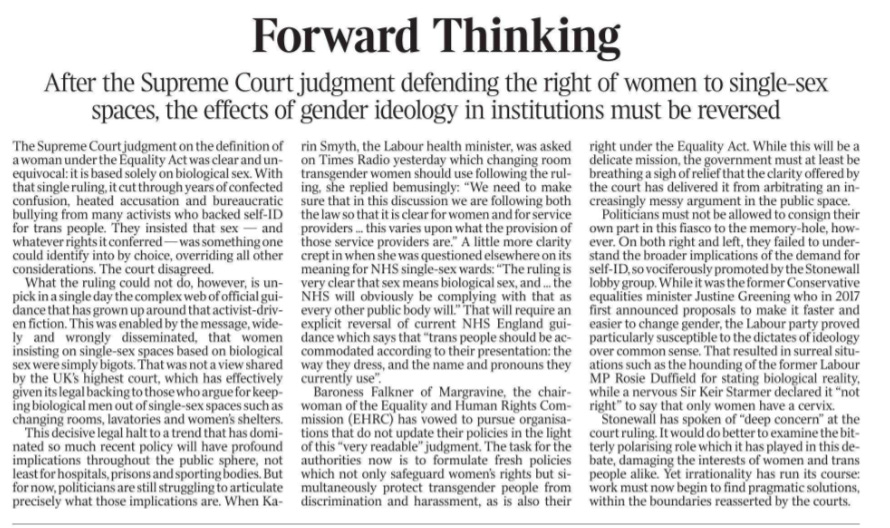
Daily Mail [5]
![LABOUR TURMOIL ON TRANS RULING As party faces pressure to rip up gender laws, ministers are STILL in a muddle on protecting women-only spaces Daily Mail18 Apr 2025By Sam Merriman and Harriet Line LABOUR’S stance on women’s rights descended into farce last night as a minister failed to back single-sex spaces and its union paymaster said it will ignore the Supreme Court judgment. A health minister refused four times to say which changing room transgender women should use – despite the unanimous ruling that they are not legally women. And the president of one of Britain’s largest unions – which gives Labour millions of pounds a year – said the historic decision ‘does not change’ its pro-trans policy. It came as Left-wing Labour MPs and the party’s LGBT+ groups criticised the findings of the country’s highest court, and Chancellor Rachel Reeves squirmed when asked if Keir Starmer should apologise to an MP for criticising her assertion that only women have a cervix. Tory leader Kemi Badenoch said Labour’s failure to back single-sex spaces and its union paymaster’s ‘open hostility’ to the ruling show that claims it was pro-women’s rights were ‘completely false’. She told the Mail: ‘Women and girls will be failed by Labour again and again, as they always have been.’ Health minister Karin Smyth failed four times to clarify which changing room trans women should use in light of the Supreme Court judgment. Ms Smyth said it was ‘important that a trans woman or a trans man also has dignity in their use of public spaces’. Asked again, she told Times Radio: ‘This varies [depending] upon what the provision of those service providers are – large organisations, small organisations.’ Her comments contrasted sharply with those from the head of the equalities watchdog, who said in no uncertain terms that trans women now cannot use single-sex female facilities or compete in women’s sports. Equality and Human Rights Commission (EHRC) chairman Baroness Falkner said the ruling ‘does bring clarity’ for organisations on their single-sex policies and vowed to pursue those that do not enforce women-only spaces. She added: ‘Single-sex services like changing rooms must be based on biological sex. If a male person is allowed to use a women-only service or facility, it isn’t any longer single-sex, then it becomes a mixed-sex space.’ And asked if it was now straightforward that trans women cannot take part in women’s sport, she told BBC Radio 4: ‘Yes, it is.’ But Steve North, president of the Unison union which gave Labour more than £4 million last year said on X: ‘I want to restate my solidarity with our trans members. This judgment does not change Unison policy in support of trans rights.’ He also shared a post from one of the union’s branches that stated ‘trans women are women’ and added that any Unison members – who predominantly work in local government, education and the NHS – affected by the ruling should reach out ‘for support’. Mrs Badenoch said: ‘The flailing of Karin Smyth on the radio and the open hostility to the Supreme Court judgment from Unison, one of the Labour Party’s biggest donors, just shows that Labour’s position on this is completely false. ‘Labour doesn’t support single-sex spaces and they don’t understand the principle.’ A Labour source hit back, saying: ‘After 14 years of Tory failure to act, it’s Labour who will protect women’s spaces. We have always been crystal clear that single-sex spaces are important and that biology matters.’ It came as the Government was under growing pressure to overhaul the Equalities Act to enshrine biological sex in law. Mrs Badenoch said that ‘Labour are trying to gaslight the public and rewrite history on the Supreme Court judgment’ and called for equality laws to be rewritten to prevent this. Ms Reeves dodged questions about the court ruling and whether the Prime Minister should apologise to MP Rosie Duffield, who has said she was ‘isolated, hounded and harassed’ out of Labour for her gender-critical views. Asked whether Sir Keir should say sorry, Ms Reeves said: ‘Well, the most important thing is that we now have that clarity that is needed, so we welcome that Supreme Court ruling and the clarity that it gives to service providers and also to women.’ But Helen Joyce, director of advocacy at Sex Matters which provided evidence in the landmark case, said: ‘There really is no room for equivocation on this – it’s the law of the land. ‘Every government minister – and every politician from all parties – needs to understand this.’ And Caroline Ffiske, from Conservatives for Women, added: ‘It is hugely disappointing and an abdication of responsibility that the Labour Government appears to want to continue to pretend that the situation is complex.’ Wednesday’s Supreme Court ruling said: ‘The unanimous decision of this court is that the terms “woman” and “sex” in the Equality Act 2010 refer to biological woman and biological sex.’ The decision was the culmination of a seven-year legal fight brought by gender-critical campaign group For Women Scotland against the Scottish government. The court ruled that the process of awarding of a £6 Gender Recognition Certificate does not turn a biological man into a woman, meaning trans people do not get specific protections for biological women contained in the Equality Act. A Unison spokesman said: ‘The union is going through the judgment and will consider its implications for any guidance that is provided to members.’ Article Name:LABOUR TURMOIL ON TRANS RULING Publication:Daily Mail Author:By Sam Merriman and Harriet Line Start Page:1 End Page:1](https://substackcdn.com/image/fetch/$s_!XQO4!,f_auto,q_auto:good,fl_progressive:steep/https%3A%2F%2Fsubstack-post-media.s3.amazonaws.com%2Fpublic%2Fimages%2Ffc0e025a-3021-41fd-9712-44bb5ae70175_568x748.png "LABOUR TURMOIL ON TRANS RULING As party faces pressure to rip up gender laws, ministers are STILL in a muddle on protecting women-only spaces Daily Mail18 Apr 2025By Sam Merriman and Harriet Line LABOUR’S stance on women’s rights descended into farce last night as a minister failed to back single-sex spaces and its union paymaster said it will ignore the Supreme Court judgment. A health minister refused four times to say which changing room transgender women should use – despite the unanimous ruling that they are not legally women. And the president of one of Britain’s largest unions – which gives Labour millions of pounds a year – said the historic decision ‘does not change’ its pro-trans policy. It came as Left-wing Labour MPs and the party’s LGBT+ groups criticised the findings of the country’s highest court, and Chancellor Rachel Reeves squirmed when asked if Keir Starmer should apologise to an MP for criticising her assertion that only women have a cervix. Tory leader Kemi Badenoch said Labour’s failure to back single-sex spaces and its union paymaster’s ‘open hostility’ to the ruling show that claims it was pro-women’s rights were ‘completely false’. She told the Mail: ‘Women and girls will be failed by Labour again and again, as they always have been.’ Health minister Karin Smyth failed four times to clarify which changing room trans women should use in light of the Supreme Court judgment. Ms Smyth said it was ‘important that a trans woman or a trans man also has dignity in their use of public spaces’. Asked again, she told Times Radio: ‘This varies [depending] upon what the provision of those service providers are – large organisations, small organisations.’ Her comments contrasted sharply with those from the head of the equalities watchdog, who said in no uncertain terms that trans women now cannot use single-sex female facilities or compete in women’s sports. Equality and Human Rights Commission (EHRC) chairman Baroness Falkner said the ruling ‘does bring clarity’ for organisations on their single-sex policies and vowed to pursue those that do not enforce women-only spaces. She added: ‘Single-sex services like changing rooms must be based on biological sex. If a male person is allowed to use a women-only service or facility, it isn’t any longer single-sex, then it becomes a mixed-sex space.’ And asked if it was now straightforward that trans women cannot take part in women’s sport, she told BBC Radio 4: ‘Yes, it is.’ But Steve North, president of the Unison union which gave Labour more than £4 million last year said on X: ‘I want to restate my solidarity with our trans members. This judgment does not change Unison policy in support of trans rights.’ He also shared a post from one of the union’s branches that stated ‘trans women are women’ and added that any Unison members – who predominantly work in local government, education and the NHS – affected by the ruling should reach out ‘for support’. Mrs Badenoch said: ‘The flailing of Karin Smyth on the radio and the open hostility to the Supreme Court judgment from Unison, one of the Labour Party’s biggest donors, just shows that Labour’s position on this is completely false. ‘Labour doesn’t support single-sex spaces and they don’t understand the principle.’ A Labour source hit back, saying: ‘After 14 years of Tory failure to act, it’s Labour who will protect women’s spaces. We have always been crystal clear that single-sex spaces are important and that biology matters.’ It came as the Government was under growing pressure to overhaul the Equalities Act to enshrine biological sex in law. Mrs Badenoch said that ‘Labour are trying to gaslight the public and rewrite history on the Supreme Court judgment’ and called for equality laws to be rewritten to prevent this. Ms Reeves dodged questions about the court ruling and whether the Prime Minister should apologise to MP Rosie Duffield, who has said she was ‘isolated, hounded and harassed’ out of Labour for her gender-critical views. Asked whether Sir Keir should say sorry, Ms Reeves said: ‘Well, the most important thing is that we now have that clarity that is needed, so we welcome that Supreme Court ruling and the clarity that it gives to service providers and also to women.’ But Helen Joyce, director of advocacy at Sex Matters which provided evidence in the landmark case, said: ‘There really is no room for equivocation on this – it’s the law of the land. ‘Every government minister – and every politician from all parties – needs to understand this.’ And Caroline Ffiske, from Conservatives for Women, added: ‘It is hugely disappointing and an abdication of responsibility that the Labour Government appears to want to continue to pretend that the situation is complex.’ Wednesday’s Supreme Court ruling said: ‘The unanimous decision of this court is that the terms “woman” and “sex” in the Equality Act 2010 refer to biological woman and biological sex.’ The decision was the culmination of a seven-year legal fight brought by gender-critical campaign group For Women Scotland against the Scottish government. The court ruled that the process of awarding of a £6 Gender Recognition Certificate does not turn a biological man into a woman, meaning trans people do not get specific protections for biological women contained in the Equality Act. A Unison spokesman said: ‘The union is going through the judgment and will consider its implications for any guidance that is provided to members.’ Article Name:LABOUR TURMOIL ON TRANS RULING Publication:Daily Mail Author:By Sam Merriman and Harriet Line Start Page:1 End Page:1")


Telegraph [6]
![UK’S biggest bank vows ‘solidarity’ with trans workers Lloyds says it will continue to give support to those affected by Supreme Court ruling The Daily Telegraph18 Apr 2025By Samuel Montgomery and Janet Eastham BRITAIN’S biggest bank has pledged “solidarity” with transgender staff after women’s rights campaigners scored a landmark victory in the Supreme Court. Executives at Lloyds Bank, which counts one in two British adults as a customer, backed affected employees “at this very tough time” after the court this week said that trans women are not legally women under equalities law. Businesses and public bodies across Britain have to grapple with the implications of the ruling, which means trans women will no longer be granted access to female-only spaces such as women’s bathrooms. The judgment is expected to lead to thousands of unisex lavatories being introduced in buildings across Britain, under proposed guidance considered by the Government’s Equality and Human Rights Commission watchdog (EHRC). Baroness Falkner, the chairman of the EHRC, said yesterday that trans groups “should be using their powers of advocacy to ask for those third spaces”. The Lloyds comments risk drawing the bank into the row over the court’s decision, which was cheered by gender -critical activists who feared women’s rights were being eroded. Andrew Walton, the chief corporate affairs director at Lloyds, posted on the bank’s internal LGBTQ+ Rainbow network messaging board hours after the judgment. He said: “Thought I would come on here today with a note of support for our trans and non-binary colleagues on what I know will be an unsettling day following the UK Supreme Court decision. Please know that we cherish and celebrate you and we remain committed to inclusivity. “If you’re a line manager, please be mindful of the potential impact on members of your team and be available to them. We are here to listen and support.” Sharon Doherty, the chief people and places officer at Lloyds, said in response to Mr Walton’s post: “Very well said… standing in solidarity at this very tough time.” Both Mr Walton and Ms Doherty are among the most senior leaders at the bank, sitting on a 14-person executive committee. Their comments come as businesses await the EHRC’S updated code of practice for further guidance on how to respond to the judgment. Yesterday, leading barristers told The Telegraph that introducing a third, unisex lavatory is expected to be the most practical way to respect trans preferences while staying within the law. This option has now been endorsed by Sir Trevor Phillips, the former equalities watchdog chairman, who said that healthcare services should “stop whining about how difficult it is” and comply with the law. Speaking on The Daily T podcast, Sir Trevor said: “It’s very, very straightforward. They have to provide facilities for people of different sexes and those facilities have to protect people of different sexes according to biology.” However, adding a requirement to install unisex lavatories risks heaping pressure on businesses already grappling with high interest rates and looming legal threats under Labour’s planned worker protections. Lloyds Bank declined to comment. ‘Please know that we cherish and celebrate you and we remain committed to inclusivity’ FOR decades, influential charity Stonewall was widely regarded as a champion for equal rights – winning over the most powerful businesses and politicians. Its influence was such that hundreds of Britain’s largest organisations battled for top spot on its equality leader board, handing millions of pounds to the charity in the process. But much has changed. The 36-year-old organisation now facing a crisis that has prompted even one of its founders to turn against it. In the wake of Wednesday’s Supreme Court ruling that only biological women are women, Simon Fanshawe urged bosses to abandon Stonewall, which has long championed trans rights. “Employers can now take advice from the highest court in the land rather than from Stonewall and other lobby groups,” said Fanshawe, who was one of six activists to help set up the organisation. “Previously, in trying to become a Stonewall ‘Diversity Champion’, businesses have often gone beyond the law. “I would say that businesses should now ignore Stonewall, focus on the judgment, and that way be absolutely clear that their policies are in line with the Equality Act. “Businesses have been thinking they’ve been doing the right thing, and it transpires they haven’t. They should stop listening to lobby groups.” Scrutiny of Stonewall has been building for years, even garnering disapproval from former supporter Sir Stephen Fry, who in December branded its trans activism “nonsensical” and warned it has “got stuck in a terrible, terrible quagmire”. In particular, critics have argued that Stonewall was using corporate schemes to stifle free speech. One HR veteran, who did not want to be named, believes too many bosses leant on the charity out of fear of “holding a different position to other organisations”. “I’m surprised that any major organisation still has a relationship with them. That’s not because they haven’t done good things in the past, but they’re driving a political agenda with a small P,” they said. “From a business point of view, people will now be taking stock and saying, ‘Hang on a second, the highest court has made a decision [on the legal definition of a woman] and this organisation is disagreeing – do we want to be aligned with an organisation which is taking that stance?’” They added that HR leaders who disagree with the Supreme Court need to ask themselves how they’ve been running their businesses. “If you don’t believe the law trumps all, then you’ve essentially been running your business based on an agenda, not on the law.” Fanshawe argued last year that there had been a shift in attitude, with companies saying to themselves: “Actually, I’m not convinced that a high-street retailer should take a position on anticonversion therapy.” Concerns over Stonewall in corporate circles have grown increasingly prominent in recent years, as some of its most controversial advice came to light. For example, the charity reportedly told employers to use “parent who has given birth” instead of the word mother, while it also questioned whether private health insurance covered transition-related treatments. Stonewall has since watered down its policies, admitting last year that “mother” is a “powerful and important word”. But for many bosses the damage was already done. In 2022, Stonewall was criticised for suggesting that nurseries were not doing enough to help children as young as two “recognise their trans identity”, while last year its support of puberty blockers came under fire following a review by paediatrician Baroness Cass. The review, which warned there was a lack of established medical evidence for the use of puberty blockers for children, triggered a petition calling for Stonewall’s former chief, who advised schools to “shred” a research pack highlighting the dangers of the treatment, to lose her peerage. Yet Stonewall itself acknowledges that change may be on the cards, particularly in light of the latest Supreme Court decision. A spokesman for the charity said that many organisations, including Stonewall, will be reviewing their policies and guidance. “Stonewall regularly reviews its guidance and works with legal experts to ensure that it reflects the latest legal developments – we will continue to do so.” Emilie Cole, the founding partner of law firm Cole Khan, said: “The decision recognises that women now means biological women. So women are going to be protected in terms of having their spaces. It’s been so hard fought on both sides of the spectrum, but this judgment is welcomed because this has… got real-world consequences for people working in businesses, and clarity in this area is welcomed.” But others are not as conciliatory. As one barrister puts it: “Those who follow Stonewall should stop doing so immediately and seek counsel elsewhere. You have been led up the garden path and now have a huge task untangling the mess.” ‘If you don’t believe the law trumps all, you’ve been running your business on an agenda’ ‘You have been led up the garden path and now have a huge task untangling the mess’ Article Name:UK’S biggest bank vows ‘solidarity’ with trans workers Publication:The Daily Telegraph Author:By Samuel Montgomery and Janet Eastham Start Page:1 End Page:1](https://substackcdn.com/image/fetch/$s_!MK6U!,f_auto,q_auto:good,fl_progressive:steep/https%3A%2F%2Fsubstack-post-media.s3.amazonaws.com%2Fpublic%2Fimages%2F5ea28276-7b43-4140-9346-5aaa2b4a9ca1_523x827.png "UK’S biggest bank vows ‘solidarity’ with trans workers Lloyds says it will continue to give support to those affected by Supreme Court ruling The Daily Telegraph18 Apr 2025By Samuel Montgomery and Janet Eastham BRITAIN’S biggest bank has pledged “solidarity” with transgender staff after women’s rights campaigners scored a landmark victory in the Supreme Court. Executives at Lloyds Bank, which counts one in two British adults as a customer, backed affected employees “at this very tough time” after the court this week said that trans women are not legally women under equalities law. Businesses and public bodies across Britain have to grapple with the implications of the ruling, which means trans women will no longer be granted access to female-only spaces such as women’s bathrooms. The judgment is expected to lead to thousands of unisex lavatories being introduced in buildings across Britain, under proposed guidance considered by the Government’s Equality and Human Rights Commission watchdog (EHRC). Baroness Falkner, the chairman of the EHRC, said yesterday that trans groups “should be using their powers of advocacy to ask for those third spaces”. The Lloyds comments risk drawing the bank into the row over the court’s decision, which was cheered by gender -critical activists who feared women’s rights were being eroded. Andrew Walton, the chief corporate affairs director at Lloyds, posted on the bank’s internal LGBTQ+ Rainbow network messaging board hours after the judgment. He said: “Thought I would come on here today with a note of support for our trans and non-binary colleagues on what I know will be an unsettling day following the UK Supreme Court decision. Please know that we cherish and celebrate you and we remain committed to inclusivity. “If you’re a line manager, please be mindful of the potential impact on members of your team and be available to them. We are here to listen and support.” Sharon Doherty, the chief people and places officer at Lloyds, said in response to Mr Walton’s post: “Very well said… standing in solidarity at this very tough time.” Both Mr Walton and Ms Doherty are among the most senior leaders at the bank, sitting on a 14-person executive committee. Their comments come as businesses await the EHRC’S updated code of practice for further guidance on how to respond to the judgment. Yesterday, leading barristers told The Telegraph that introducing a third, unisex lavatory is expected to be the most practical way to respect trans preferences while staying within the law. This option has now been endorsed by Sir Trevor Phillips, the former equalities watchdog chairman, who said that healthcare services should “stop whining about how difficult it is” and comply with the law. Speaking on The Daily T podcast, Sir Trevor said: “It’s very, very straightforward. They have to provide facilities for people of different sexes and those facilities have to protect people of different sexes according to biology.” However, adding a requirement to install unisex lavatories risks heaping pressure on businesses already grappling with high interest rates and looming legal threats under Labour’s planned worker protections. Lloyds Bank declined to comment. ‘Please know that we cherish and celebrate you and we remain committed to inclusivity’ FOR decades, influential charity Stonewall was widely regarded as a champion for equal rights – winning over the most powerful businesses and politicians. Its influence was such that hundreds of Britain’s largest organisations battled for top spot on its equality leader board, handing millions of pounds to the charity in the process. But much has changed. The 36-year-old organisation now facing a crisis that has prompted even one of its founders to turn against it. In the wake of Wednesday’s Supreme Court ruling that only biological women are women, Simon Fanshawe urged bosses to abandon Stonewall, which has long championed trans rights. “Employers can now take advice from the highest court in the land rather than from Stonewall and other lobby groups,” said Fanshawe, who was one of six activists to help set up the organisation. “Previously, in trying to become a Stonewall ‘Diversity Champion’, businesses have often gone beyond the law. “I would say that businesses should now ignore Stonewall, focus on the judgment, and that way be absolutely clear that their policies are in line with the Equality Act. “Businesses have been thinking they’ve been doing the right thing, and it transpires they haven’t. They should stop listening to lobby groups.” Scrutiny of Stonewall has been building for years, even garnering disapproval from former supporter Sir Stephen Fry, who in December branded its trans activism “nonsensical” and warned it has “got stuck in a terrible, terrible quagmire”. In particular, critics have argued that Stonewall was using corporate schemes to stifle free speech. One HR veteran, who did not want to be named, believes too many bosses leant on the charity out of fear of “holding a different position to other organisations”. “I’m surprised that any major organisation still has a relationship with them. That’s not because they haven’t done good things in the past, but they’re driving a political agenda with a small P,” they said. “From a business point of view, people will now be taking stock and saying, ‘Hang on a second, the highest court has made a decision [on the legal definition of a woman] and this organisation is disagreeing – do we want to be aligned with an organisation which is taking that stance?’” They added that HR leaders who disagree with the Supreme Court need to ask themselves how they’ve been running their businesses. “If you don’t believe the law trumps all, then you’ve essentially been running your business based on an agenda, not on the law.” Fanshawe argued last year that there had been a shift in attitude, with companies saying to themselves: “Actually, I’m not convinced that a high-street retailer should take a position on anticonversion therapy.” Concerns over Stonewall in corporate circles have grown increasingly prominent in recent years, as some of its most controversial advice came to light. For example, the charity reportedly told employers to use “parent who has given birth” instead of the word mother, while it also questioned whether private health insurance covered transition-related treatments. Stonewall has since watered down its policies, admitting last year that “mother” is a “powerful and important word”. But for many bosses the damage was already done. In 2022, Stonewall was criticised for suggesting that nurseries were not doing enough to help children as young as two “recognise their trans identity”, while last year its support of puberty blockers came under fire following a review by paediatrician Baroness Cass. The review, which warned there was a lack of established medical evidence for the use of puberty blockers for children, triggered a petition calling for Stonewall’s former chief, who advised schools to “shred” a research pack highlighting the dangers of the treatment, to lose her peerage. Yet Stonewall itself acknowledges that change may be on the cards, particularly in light of the latest Supreme Court decision. A spokesman for the charity said that many organisations, including Stonewall, will be reviewing their policies and guidance. “Stonewall regularly reviews its guidance and works with legal experts to ensure that it reflects the latest legal developments – we will continue to do so.” Emilie Cole, the founding partner of law firm Cole Khan, said: “The decision recognises that women now means biological women. So women are going to be protected in terms of having their spaces. It’s been so hard fought on both sides of the spectrum, but this judgment is welcomed because this has… got real-world consequences for people working in businesses, and clarity in this area is welcomed.” But others are not as conciliatory. As one barrister puts it: “Those who follow Stonewall should stop doing so immediately and seek counsel elsewhere. You have been led up the garden path and now have a huge task untangling the mess.” ‘If you don’t believe the law trumps all, you’ve been running your business on an agenda’ ‘You have been led up the garden path and now have a huge task untangling the mess’ Article Name:UK’S biggest bank vows ‘solidarity’ with trans workers Publication:The Daily Telegraph Author:By Samuel Montgomery and Janet Eastham Start Page:1 End Page:1")


![UK’S biggest bank vows ‘solidarity’ with trans workers Lloyds says it will continue to give support to those affected by Supreme Court ruling The Daily Telegraph18 Apr 2025By Samuel Montgomery and Janet Eastham BRITAIN’S biggest bank has pledged “solidarity” with transgender staff after women’s rights campaigners scored a landmark victory in the Supreme Court. Executives at Lloyds Bank, which counts one in two British adults as a customer, backed affected employees “at this very tough time” after the court this week said that trans women are not legally women under equalities law. Businesses and public bodies across Britain have to grapple with the implications of the ruling, which means trans women will no longer be granted access to female-only spaces such as women’s bathrooms. The judgment is expected to lead to thousands of unisex lavatories being introduced in buildings across Britain, under proposed guidance considered by the Government’s Equality and Human Rights Commission watchdog (EHRC). Baroness Falkner, the chairman of the EHRC, said yesterday that trans groups “should be using their powers of advocacy to ask for those third spaces”. The Lloyds comments risk drawing the bank into the row over the court’s decision, which was cheered by gender -critical activists who feared women’s rights were being eroded. Andrew Walton, the chief corporate affairs director at Lloyds, posted on the bank’s internal LGBTQ+ Rainbow network messaging board hours after the judgment. He said: “Thought I would come on here today with a note of support for our trans and non-binary colleagues on what I know will be an unsettling day following the UK Supreme Court decision. Please know that we cherish and celebrate you and we remain committed to inclusivity. “If you’re a line manager, please be mindful of the potential impact on members of your team and be available to them. We are here to listen and support.” Sharon Doherty, the chief people and places officer at Lloyds, said in response to Mr Walton’s post: “Very well said… standing in solidarity at this very tough time.” Both Mr Walton and Ms Doherty are among the most senior leaders at the bank, sitting on a 14-person executive committee. Their comments come as businesses await the EHRC’S updated code of practice for further guidance on how to respond to the judgment. Yesterday, leading barristers told The Telegraph that introducing a third, unisex lavatory is expected to be the most practical way to respect trans preferences while staying within the law. This option has now been endorsed by Sir Trevor Phillips, the former equalities watchdog chairman, who said that healthcare services should “stop whining about how difficult it is” and comply with the law. Speaking on The Daily T podcast, Sir Trevor said: “It’s very, very straightforward. They have to provide facilities for people of different sexes and those facilities have to protect people of different sexes according to biology.” However, adding a requirement to install unisex lavatories risks heaping pressure on businesses already grappling with high interest rates and looming legal threats under Labour’s planned worker protections. Lloyds Bank declined to comment. ‘Please know that we cherish and celebrate you and we remain committed to inclusivity’ FOR decades, influential charity Stonewall was widely regarded as a champion for equal rights – winning over the most powerful businesses and politicians. Its influence was such that hundreds of Britain’s largest organisations battled for top spot on its equality leader board, handing millions of pounds to the charity in the process. But much has changed. The 36-year-old organisation now facing a crisis that has prompted even one of its founders to turn against it. In the wake of Wednesday’s Supreme Court ruling that only biological women are women, Simon Fanshawe urged bosses to abandon Stonewall, which has long championed trans rights. “Employers can now take advice from the highest court in the land rather than from Stonewall and other lobby groups,” said Fanshawe, who was one of six activists to help set up the organisation. “Previously, in trying to become a Stonewall ‘Diversity Champion’, businesses have often gone beyond the law. “I would say that businesses should now ignore Stonewall, focus on the judgment, and that way be absolutely clear that their policies are in line with the Equality Act. “Businesses have been thinking they’ve been doing the right thing, and it transpires they haven’t. They should stop listening to lobby groups.” Scrutiny of Stonewall has been building for years, even garnering disapproval from former supporter Sir Stephen Fry, who in December branded its trans activism “nonsensical” and warned it has “got stuck in a terrible, terrible quagmire”. In particular, critics have argued that Stonewall was using corporate schemes to stifle free speech. One HR veteran, who did not want to be named, believes too many bosses leant on the charity out of fear of “holding a different position to other organisations”. “I’m surprised that any major organisation still has a relationship with them. That’s not because they haven’t done good things in the past, but they’re driving a political agenda with a small P,” they said. “From a business point of view, people will now be taking stock and saying, ‘Hang on a second, the highest court has made a decision [on the legal definition of a woman] and this organisation is disagreeing – do we want to be aligned with an organisation which is taking that stance?’” They added that HR leaders who disagree with the Supreme Court need to ask themselves how they’ve been running their businesses. “If you don’t believe the law trumps all, then you’ve essentially been running your business based on an agenda, not on the law.” Fanshawe argued last year that there had been a shift in attitude, with companies saying to themselves: “Actually, I’m not convinced that a high-street retailer should take a position on anticonversion therapy.” Concerns over Stonewall in corporate circles have grown increasingly prominent in recent years, as some of its most controversial advice came to light. For example, the charity reportedly told employers to use “parent who has given birth” instead of the word mother, while it also questioned whether private health insurance covered transition-related treatments. Stonewall has since watered down its policies, admitting last year that “mother” is a “powerful and important word”. But for many bosses the damage was already done. In 2022, Stonewall was criticised for suggesting that nurseries were not doing enough to help children as young as two “recognise their trans identity”, while last year its support of puberty blockers came under fire following a review by paediatrician Baroness Cass. The review, which warned there was a lack of established medical evidence for the use of puberty blockers for children, triggered a petition calling for Stonewall’s former chief, who advised schools to “shred” a research pack highlighting the dangers of the treatment, to lose her peerage. Yet Stonewall itself acknowledges that change may be on the cards, particularly in light of the latest Supreme Court decision. A spokesman for the charity said that many organisations, including Stonewall, will be reviewing their policies and guidance. “Stonewall regularly reviews its guidance and works with legal experts to ensure that it reflects the latest legal developments – we will continue to do so.” Emilie Cole, the founding partner of law firm Cole Khan, said: “The decision recognises that women now means biological women. So women are going to be protected in terms of having their spaces. It’s been so hard fought on both sides of the spectrum, but this judgment is welcomed because this has… got real-world consequences for people working in businesses, and clarity in this area is welcomed.” But others are not as conciliatory. As one barrister puts it: “Those who follow Stonewall should stop doing so immediately and seek counsel elsewhere. You have been led up the garden path and now have a huge task untangling the mess.” ‘If you don’t believe the law trumps all, you’ve been running your business on an agenda’ ‘You have been led up the garden path and now have a huge task untangling the mess’ Article Name:UK’S biggest bank vows ‘solidarity’ with trans workers Publication:The Daily Telegraph Author:By Samuel Montgomery and Janet Eastham Start Page:5 End Page:5](https://substackcdn.com/image/fetch/$s_!Ncoy!,f_auto,q_auto:good,fl_progressive:steep/https%3A%2F%2Fsubstack-post-media.s3.amazonaws.com%2Fpublic%2Fimages%2Fe7692699-1577-4678-add0-7bba4bc65898_1505x530.png "UK’S biggest bank vows ‘solidarity’ with trans workers Lloyds says it will continue to give support to those affected by Supreme Court ruling The Daily Telegraph18 Apr 2025By Samuel Montgomery and Janet Eastham BRITAIN’S biggest bank has pledged “solidarity” with transgender staff after women’s rights campaigners scored a landmark victory in the Supreme Court. Executives at Lloyds Bank, which counts one in two British adults as a customer, backed affected employees “at this very tough time” after the court this week said that trans women are not legally women under equalities law. Businesses and public bodies across Britain have to grapple with the implications of the ruling, which means trans women will no longer be granted access to female-only spaces such as women’s bathrooms. The judgment is expected to lead to thousands of unisex lavatories being introduced in buildings across Britain, under proposed guidance considered by the Government’s Equality and Human Rights Commission watchdog (EHRC). Baroness Falkner, the chairman of the EHRC, said yesterday that trans groups “should be using their powers of advocacy to ask for those third spaces”. The Lloyds comments risk drawing the bank into the row over the court’s decision, which was cheered by gender -critical activists who feared women’s rights were being eroded. Andrew Walton, the chief corporate affairs director at Lloyds, posted on the bank’s internal LGBTQ+ Rainbow network messaging board hours after the judgment. He said: “Thought I would come on here today with a note of support for our trans and non-binary colleagues on what I know will be an unsettling day following the UK Supreme Court decision. Please know that we cherish and celebrate you and we remain committed to inclusivity. “If you’re a line manager, please be mindful of the potential impact on members of your team and be available to them. We are here to listen and support.” Sharon Doherty, the chief people and places officer at Lloyds, said in response to Mr Walton’s post: “Very well said… standing in solidarity at this very tough time.” Both Mr Walton and Ms Doherty are among the most senior leaders at the bank, sitting on a 14-person executive committee. Their comments come as businesses await the EHRC’S updated code of practice for further guidance on how to respond to the judgment. Yesterday, leading barristers told The Telegraph that introducing a third, unisex lavatory is expected to be the most practical way to respect trans preferences while staying within the law. This option has now been endorsed by Sir Trevor Phillips, the former equalities watchdog chairman, who said that healthcare services should “stop whining about how difficult it is” and comply with the law. Speaking on The Daily T podcast, Sir Trevor said: “It’s very, very straightforward. They have to provide facilities for people of different sexes and those facilities have to protect people of different sexes according to biology.” However, adding a requirement to install unisex lavatories risks heaping pressure on businesses already grappling with high interest rates and looming legal threats under Labour’s planned worker protections. Lloyds Bank declined to comment. ‘Please know that we cherish and celebrate you and we remain committed to inclusivity’ FOR decades, influential charity Stonewall was widely regarded as a champion for equal rights – winning over the most powerful businesses and politicians. Its influence was such that hundreds of Britain’s largest organisations battled for top spot on its equality leader board, handing millions of pounds to the charity in the process. But much has changed. The 36-year-old organisation now facing a crisis that has prompted even one of its founders to turn against it. In the wake of Wednesday’s Supreme Court ruling that only biological women are women, Simon Fanshawe urged bosses to abandon Stonewall, which has long championed trans rights. “Employers can now take advice from the highest court in the land rather than from Stonewall and other lobby groups,” said Fanshawe, who was one of six activists to help set up the organisation. “Previously, in trying to become a Stonewall ‘Diversity Champion’, businesses have often gone beyond the law. “I would say that businesses should now ignore Stonewall, focus on the judgment, and that way be absolutely clear that their policies are in line with the Equality Act. “Businesses have been thinking they’ve been doing the right thing, and it transpires they haven’t. They should stop listening to lobby groups.” Scrutiny of Stonewall has been building for years, even garnering disapproval from former supporter Sir Stephen Fry, who in December branded its trans activism “nonsensical” and warned it has “got stuck in a terrible, terrible quagmire”. In particular, critics have argued that Stonewall was using corporate schemes to stifle free speech. One HR veteran, who did not want to be named, believes too many bosses leant on the charity out of fear of “holding a different position to other organisations”. “I’m surprised that any major organisation still has a relationship with them. That’s not because they haven’t done good things in the past, but they’re driving a political agenda with a small P,” they said. “From a business point of view, people will now be taking stock and saying, ‘Hang on a second, the highest court has made a decision [on the legal definition of a woman] and this organisation is disagreeing – do we want to be aligned with an organisation which is taking that stance?’” They added that HR leaders who disagree with the Supreme Court need to ask themselves how they’ve been running their businesses. “If you don’t believe the law trumps all, then you’ve essentially been running your business based on an agenda, not on the law.” Fanshawe argued last year that there had been a shift in attitude, with companies saying to themselves: “Actually, I’m not convinced that a high-street retailer should take a position on anticonversion therapy.” Concerns over Stonewall in corporate circles have grown increasingly prominent in recent years, as some of its most controversial advice came to light. For example, the charity reportedly told employers to use “parent who has given birth” instead of the word mother, while it also questioned whether private health insurance covered transition-related treatments. Stonewall has since watered down its policies, admitting last year that “mother” is a “powerful and important word”. But for many bosses the damage was already done. In 2022, Stonewall was criticised for suggesting that nurseries were not doing enough to help children as young as two “recognise their trans identity”, while last year its support of puberty blockers came under fire following a review by paediatrician Baroness Cass. The review, which warned there was a lack of established medical evidence for the use of puberty blockers for children, triggered a petition calling for Stonewall’s former chief, who advised schools to “shred” a research pack highlighting the dangers of the treatment, to lose her peerage. Yet Stonewall itself acknowledges that change may be on the cards, particularly in light of the latest Supreme Court decision. A spokesman for the charity said that many organisations, including Stonewall, will be reviewing their policies and guidance. “Stonewall regularly reviews its guidance and works with legal experts to ensure that it reflects the latest legal developments – we will continue to do so.” Emilie Cole, the founding partner of law firm Cole Khan, said: “The decision recognises that women now means biological women. So women are going to be protected in terms of having their spaces. It’s been so hard fought on both sides of the spectrum, but this judgment is welcomed because this has… got real-world consequences for people working in businesses, and clarity in this area is welcomed.” But others are not as conciliatory. As one barrister puts it: “Those who follow Stonewall should stop doing so immediately and seek counsel elsewhere. You have been led up the garden path and now have a huge task untangling the mess.” ‘If you don’t believe the law trumps all, you’ve been running your business on an agenda’ ‘You have been led up the garden path and now have a huge task untangling the mess’ Article Name:UK’S biggest bank vows ‘solidarity’ with trans workers Publication:The Daily Telegraph Author:By Samuel Montgomery and Janet Eastham Start Page:5 End Page:5")
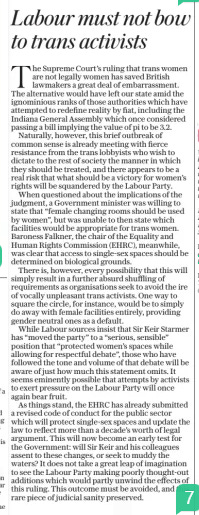
Saturday Total: 14
The Guardian [2]
![JK Rowling How author became campaign’s most vocal supporter The Guardian19 Apr 2025Caroline Davies JK Rowling PHOTOGRAPH: JONNY BIRCH/GETTY IMAGES ‘Erasing the concept of sex removes the ability of so many to meaningfully discuss their lives’ JK Rowling at the Baftas in 2017, two years before she went public with her gender-critical views, to the dismay of some Cocktail in hand and puffing on a celebratory cigar onboard her superyacht, reportedly somewhere in the Bahamas, JK Rowling greeted this week’s supreme court ruling that the legal definition of a woman is based on biological sex, by taking to social media. “I love it when a plan comes together,” she posted on X, borrowing the famous catchphrase from the popular 1980s TV series, The A-Team. She added, referencing the bitter and polarised gender identification debate: “To those celebrating the fact that I’m smoking a blunt [a type of joint]: it’s a cigar. Even if it decided to identify as a blunt for the purposes of this celebration, it would remain objectively, provably and demonstratively a cigar.” It was a typical response from the 59-year-old multi-millionaire creator of the iconic Harry Potter franchise, who has over recent years regularly utilised social media in her support of womenonly spaces, and who has been a vocal and financial supporter of For Women Scotland, having donated £70,000 to the group’s crowdfunding for the legal challenge that culminated in Wednesday’s ruling. The journey has seen her publicly evolve into a fearless figurehead for gender-critical campaigners; someone willing to have battles on X in particular, where she fights fire with fire, and seemingly cannot be cowed. Supporters will say Rowling’s financial contribution has been important, though point out the lesser sums donated by hundreds of other women to the crowdfunding were equally so. Her vocal support, however, has been of even greater consequence. They praise her doggedness, her clear-sightedness as an uncompromising feminist. She is, they believe, strategic. Detractors are highly vocal in accusing her of transphobia, of using provocative language. They question her claims about numbers of people detransitioning. She has been labelled a Terf (trans– exclusionary radical feminist). She denies she is transphobic, having said she respects “every trans person’s right to live any way that feels authentic and comfortable to them”. Rowling’s first public foray came in December 2019 when she tweeted support for Maya Forstater, a tax specialist who lost her job at a thinktank after tweeting that transgender women could not change their biological sex. Then, in June 2020, Rowling posted a link to an article headlined “Creating a more equal post-Covid-19 world for people who menstruate”, to which she commented: “‘People who menstruate.’ I’m sure there used to be a word for those people. Someone help me out. Wumben? Wimpund? Woomud?” She added: “If sex isn’t real, the lived reality of women globally is erased. I know and love trans people but erasing the concept of sex removes the ability of so many to meaningfully discuss their lives.” The furore that followed led her to post an essay on her website outlining her concerns over “the new trans activism”. She described herself as a “domestic abuse and sexual assault survivor” who had been “triggered” by learning the Scottish government was “proceeding with its controversial gender recognition plans”. She said she had spoken up about the importance of sex “and have been paying the price ever since. I was transphobic, I was a cunt, a bitch, a TERF, I deserved cancelling, punching and death.” The backlash against her included Harry Potter actors Daniel Radcliffe, Emma Watson and Rupert Grint, making public their support for transgender rights. There were reports of bookburnings. Rowling returned her Ripple of Hope award given to her by the Robert F Kennedy Human Rights organisation after its president, Kennedy’s daughter, criticised her transgender views. Quidditch, the actual sport inspired by the fictional Harry Potter announced in 2022 it was changing its name to Quadball, with one of several reasons being that Rowling had “increasingly come under scrutiny for her antitrans positions”, the International Quidditch Association said. Rowling is a serious philanthropist. She supports a wide range of humanitarian causes through her charitable trust Volant, including charities working with women and children, and donated £10m to set up a world-leading research and treatment centre for multiple sclerosis in Scotland founded in the name of her mother, who died from the disease. In 2022, she funded and co-founded Beria’s Place, a sexual violence support service for women in Edinburgh. If she has had concerns of any impact on her commercial success, she has not expressed them. She bats off any suggestions from fans that she has “ruined” her legacy, telling one podcast they “could not have misunderstood me more profoundly”. “What a pompous way to live your life, walking around thinking, what will my legacy be? I’ll be dead. I care about now. I care about the living.” Article Name:JK Rowling Publication:The Guardian Author:Caroline Davies Start Page:9 End Page:9](https://substackcdn.com/image/fetch/$s_!i7iZ!,f_auto,q_auto:good,fl_progressive:steep/https%3A%2F%2Fsubstack-post-media.s3.amazonaws.com%2Fpublic%2Fimages%2Fb946d59b-6063-4086-9a8b-0ad67e99eb9c_1025x780.png "JK Rowling How author became campaign’s most vocal supporter The Guardian19 Apr 2025Caroline Davies JK Rowling PHOTOGRAPH: JONNY BIRCH/GETTY IMAGES ‘Erasing the concept of sex removes the ability of so many to meaningfully discuss their lives’ JK Rowling at the Baftas in 2017, two years before she went public with her gender-critical views, to the dismay of some Cocktail in hand and puffing on a celebratory cigar onboard her superyacht, reportedly somewhere in the Bahamas, JK Rowling greeted this week’s supreme court ruling that the legal definition of a woman is based on biological sex, by taking to social media. “I love it when a plan comes together,” she posted on X, borrowing the famous catchphrase from the popular 1980s TV series, The A-Team. She added, referencing the bitter and polarised gender identification debate: “To those celebrating the fact that I’m smoking a blunt [a type of joint]: it’s a cigar. Even if it decided to identify as a blunt for the purposes of this celebration, it would remain objectively, provably and demonstratively a cigar.” It was a typical response from the 59-year-old multi-millionaire creator of the iconic Harry Potter franchise, who has over recent years regularly utilised social media in her support of womenonly spaces, and who has been a vocal and financial supporter of For Women Scotland, having donated £70,000 to the group’s crowdfunding for the legal challenge that culminated in Wednesday’s ruling. The journey has seen her publicly evolve into a fearless figurehead for gender-critical campaigners; someone willing to have battles on X in particular, where she fights fire with fire, and seemingly cannot be cowed. Supporters will say Rowling’s financial contribution has been important, though point out the lesser sums donated by hundreds of other women to the crowdfunding were equally so. Her vocal support, however, has been of even greater consequence. They praise her doggedness, her clear-sightedness as an uncompromising feminist. She is, they believe, strategic. Detractors are highly vocal in accusing her of transphobia, of using provocative language. They question her claims about numbers of people detransitioning. She has been labelled a Terf (trans– exclusionary radical feminist). She denies she is transphobic, having said she respects “every trans person’s right to live any way that feels authentic and comfortable to them”. Rowling’s first public foray came in December 2019 when she tweeted support for Maya Forstater, a tax specialist who lost her job at a thinktank after tweeting that transgender women could not change their biological sex. Then, in June 2020, Rowling posted a link to an article headlined “Creating a more equal post-Covid-19 world for people who menstruate”, to which she commented: “‘People who menstruate.’ I’m sure there used to be a word for those people. Someone help me out. Wumben? Wimpund? Woomud?” She added: “If sex isn’t real, the lived reality of women globally is erased. I know and love trans people but erasing the concept of sex removes the ability of so many to meaningfully discuss their lives.” The furore that followed led her to post an essay on her website outlining her concerns over “the new trans activism”. She described herself as a “domestic abuse and sexual assault survivor” who had been “triggered” by learning the Scottish government was “proceeding with its controversial gender recognition plans”. She said she had spoken up about the importance of sex “and have been paying the price ever since. I was transphobic, I was a cunt, a bitch, a TERF, I deserved cancelling, punching and death.” The backlash against her included Harry Potter actors Daniel Radcliffe, Emma Watson and Rupert Grint, making public their support for transgender rights. There were reports of bookburnings. Rowling returned her Ripple of Hope award given to her by the Robert F Kennedy Human Rights organisation after its president, Kennedy’s daughter, criticised her transgender views. Quidditch, the actual sport inspired by the fictional Harry Potter announced in 2022 it was changing its name to Quadball, with one of several reasons being that Rowling had “increasingly come under scrutiny for her antitrans positions”, the International Quidditch Association said. Rowling is a serious philanthropist. She supports a wide range of humanitarian causes through her charitable trust Volant, including charities working with women and children, and donated £10m to set up a world-leading research and treatment centre for multiple sclerosis in Scotland founded in the name of her mother, who died from the disease. In 2022, she funded and co-founded Beria’s Place, a sexual violence support service for women in Edinburgh. If she has had concerns of any impact on her commercial success, she has not expressed them. She bats off any suggestions from fans that she has “ruined” her legacy, telling one podcast they “could not have misunderstood me more profoundly”. “What a pompous way to live your life, walking around thinking, what will my legacy be? I’ll be dead. I care about now. I care about the living.” Article Name:JK Rowling Publication:The Guardian Author:Caroline Davies Start Page:9 End Page:9")
The Times [4]
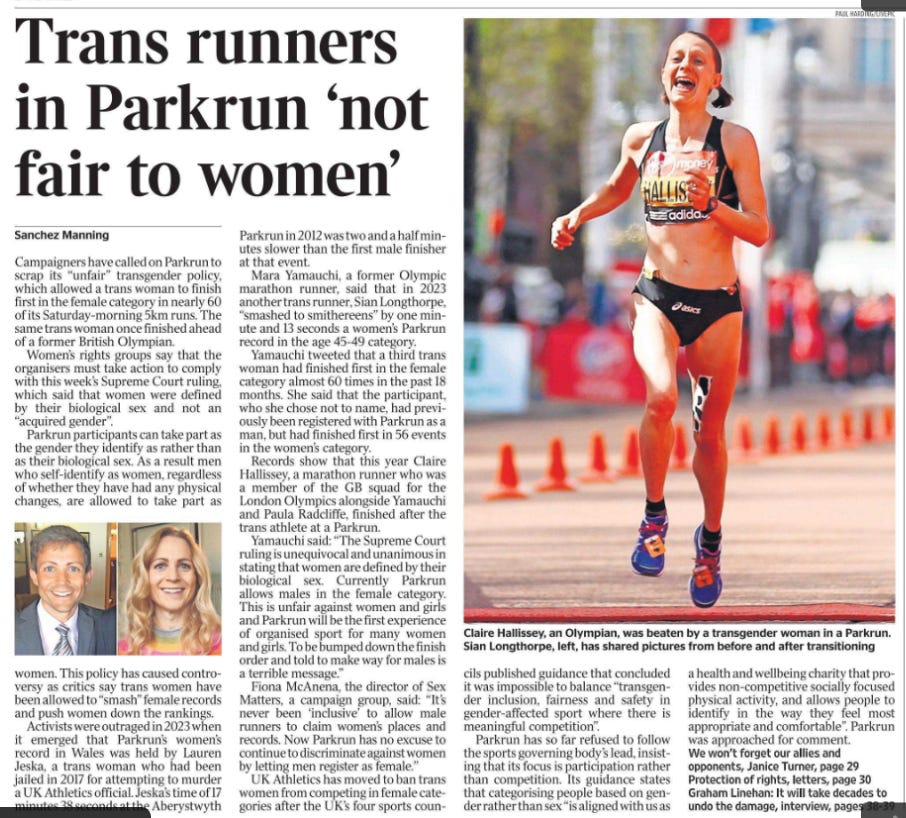


![‘It will take decades to undo the damage from the trans movement’ The legal ruling on the meaning of ‘woman’ was a vindication for Graham Linehan, the comedy writer, but the scars persist, he tells Andrew Billen Susan Smith and Marion Calder of For Women Scotland, which brought the case, outside the Supreme Court. Next image › It was when Lord Hodge explained that the Supreme Court had used biology to assemble its legal definition of what a woman was that Graham Linehan dared to hope victory might be coming to the cause that had cost him his family and career. “You could feel a crackle around the room,” says the Father Ted co-creator turned anti-trans activist, who was in the public gallery for Wednesday’s epic ruling. “It was a lovely thing to experience. And then, as soon as the judges left, the whole place just broke out in applause.” Shortly after 10am the former stand-up whose savage wit as directed towards trans activists had alienated many even on his side (was this, feminists asked, his battle to fight?) emerged into Parliament Square to the cheers of women. “It was,” he says from a friend’s house the next day, “one of the nicest things that’s ever happened to me.” On Thursday one front-page headline read simply “Trans women are not women”, the exact phrase that had got Linehan banned from Twitter, further, he says, destroying his reputation. “To see it on a newspaper headline — it felt like reality was breaking out.” Afterwards he celebrated with fellow campaigners. A photo on X, to which — under Elon Musk’s management — he had been restored, showed him raising a glass with Venice Allan, a campaigner against trans women swimming in the Ladies’ Pond on Hampstead Heath. Jet-lagged from travelling from the United States, where he is relocating, he went to bed at a reasonable hour but got up at 2am. By noon on Zoom he is a little blurry, but not so blurry that he cannot focus on the clarity of the Supreme Court ruling. He compares it to the murky language of the trans debate, where the very words “trans woman” could baffle. “A good way of understanding the word ‘trans’ is taking it to mean opposite. So ‘trans woman’ means man and ‘trans man’ means woman. That kind of oppositional language has been a major weapon for trans activists. They used language in such a way that people felt they were on unsteady ground. They couldn’t argue their points. The language was just so corrupted.” He compares the huge increase in numbers of transgender people with the epidemic of anorexia after the singer Karen Carpenter died of it in 1983. “It just spread like wildfire, most particularly amongst young girls who are particularly susceptible to this kind of obsessive, harmful thinking about their own bodies. I think that the trans movement for young girls has been a kind of anorexia 2.0. But the difference is that in the Seventies and Eighties people were very rightly saying, ‘No, you’re not fat. This is just a thought in your head and we need to work on that.’ But with the trans issue, the whole of society was saying [the equivalent of], ‘Yes, you are fat. It’s a problem.’ Everyone was saying this, from celebrities to the NHS. And, of course, the internet spread it like Covid. It’s been ten years really, trying to get back to a place of normalcy in regards to women’s rights and it’s going to take decades to undo the damage.” He does think the fight to preserve women’s singlesex spaces in public lavatories, changing rooms and women’s sport is probably won but argues that the toll on the health of biological girls who took gender-altering hormones and on biological boys prescribed oestrogen will persist. While fewer people will be fired for holding gendercritical views, the protrans bias will persist in television, theatre and publishing “because those areas are heavily captured”. On this he is an expert witness. In 2018, coming round in hospital from an operation for testicular cancer, he woozily tweeted something he cannot quite recall about transgender people. Someone immediately responded that they wished the cancer had won. Within months, the Irish-born scriptwriter responsible for The IT Crowd and co-creator of Black Books could no longer get work. A stage musical of Father Ted, his surrealist 1995 sitcom co-created with Arthur Matthews about priests on an Irish island, stalled, its producers suggesting he quit the trans wars. When he refused, explaining he was fighting to defend his teenage daughter, they offered him £200,000 to walk away, conditional on removing his name from the project (aside from a credit as the sitcom’s co-creator). The show was abandoned. By then he had attracted legal threats from trans activists and a visit from the police warning him not to contact a pro-trans GP. He was prescribed anti-anxiety drugs; his hands developed a shake. In 2020 his 16-year marriage to the comedy writer Helen Serafinowicz ended. He said the pressure — the legal threats, the money worries — simply got too much for her. From the family home in Norwich he moved to a flat in the London docklands, from where he reverted to his original profession, journalism. His Glinner Update on Substack reported the trans wars but with only 3,000 subscribers made a loss. “I think,” he says, “this whole thing has been a failure of the celebrity class. They didn’t even have to defend me. They only had to defend their daughters, and they never did. “I just don’t understand how friends could allow another friend to lose all his income, all his friends and then just forget about him.” Naturally, he blames the “toxicity” of the debate on the pro-trans lobby, its “violent” reaction to scrutiny. However, his own social media contributions are incendiary. He confesses he has even been “a bit bad” over the past few days. On the other hand, if someone posts “how’s the wife?” and it is a “young girl with a beard”, he lets it go because he knows what medically is in store for them. “It’s not trans people I have a problem with. It’s trans activists.” But does he feel any sympathy for a trans person who had undergone treatment, and perhaps surgery, only now to find their gender recognition certificate effectively worthless? “Well, I guess so but it’s just one of those things that should never have happened in the first place,” he replies, reciting the dangers of hormone therapy and the “lie” that puberty blockers are reversible. “I do have sympathy for them but I don’t have sympathy for the people who lied to them. They’re the ones who I really, really hate.” Two years ago, in the depths of his war, I interviewed Linehan near his London home. He says now that his years there were not as depressing as I imagined them. A neighbour, the writer Polly Clark, befriended him and “saved my life”. Getting to know doctors, nurses and social workers broadened his world. But although Nicola Sturgeon’s policy of locking Scottish trans women in women’s jails was already falling apart in early 2023, he was gloomy when I suggested the tide was turning. A year later the Cass review on children’s gender identity services recommended extreme caution in using hormone treatment on under- 18s, and the Tavistock Clinic’s gender and identity service closed. Now comes the Supreme Court judgment. He agrees there is a sea change, but says that the media is still “captured”. For him too life has changed, and for the better. There remain worries: he is crowdfunding a defence to a libel action and was recently interviewed under caution by police after a skirmish with a trans activist who he claims was harassing him. But he gets on “great” with his children, and his Substack now makes him “a fair living”. Visas permitting, he has a job in Phoenix, Arizona — where he is starting a production company with the Northern Irish satirist and journalist Andrew Doyle and the Saturday Night Live alumnus Rob Schneider. Both are antiwoke warriors, but he promises that the sitcom they are working on will be merely “unwoke”. “I don’t want to do antiwoke comedy because I think it will age just as badly as the woke movement. I think that in a few years, phrases like ‘trans women are women’ are going to go the same way as ‘groovy’ you know?” What if Jimmy Mulville of Hat Trick Productions, which made Father Ted, now rang and said the musical could go ahead with his name on it? Linehan says he would also need a public apology for what he was put through: “It was inexcusable.”](https://substackcdn.com/image/fetch/$s_!MCUu!,f_auto,q_auto:good,fl_progressive:steep/https%3A%2F%2Fsubstack-post-media.s3.amazonaws.com%2Fpublic%2Fimages%2Ff8598848-9237-4b25-a295-27cf3d82e7a1_1354x847.png "‘It will take decades to undo the damage from the trans movement’ The legal ruling on the meaning of ‘woman’ was a vindication for Graham Linehan, the comedy writer, but the scars persist, he tells Andrew Billen Susan Smith and Marion Calder of For Women Scotland, which brought the case, outside the Supreme Court. Next image › It was when Lord Hodge explained that the Supreme Court had used biology to assemble its legal definition of what a woman was that Graham Linehan dared to hope victory might be coming to the cause that had cost him his family and career. “You could feel a crackle around the room,” says the Father Ted co-creator turned anti-trans activist, who was in the public gallery for Wednesday’s epic ruling. “It was a lovely thing to experience. And then, as soon as the judges left, the whole place just broke out in applause.” Shortly after 10am the former stand-up whose savage wit as directed towards trans activists had alienated many even on his side (was this, feminists asked, his battle to fight?) emerged into Parliament Square to the cheers of women. “It was,” he says from a friend’s house the next day, “one of the nicest things that’s ever happened to me.” On Thursday one front-page headline read simply “Trans women are not women”, the exact phrase that had got Linehan banned from Twitter, further, he says, destroying his reputation. “To see it on a newspaper headline — it felt like reality was breaking out.” Afterwards he celebrated with fellow campaigners. A photo on X, to which — under Elon Musk’s management — he had been restored, showed him raising a glass with Venice Allan, a campaigner against trans women swimming in the Ladies’ Pond on Hampstead Heath. Jet-lagged from travelling from the United States, where he is relocating, he went to bed at a reasonable hour but got up at 2am. By noon on Zoom he is a little blurry, but not so blurry that he cannot focus on the clarity of the Supreme Court ruling. He compares it to the murky language of the trans debate, where the very words “trans woman” could baffle. “A good way of understanding the word ‘trans’ is taking it to mean opposite. So ‘trans woman’ means man and ‘trans man’ means woman. That kind of oppositional language has been a major weapon for trans activists. They used language in such a way that people felt they were on unsteady ground. They couldn’t argue their points. The language was just so corrupted.” He compares the huge increase in numbers of transgender people with the epidemic of anorexia after the singer Karen Carpenter died of it in 1983. “It just spread like wildfire, most particularly amongst young girls who are particularly susceptible to this kind of obsessive, harmful thinking about their own bodies. I think that the trans movement for young girls has been a kind of anorexia 2.0. But the difference is that in the Seventies and Eighties people were very rightly saying, ‘No, you’re not fat. This is just a thought in your head and we need to work on that.’ But with the trans issue, the whole of society was saying [the equivalent of], ‘Yes, you are fat. It’s a problem.’ Everyone was saying this, from celebrities to the NHS. And, of course, the internet spread it like Covid. It’s been ten years really, trying to get back to a place of normalcy in regards to women’s rights and it’s going to take decades to undo the damage.” He does think the fight to preserve women’s singlesex spaces in public lavatories, changing rooms and women’s sport is probably won but argues that the toll on the health of biological girls who took gender-altering hormones and on biological boys prescribed oestrogen will persist. While fewer people will be fired for holding gendercritical views, the protrans bias will persist in television, theatre and publishing “because those areas are heavily captured”. On this he is an expert witness. In 2018, coming round in hospital from an operation for testicular cancer, he woozily tweeted something he cannot quite recall about transgender people. Someone immediately responded that they wished the cancer had won. Within months, the Irish-born scriptwriter responsible for The IT Crowd and co-creator of Black Books could no longer get work. A stage musical of Father Ted, his surrealist 1995 sitcom co-created with Arthur Matthews about priests on an Irish island, stalled, its producers suggesting he quit the trans wars. When he refused, explaining he was fighting to defend his teenage daughter, they offered him £200,000 to walk away, conditional on removing his name from the project (aside from a credit as the sitcom’s co-creator). The show was abandoned. By then he had attracted legal threats from trans activists and a visit from the police warning him not to contact a pro-trans GP. He was prescribed anti-anxiety drugs; his hands developed a shake. In 2020 his 16-year marriage to the comedy writer Helen Serafinowicz ended. He said the pressure — the legal threats, the money worries — simply got too much for her. From the family home in Norwich he moved to a flat in the London docklands, from where he reverted to his original profession, journalism. His Glinner Update on Substack reported the trans wars but with only 3,000 subscribers made a loss. “I think,” he says, “this whole thing has been a failure of the celebrity class. They didn’t even have to defend me. They only had to defend their daughters, and they never did. “I just don’t understand how friends could allow another friend to lose all his income, all his friends and then just forget about him.” Naturally, he blames the “toxicity” of the debate on the pro-trans lobby, its “violent” reaction to scrutiny. However, his own social media contributions are incendiary. He confesses he has even been “a bit bad” over the past few days. On the other hand, if someone posts “how’s the wife?” and it is a “young girl with a beard”, he lets it go because he knows what medically is in store for them. “It’s not trans people I have a problem with. It’s trans activists.” But does he feel any sympathy for a trans person who had undergone treatment, and perhaps surgery, only now to find their gender recognition certificate effectively worthless? “Well, I guess so but it’s just one of those things that should never have happened in the first place,” he replies, reciting the dangers of hormone therapy and the “lie” that puberty blockers are reversible. “I do have sympathy for them but I don’t have sympathy for the people who lied to them. They’re the ones who I really, really hate.” Two years ago, in the depths of his war, I interviewed Linehan near his London home. He says now that his years there were not as depressing as I imagined them. A neighbour, the writer Polly Clark, befriended him and “saved my life”. Getting to know doctors, nurses and social workers broadened his world. But although Nicola Sturgeon’s policy of locking Scottish trans women in women’s jails was already falling apart in early 2023, he was gloomy when I suggested the tide was turning. A year later the Cass review on children’s gender identity services recommended extreme caution in using hormone treatment on under- 18s, and the Tavistock Clinic’s gender and identity service closed. Now comes the Supreme Court judgment. He agrees there is a sea change, but says that the media is still “captured”. For him too life has changed, and for the better. There remain worries: he is crowdfunding a defence to a libel action and was recently interviewed under caution by police after a skirmish with a trans activist who he claims was harassing him. But he gets on “great” with his children, and his Substack now makes him “a fair living”. Visas permitting, he has a job in Phoenix, Arizona — where he is starting a production company with the Northern Irish satirist and journalist Andrew Doyle and the Saturday Night Live alumnus Rob Schneider. Both are antiwoke warriors, but he promises that the sitcom they are working on will be merely “unwoke”. “I don’t want to do antiwoke comedy because I think it will age just as badly as the woke movement. I think that in a few years, phrases like ‘trans women are women’ are going to go the same way as ‘groovy’ you know?” What if Jimmy Mulville of Hat Trick Productions, which made Father Ted, now rang and said the musical could go ahead with his name on it? Linehan says he would also need a public apology for what he was put through: “It was inexcusable.”")
Daily Mail [4]


Telegraph [4]


Sunday Total: 14
The Observer [3]
![United, undeterred and unafraid, trans people rally over court ruling Thousands gather in London’s Parliament Square to protest at judges’ decision The Observer20 Apr 2025James Tapper Stephen Chung/ LNP LEFT Crowds gather outside Parliament in a huge show of unity and solidarity. After last week’s supreme court decision, activists had been worried trans people might become fearful of going out in public in case they were abused. They weren’t afraid in London yesterday. Thousands of trans and nonbinary people thronged Parliament Square, alongside families and supporters waving baby blue, white and pink flags to demonstrate their anger at the judges’ ruling. The numbers seemed to take the organisers and police by surprise. Protesters from a hastily assembled coalition of 24 groups gathered in a ring against the barriers surrounding the grass and began speeches. But after the roads became clogged with people, a woman wearing a “Nobody knows I’m a lesbian” top ran across with her dog and soon the square was full. “It’s one hell of a turnout and there is a really strong sense of unity and solidarity,” said Jamie Strudwick, one of the organisers. “I think it’s impossible to compare it – it’s like nothing I’ve ever seen before.” Last Wednesday, the supreme court ruled that when the Equality Act 2010 referred to women, it referred only to biological sex and did not include transgender women who hold a gender recognition certificate (GRC). The judgment was celebrated by groups including For Women Scotland, a gender-critical campaign group backed by JK Rowling, which says that women’s safety is threatened by allowing transgender women into single-sex spaces. In his judgment, Lord Hodge said that trans people were still protected from discrimination and harassment under the Equality Act. But some trans people say they have felt confusion, fear and anger, with many believing they will find it harder to challenge unfair treatment and receive support from authorities that should be helping them. After the ruling, the Equality and Human Rights Commission chair, Kishwer Falkner, said that it would create a new statutory code of practice by the summer, giving guidance to public bodies on how they should change their treatment of women and trans people. She said the NHS would need to change its rules on single-sex wards and her organisation would pursue the matter if it did not. Other organisations have already acted. British Transport Police said same-sex searches in custody would be conducted “in accordance with the biological birth sex of the detainee”. “In the last week, I’ve had to ‘It’s like we’re going back in time. It feels like we’re not protected by the law any more’ A trans woman protester respond to four suicide attempts or threats from young people,” said Oscar Hoyle, who founded the Blossom LGBT community interest group in 2018. “The most significant one, I was on the phone for three hours to a transgender girl, 18 years old. It took three hours for police to come.” Blossom works with about 400 16 to 30-year-olds from across the LGBTQ community to support them into adulthood, and about twothirds identify as trans or non-binary. “Regardless of where you sit , nobody should be in a position where they feel like life isn’t worth living just because they fall within a marginalised group,” Hoyle said. Among the crowds outside parliament were Awsten Atkinson, a 23-year-old trans man and their partner, Daisy Watt, a 19-year-old trans woman. “My first reaction to the ruling was absolute horror,” Watt said. “I remember looking at the news and thinking, how on earth have we fallen this far? Not even 10 years ago we were making incredible progress but we just seemed to backslide so severely.” Atkinson was “in disbelief”: “Why do people care so much about what we do with our lives when it doesn’t actually affect them? This is being framed as a feminist movement but the criteria they’re using to decide who is a woman brings the focus back to women as objects, as the sum of their body parts.” Watt was “reassured that we have a community around us that is willing to stand up and speak truth to power”. Atkinson added: “As we were coming along, I started smiling and I said to them [Watt and her friends] ‘wow look at everybody’. What you can count on in this community is that people will rally round.” Near Mahatma Gandhi’s statue, two trans women in their 20s said they were worried that the UK was becoming more like the US. “When they instituted the bathroom bans there, you saw that it wasn’t just trans people, it was also cis people getting accused and being forced out,” one said. The other said: “What I see is trans misogyny that women legally can’t be women, whereas men will always be men. I find it very scary. “In public spaces I have a different vibe. It’s like we’re going back in time. It feels like we’re not protected by the law any more.” Ann-Marie Still was there with her sister and niece. When she heard the news she was disappointed. “I immediately reached out to trans friends, family, with a simple message: ‘you are loved, you are valid’.” “Most people disregard the young,” said Dani, who was there representing her trans sister. “Parents, children, elderly people – they can’t live their lives as they actually want to.” Police later launched an investigation after seven statues were daubed with graffiti, among them that of the suffragette Millicent Fawcett. Scotland Yard said its officers were in Parliament Square at the time, but did not witness the “criminal damage” take place. No arrests had been made, but officers were investigating, said Ch Supt Stuart Bell, leading the protest policing operation. Article Name:United, undeterred and unafraid, trans people rally over court ruling Publication:The Observer Author:James Tapper Start Page:15 End Page:15](https://substackcdn.com/image/fetch/$s_!9dt0!,f_auto,q_auto:good,fl_progressive:steep/https%3A%2F%2Fsubstack-post-media.s3.amazonaws.com%2Fpublic%2Fimages%2Ff0e72cd1-5955-4129-b3f9-97410d9b2970_630x782.png "United, undeterred and unafraid, trans people rally over court ruling Thousands gather in London’s Parliament Square to protest at judges’ decision The Observer20 Apr 2025James Tapper Stephen Chung/ LNP LEFT Crowds gather outside Parliament in a huge show of unity and solidarity. After last week’s supreme court decision, activists had been worried trans people might become fearful of going out in public in case they were abused. They weren’t afraid in London yesterday. Thousands of trans and nonbinary people thronged Parliament Square, alongside families and supporters waving baby blue, white and pink flags to demonstrate their anger at the judges’ ruling. The numbers seemed to take the organisers and police by surprise. Protesters from a hastily assembled coalition of 24 groups gathered in a ring against the barriers surrounding the grass and began speeches. But after the roads became clogged with people, a woman wearing a “Nobody knows I’m a lesbian” top ran across with her dog and soon the square was full. “It’s one hell of a turnout and there is a really strong sense of unity and solidarity,” said Jamie Strudwick, one of the organisers. “I think it’s impossible to compare it – it’s like nothing I’ve ever seen before.” Last Wednesday, the supreme court ruled that when the Equality Act 2010 referred to women, it referred only to biological sex and did not include transgender women who hold a gender recognition certificate (GRC). The judgment was celebrated by groups including For Women Scotland, a gender-critical campaign group backed by JK Rowling, which says that women’s safety is threatened by allowing transgender women into single-sex spaces. In his judgment, Lord Hodge said that trans people were still protected from discrimination and harassment under the Equality Act. But some trans people say they have felt confusion, fear and anger, with many believing they will find it harder to challenge unfair treatment and receive support from authorities that should be helping them. After the ruling, the Equality and Human Rights Commission chair, Kishwer Falkner, said that it would create a new statutory code of practice by the summer, giving guidance to public bodies on how they should change their treatment of women and trans people. She said the NHS would need to change its rules on single-sex wards and her organisation would pursue the matter if it did not. Other organisations have already acted. British Transport Police said same-sex searches in custody would be conducted “in accordance with the biological birth sex of the detainee”. “In the last week, I’ve had to ‘It’s like we’re going back in time. It feels like we’re not protected by the law any more’ A trans woman protester respond to four suicide attempts or threats from young people,” said Oscar Hoyle, who founded the Blossom LGBT community interest group in 2018. “The most significant one, I was on the phone for three hours to a transgender girl, 18 years old. It took three hours for police to come.” Blossom works with about 400 16 to 30-year-olds from across the LGBTQ community to support them into adulthood, and about twothirds identify as trans or non-binary. “Regardless of where you sit , nobody should be in a position where they feel like life isn’t worth living just because they fall within a marginalised group,” Hoyle said. Among the crowds outside parliament were Awsten Atkinson, a 23-year-old trans man and their partner, Daisy Watt, a 19-year-old trans woman. “My first reaction to the ruling was absolute horror,” Watt said. “I remember looking at the news and thinking, how on earth have we fallen this far? Not even 10 years ago we were making incredible progress but we just seemed to backslide so severely.” Atkinson was “in disbelief”: “Why do people care so much about what we do with our lives when it doesn’t actually affect them? This is being framed as a feminist movement but the criteria they’re using to decide who is a woman brings the focus back to women as objects, as the sum of their body parts.” Watt was “reassured that we have a community around us that is willing to stand up and speak truth to power”. Atkinson added: “As we were coming along, I started smiling and I said to them [Watt and her friends] ‘wow look at everybody’. What you can count on in this community is that people will rally round.” Near Mahatma Gandhi’s statue, two trans women in their 20s said they were worried that the UK was becoming more like the US. “When they instituted the bathroom bans there, you saw that it wasn’t just trans people, it was also cis people getting accused and being forced out,” one said. The other said: “What I see is trans misogyny that women legally can’t be women, whereas men will always be men. I find it very scary. “In public spaces I have a different vibe. It’s like we’re going back in time. It feels like we’re not protected by the law any more.” Ann-Marie Still was there with her sister and niece. When she heard the news she was disappointed. “I immediately reached out to trans friends, family, with a simple message: ‘you are loved, you are valid’.” “Most people disregard the young,” said Dani, who was there representing her trans sister. “Parents, children, elderly people – they can’t live their lives as they actually want to.” Police later launched an investigation after seven statues were daubed with graffiti, among them that of the suffragette Millicent Fawcett. Scotland Yard said its officers were in Parliament Square at the time, but did not witness the “criminal damage” take place. No arrests had been made, but officers were investigating, said Ch Supt Stuart Bell, leading the protest policing operation. Article Name:United, undeterred and unafraid, trans people rally over court ruling Publication:The Observer Author:James Tapper Start Page:15 End Page:15")


The Sunday Times [0]
![Supreme Court victors tell of hate mail — as Mumsnet boss says site was ‘blacklisted’ from having government ads Hadley Freeman, Rosamund Urwin, Harry Yorke, William Turvill and Dominic Hauschild Susan Smith, left, and Marion Calder are two of the founders of For Women Scotland, which brought last week’s Supreme Court challenge on the legal definition of a woman under the Equality Act Next image › The campaigners who won the Supreme Court battle over the legal definition of a woman have been inundated with death threats and misogynistic abuse since the landmark judgment. On Wednesday five judges sided with For Women Scotland (FWS), which argued that single-sex spaces and protections should apply only to people born female. It marked the end of a long-running legal battle and is expected to have big implications for how transgender issues and sex-based rights are applied across Britain. The public response has been highly polarised. The three women behind FWS’s campaign revealed they have since been subjected to an outpouring of hatred online. They also talked about how their opinions damaged their employment and business interests. Messages sent to the organisation’s email address included one received hours after the ruling that said: “You’re a group of disgusting murderers and deserve death. God will rip you from your family one day and nobody will mourn you.” Another read: “Your inhumanity makes me vomit. You stupid women should feel deeply ashamed for being so stupid.” Susan Smith, one of the FWS campaigners, said: “It would never occur to us to send messages like this or to call our opponents ugly. But we get this every day.” Another, Marion Calder, added: “Sadly, it is almost inevitable that women who speak up for our rights will be threatened by angry men. It’s a tale as old as the hills. “Ironically, this lot think they are on the side of ‘progress’, ‘kindness’ and ‘human rights’, but they have no issue using the most dehumanising, sexist abuse or threatening the most extreme violence. “Thankfully, the nastiness is dwarfed by messages of love and support, many of which have brought us to tears.” The women have not reported the threats to Police Scotland, who would need this to investigate. On Saturday several thousand protesters gathered in central London to demonstrate against the ruling. In Parliament Square, close to the Supreme Court building, many waved the trans Pride flag and held placards that criticised the government, particularly the health secretary, Wes Streeting. Statues including that of Winston Churchill had Pride flags taped to their hands, and one of the suffragist Millicent Fawcett was defaced with a slogan. The Metropolitan Police said they were investigating acts of vandalism. At mid-afternoon the crowd began an impromptu march, seemingly unhindered by the police and bringing traffic to a standstill. Demonstrators chanted slogans including “Wes Streeting, blood on your hands” and “F*** the judges, burn the courts”. Others chanted: “Trans liberation, no assimilation.” The founder of Mumsnet claimed the site had previously been “blacklisted” from hosting government advertising because of its stance on transgender issues. Justine Roberts said the company discovered in early 2022 that the media agency that buys adverts for the government was no longer placing them on the site. Roberts, who believes the decision was overturned by officials working for Boris Johnson, the prime minister at the time, said: “We’re not antitrans. But we believe women have a right to raise concerns about their sex-based rights.” Last year Mumsnet called for reform of the Equality Act to ensure biological women have access to single-sex spaces. Roberts said last week she feared for the company’s survival after it was branded “bigoted” and blacklisted by advertisers including Barclays and Ocado over allowing debate on trans issues on the site. She said yesterday she believed its problems extended to the government. “We were on a blacklist with Omnigov, the media buying agency that does all the government’s advertising,” Roberts said. “I spoke to [Johnson’s] team about this in May 2022 when I interviewed him for Mumsnet and they were really shocked and seemed to unlock the situation, as government spending with us started up again.” Omnigov, a division of the advertising giant MG OMD, buys advertising space for the government, although strategic decisions are taken by the Cabinet Office. A Cabinet Office spokesman said: “We have never blacklisted any outlet for gender-critical views. Mumsnet has continued to be used for advertising and partnerships, including in 2022. We follow transparent criteria for where we place advertising in our ‘Safe’ framework [for ethical decision-making] published online.” A senior civil servant who was familiar with the discussions at the time said: “[The government] got very wokey. The ‘woke mind virus’ did infect government advertising after 2022.” Trans activists targeted brands on social media, telling them not to advertise with Mumsnet, and tried to press the platform to “shut down” conversations about issues such as safeguarding of single-sex spaces. “Things got particularly tough during Covid. We had to make some difficult decisions, including redundancies,” Roberts said. “We’d gone almost overnight from a world where saying there are two sexes was a commonplace view to one where stating that belief could be labelled as hateful. That kind of climate understandably made risk-averse companies jumpy ... These days, advertisers rarely raise it.” Roberts believes attitudes in businesses have since shifted dramatically. “The lazy and ... misogynistic narrative that this was simply ‘mums in a moral panic’ has been challenged,” she said. “I think some organisations rushed to adopt guidance from groups like Stonewall without fully interrogating how extreme some of those positions had become.” Ocado, which last year pulled out of a partnership with Mumsnet, citing its “hateful political views”, apologised “unreservedly” on Friday. Roberts said Mumsnet was open to working with the grocery delivery service again. Although sex and gender topics account for only about 5 per cent of conversations on the forum, Roberts said they required a disproportionate amount of moderation, “often due to attempts to inflame or derail discussion”. Government departments are hurrying to work out what the Supreme Court ruling, which centred on whether trans women could take seats on boards reserved for women, means for policy. Employers are being advised to review all policies on dress codes, single-sex spaces and parental leave in a scramble to avoid legal problems. The Chartered Institute of Personnel and Development has issued guidance to its 160,000 members, representing small and large businesses across the UK, advising them to “audit” internal guidelines to ensure “language reflects the legal definition of sex”. Corporate leaders are preparing to formulate new workplace rules to avoid legal problems. Alex Mahon, Channel 4’s chief executive, said: “The impact is pretty unclear at this time for companies. We will all need to take legal advice and that will take time.”](https://substackcdn.com/image/fetch/$s_!5h3I!,f_auto,q_auto:good,fl_progressive:steep/https%3A%2F%2Fsubstack-post-media.s3.amazonaws.com%2Fpublic%2Fimages%2F1c6b1aeb-b245-499b-9736-2c15cab1a817_520x730.png "Supreme Court victors tell of hate mail — as Mumsnet boss says site was ‘blacklisted’ from having government ads Hadley Freeman, Rosamund Urwin, Harry Yorke, William Turvill and Dominic Hauschild Susan Smith, left, and Marion Calder are two of the founders of For Women Scotland, which brought last week’s Supreme Court challenge on the legal definition of a woman under the Equality Act Next image › The campaigners who won the Supreme Court battle over the legal definition of a woman have been inundated with death threats and misogynistic abuse since the landmark judgment. On Wednesday five judges sided with For Women Scotland (FWS), which argued that single-sex spaces and protections should apply only to people born female. It marked the end of a long-running legal battle and is expected to have big implications for how transgender issues and sex-based rights are applied across Britain. The public response has been highly polarised. The three women behind FWS’s campaign revealed they have since been subjected to an outpouring of hatred online. They also talked about how their opinions damaged their employment and business interests. Messages sent to the organisation’s email address included one received hours after the ruling that said: “You’re a group of disgusting murderers and deserve death. God will rip you from your family one day and nobody will mourn you.” Another read: “Your inhumanity makes me vomit. You stupid women should feel deeply ashamed for being so stupid.” Susan Smith, one of the FWS campaigners, said: “It would never occur to us to send messages like this or to call our opponents ugly. But we get this every day.” Another, Marion Calder, added: “Sadly, it is almost inevitable that women who speak up for our rights will be threatened by angry men. It’s a tale as old as the hills. “Ironically, this lot think they are on the side of ‘progress’, ‘kindness’ and ‘human rights’, but they have no issue using the most dehumanising, sexist abuse or threatening the most extreme violence. “Thankfully, the nastiness is dwarfed by messages of love and support, many of which have brought us to tears.” The women have not reported the threats to Police Scotland, who would need this to investigate. On Saturday several thousand protesters gathered in central London to demonstrate against the ruling. In Parliament Square, close to the Supreme Court building, many waved the trans Pride flag and held placards that criticised the government, particularly the health secretary, Wes Streeting. Statues including that of Winston Churchill had Pride flags taped to their hands, and one of the suffragist Millicent Fawcett was defaced with a slogan. The Metropolitan Police said they were investigating acts of vandalism. At mid-afternoon the crowd began an impromptu march, seemingly unhindered by the police and bringing traffic to a standstill. Demonstrators chanted slogans including “Wes Streeting, blood on your hands” and “F*** the judges, burn the courts”. Others chanted: “Trans liberation, no assimilation.” The founder of Mumsnet claimed the site had previously been “blacklisted” from hosting government advertising because of its stance on transgender issues. Justine Roberts said the company discovered in early 2022 that the media agency that buys adverts for the government was no longer placing them on the site. Roberts, who believes the decision was overturned by officials working for Boris Johnson, the prime minister at the time, said: “We’re not antitrans. But we believe women have a right to raise concerns about their sex-based rights.” Last year Mumsnet called for reform of the Equality Act to ensure biological women have access to single-sex spaces. Roberts said last week she feared for the company’s survival after it was branded “bigoted” and blacklisted by advertisers including Barclays and Ocado over allowing debate on trans issues on the site. She said yesterday she believed its problems extended to the government. “We were on a blacklist with Omnigov, the media buying agency that does all the government’s advertising,” Roberts said. “I spoke to [Johnson’s] team about this in May 2022 when I interviewed him for Mumsnet and they were really shocked and seemed to unlock the situation, as government spending with us started up again.” Omnigov, a division of the advertising giant MG OMD, buys advertising space for the government, although strategic decisions are taken by the Cabinet Office. A Cabinet Office spokesman said: “We have never blacklisted any outlet for gender-critical views. Mumsnet has continued to be used for advertising and partnerships, including in 2022. We follow transparent criteria for where we place advertising in our ‘Safe’ framework [for ethical decision-making] published online.” A senior civil servant who was familiar with the discussions at the time said: “[The government] got very wokey. The ‘woke mind virus’ did infect government advertising after 2022.” Trans activists targeted brands on social media, telling them not to advertise with Mumsnet, and tried to press the platform to “shut down” conversations about issues such as safeguarding of single-sex spaces. “Things got particularly tough during Covid. We had to make some difficult decisions, including redundancies,” Roberts said. “We’d gone almost overnight from a world where saying there are two sexes was a commonplace view to one where stating that belief could be labelled as hateful. That kind of climate understandably made risk-averse companies jumpy ... These days, advertisers rarely raise it.” Roberts believes attitudes in businesses have since shifted dramatically. “The lazy and ... misogynistic narrative that this was simply ‘mums in a moral panic’ has been challenged,” she said. “I think some organisations rushed to adopt guidance from groups like Stonewall without fully interrogating how extreme some of those positions had become.” Ocado, which last year pulled out of a partnership with Mumsnet, citing its “hateful political views”, apologised “unreservedly” on Friday. Roberts said Mumsnet was open to working with the grocery delivery service again. Although sex and gender topics account for only about 5 per cent of conversations on the forum, Roberts said they required a disproportionate amount of moderation, “often due to attempts to inflame or derail discussion”. Government departments are hurrying to work out what the Supreme Court ruling, which centred on whether trans women could take seats on boards reserved for women, means for policy. Employers are being advised to review all policies on dress codes, single-sex spaces and parental leave in a scramble to avoid legal problems. The Chartered Institute of Personnel and Development has issued guidance to its 160,000 members, representing small and large businesses across the UK, advising them to “audit” internal guidelines to ensure “language reflects the legal definition of sex”. Corporate leaders are preparing to formulate new workplace rules to avoid legal problems. Alex Mahon, Channel 4’s chief executive, said: “The impact is pretty unclear at this time for companies. We will all need to take legal advice and that will take time.”")
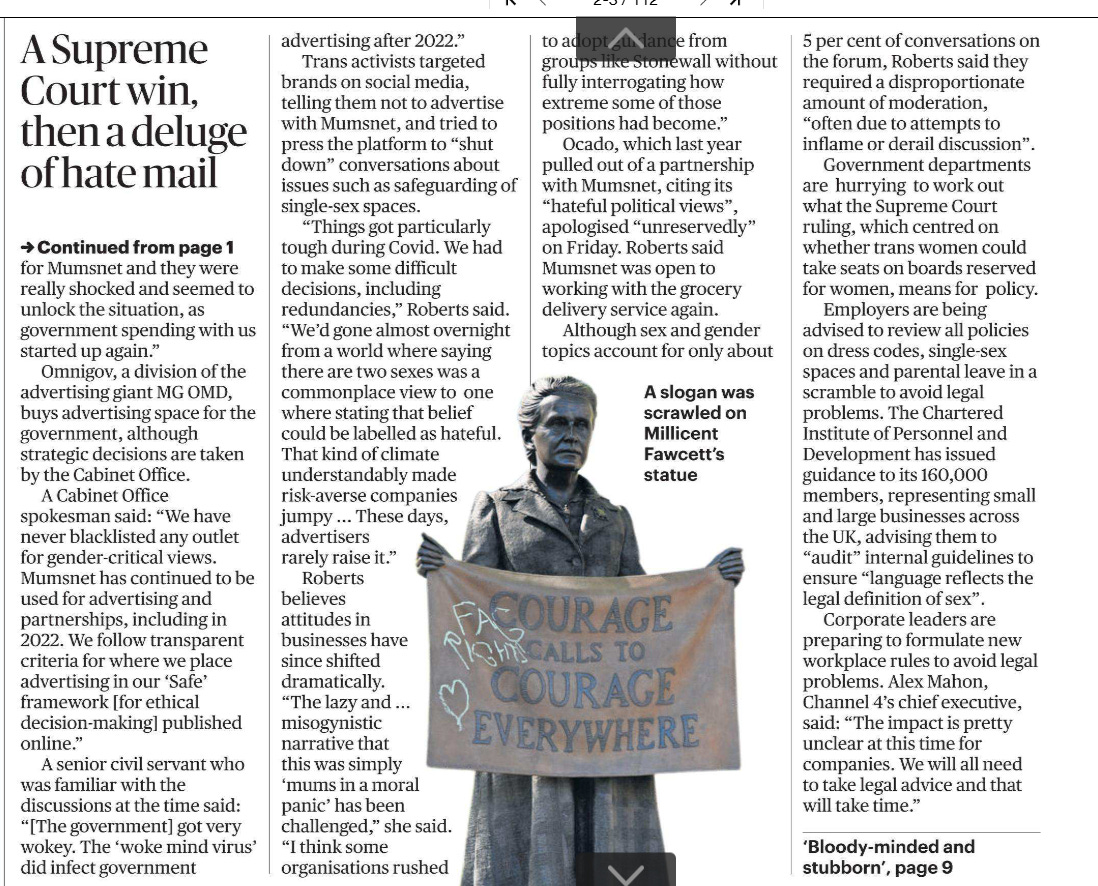
![‘Bloody-minded and stubborn’ Abuse, threats and six years without a holiday? The Mumsnet friends who won a court victory on biological sex say it was all worth it — and tell how it began over a plate of sausage rolls HADLEY FREEMAN HADLEY FREEMAN Next image › It started with sausage rolls. In the lobby of a Premier Inn in Westminster, two women from Scotland — with no political or legal background — are explaining how they took their own government to the Supreme Court last week and won. “We knew that MSPs were never going to invite us to the table. But we figured out that if we offered food, they’d come and listen to us,” says Marion Calder, 55, an NHS worker and single mother from Edinburgh. “It wasn’t easy because we had absolutely no money,” adds Susan Smith, 53, a former financial adviser and a mother of three. “But MSPs love a freebie. So we bought some sausage rolls, some shortbread, teas and coffees, and far more politicians than we expected came to our first open session in January 2019. So that was the beginning.” From sausage rolls to the Supreme Court. Calder, Smith and Trina Budge, 54, a Highland farmer, met on Mumsnet in 2018, connecting over their shared concern about the rise of gender ideology, which was sold by activists as a continuation of the gay rights movement. But to the three women it looked more like a men’s rights movement, one which insists male feelings are more important than female rights and safety. So Calder, Smith and Budge established the grassroots feminist group For Women Scotland (FWS) and last Wednesday, FWS achieved an era-defining victory when the Supreme Court found unanimously in their favour. It ruled that, while the Gender Recognition Act 2004 protects trans people from discrimination, the Equality Act 2010 defines a woman as an adult female, not a man who wishes to identify as a woman, as the Scottish government repeatedly insisted. The past decade of misogynistic magical thinking — when women, including Maya Forstater and Kathleen Stock, were driven from their jobs for refusing to believe that womanhood is a feeling rather than a biological fact — is now over, and it is thanks to these three utterly normal, extremely brave women. What Alan Bates did for employees of the Post Office, Calder, Smith and Budge have now done for British women. I call Budge, who is back in Caithness, and she puts FWS’s victory down to one simple factor: “It just boiled down to bloodyminded stubbornness.” The window of the Premier Inn lobby where I meet Calder and Smith looks out directly onto parliament. They should give some of its politicians lessons in courage. MPs of all stripes have parroted the mantras from gender activist organisations, insisting a man can have a cervix (Sir Keir Starmer) and that a man can become a woman without medical intervention (Theresa May). In the wake of the court’s judgment, many will be quietly hoping the public has short memories. FWS is too relieved to gloat. “None of us has had a holiday in six years. But it was worth it,” says Smith. When Calder went on Mumsnet in 2014, it wasn’t because she was worried about gender activism. “I just wanted tips about how to maximise the points on my Boots Advantage card, because Christmas was coming up.” But in between picking up loyalty card shortcuts, she read about “all the bonkers things happening in Canada”, which was starting to pursue a policy of “self-ID”, meaning a man could claim to be a woman, even without having undergone any medical or legal intervention. “And I thought, ‘Well, that can’t be right,’” says Calder who could not have then imagined that her own government would, in 2022, pass a similar bill, championed by Nicola Sturgeon. It was blocked the following year by Rishi Sunak’s government, and the bill sank, along with Sturgeon’s career. Smith started following this issue in 2016: “It was actually your fault, Hadley, because it was something you wrote that made me go, ‘Hang on a second, I need to look into this’.” This was a column I wrote for The Guardian about Caitlyn Jenner, who had undergone a surgical transition the year before and had just been named one of Glamour magazine’s Women of the Year. I wrote that this seemed a bit rum, given that same year Jenner had driven an SUV at what investigators described as an unsafe speed and crashed into two cars, resulting in the death of a 69-year-old woman named Kim Howe. It was a clear example of an attitude that was taking shape, that validating trans women’s feelings matters more than women’s safety. “I only read The Guardian and the BBC in those days, so I had no clue about what was going on, because they barely covered it at all. I was really cross. I’d invested so much of my time and intellectual energy into these so-called bastions of liberalism and free speech, and they let me down,” Smith says. She assumed others in her centre-left milieu would be equally horrified and so she posted her thoughts in a Liberal Democrat Facebook group. “The response I got was like nothing I’d ever seen — all these vicious, angry young men calling me all sorts of abusive names. So that’s when I first logged on to Mumsnet and there were all these smart, funny women who really knew what they were talking about, and I thought, ‘Oh thank God.’” Budge realised how embedded gender ideology was becoming in Scotland when her son started secondary school. “Multiple teachers had told him that children can change sex — and we live in the middle of rural blooming nowhere! Plus these are kids who live on farms. Imagine telling kids who grew up on farmyards biological sex doesn’t exist,” she says. Calder and Budge saw each other’s posts on Mumsnet and messaged each other about starting a feminist group, with Calder’s friend, Magdalen Berns, a computer programmer who made increasingly popular videos on YouTube about the absurdities of gender ideology. “We’re all straight,” says Calder, referring to herself, Budge and Smith. “And Magdalen represented the lesbian contingent.” Budge sent Smith a message in 2017: “I’ve seen your posts on Mumsnet and you seem OK. Can we have a chat?” “Which was so exciting,” says Smith. The women started making plans to launch FWS, but in 2017 Berns was diagnosed with an aggressive brain tumour. She died in 2019, at only 36. Berns made a huge impact on the then nascent gendercritical movement, and one Scottish feminist in particular. Shortly before Berns died, JK Rowling contacted her and later described her as “an immensely brave young feminist and lesbian”. So FWS became Smith, Calder and Budge, none of whom had any experience of campaigning. The most activism Calder had done was to convince her son’s school to move its PTA meetings from the schoolrooms to the pub. In 2018 the Scottish parliament passed a bill that said the governing bodies of public boards had to be “gender balanced”. But Budge realised that because the Scottish government insisted men can identify as women, the boards could be all-male and still be classified as “gender balanced”. In January 2019, they forked out for some sausage rolls, started speaking to MSPs and held their first event for the public at a hotel in Edinburgh. “We sold out, which was lovely, but the hotel received threats from activists,” says Calder. “The hotel, to their credit, didn’t cancel us, but they said we needed to pay for eight security guards, not just two. But because Eventbrite wouldn’t release the money we made from ticket sales until after the event, we had to pay for the security guards on our credit cards.” Trans activists have accused FWS of being funded by far-right American groups, which makes the women hoot with laughter: “Unless the American far right has set up hundreds of PayPal accounts that give us £2.50 a month, it’s not true,” says Smith. “They keep throwing insults at us, but none of them stick because they’re nonsense. First they said we’re transphobes, then they called us homophobes, then it was bigots, now they say we’re pro- Trump. It’s all completely ridiculous,” says Calder. '' The socalled bastions of free speech let us down By 2020, the Scottish government and Sturgeon was increasingly focused on passing the Gender Recognition Reform Bill, which would usher in self-ID, and lower the legal age when young people can transition to 16. Calder is still amazed at how Scotland went “so batshit crazy” about gender. “I think a lot of this is about Section 28 [a law which banned the promotion of homosexuality],” says Budge. “A lot of people who are still in the Scottish government made wrong choices then, and they saw gender as a way of proving they weren’t homophobic.” That same year, Smith was diagnosed with breast cancer and underwent a single mastectomy. Ten days after her surgery, she gave a speech in front of the Scottish parliament, a pillow clamped under her arm. “Having gone through a mastectomy myself, which I needed to save my life, I am disgusted by people who celebrate giving mastectomies to healthy young women as a ‘gender-confirming’ surgery. I think it is genuinely wicked,” she says. FWS’s argument with the Scottish government boiled down to whether the Equality Act 2010 says that a trans woman — ie a biological male — with a gender recognition certificate, which can be bought for £6, is the same as a female. The Scottish government said it did. FWS disagreed. In February last year, the women were given permission to appeal to the Supreme Court after the Court of Session ruled against them. FWS crowdsourced donations to fund their legal challenge; Rowling donated £70,000. “It was a big gamble, but we decided the appeal was worth it, because even if we lost, it would show that the law currently makes no sense, and that would have been hard work for them over the road,” Calder says, with a wry look in the direction of parliament. In the 24 hours after its win, FWS was inundated with abuse, much of it consisting of obscene personal insults. They’re used to this, but it never fails to amaze: “It would never occur to us to send messages like this, or to call our opponents ugly. But we get this every day,” says Smith. Their work is nowhere near done: a series of gender-based legal disputes are coming up in Scotland, and they hope their success means their organisation will be a little less hand-to-mouth. But for now, the mood is jubilant — they have an answer to the question that stumped politicians for years: what is a woman? A woman is officially a woman. “So there’s only one thing to do now,” says Calder. “Have a gigantic party.”](https://substackcdn.com/image/fetch/$s_!TwWH!,f_auto,q_auto:good,fl_progressive:steep/https%3A%2F%2Fsubstack-post-media.s3.amazonaws.com%2Fpublic%2Fimages%2F381081d1-3b58-4797-bd83-f6e8c42654a1_543x684.png "‘Bloody-minded and stubborn’ Abuse, threats and six years without a holiday? The Mumsnet friends who won a court victory on biological sex say it was all worth it — and tell how it began over a plate of sausage rolls HADLEY FREEMAN HADLEY FREEMAN Next image › It started with sausage rolls. In the lobby of a Premier Inn in Westminster, two women from Scotland — with no political or legal background — are explaining how they took their own government to the Supreme Court last week and won. “We knew that MSPs were never going to invite us to the table. But we figured out that if we offered food, they’d come and listen to us,” says Marion Calder, 55, an NHS worker and single mother from Edinburgh. “It wasn’t easy because we had absolutely no money,” adds Susan Smith, 53, a former financial adviser and a mother of three. “But MSPs love a freebie. So we bought some sausage rolls, some shortbread, teas and coffees, and far more politicians than we expected came to our first open session in January 2019. So that was the beginning.” From sausage rolls to the Supreme Court. Calder, Smith and Trina Budge, 54, a Highland farmer, met on Mumsnet in 2018, connecting over their shared concern about the rise of gender ideology, which was sold by activists as a continuation of the gay rights movement. But to the three women it looked more like a men’s rights movement, one which insists male feelings are more important than female rights and safety. So Calder, Smith and Budge established the grassroots feminist group For Women Scotland (FWS) and last Wednesday, FWS achieved an era-defining victory when the Supreme Court found unanimously in their favour. It ruled that, while the Gender Recognition Act 2004 protects trans people from discrimination, the Equality Act 2010 defines a woman as an adult female, not a man who wishes to identify as a woman, as the Scottish government repeatedly insisted. The past decade of misogynistic magical thinking — when women, including Maya Forstater and Kathleen Stock, were driven from their jobs for refusing to believe that womanhood is a feeling rather than a biological fact — is now over, and it is thanks to these three utterly normal, extremely brave women. What Alan Bates did for employees of the Post Office, Calder, Smith and Budge have now done for British women. I call Budge, who is back in Caithness, and she puts FWS’s victory down to one simple factor: “It just boiled down to bloodyminded stubbornness.” The window of the Premier Inn lobby where I meet Calder and Smith looks out directly onto parliament. They should give some of its politicians lessons in courage. MPs of all stripes have parroted the mantras from gender activist organisations, insisting a man can have a cervix (Sir Keir Starmer) and that a man can become a woman without medical intervention (Theresa May). In the wake of the court’s judgment, many will be quietly hoping the public has short memories. FWS is too relieved to gloat. “None of us has had a holiday in six years. But it was worth it,” says Smith. When Calder went on Mumsnet in 2014, it wasn’t because she was worried about gender activism. “I just wanted tips about how to maximise the points on my Boots Advantage card, because Christmas was coming up.” But in between picking up loyalty card shortcuts, she read about “all the bonkers things happening in Canada”, which was starting to pursue a policy of “self-ID”, meaning a man could claim to be a woman, even without having undergone any medical or legal intervention. “And I thought, ‘Well, that can’t be right,’” says Calder who could not have then imagined that her own government would, in 2022, pass a similar bill, championed by Nicola Sturgeon. It was blocked the following year by Rishi Sunak’s government, and the bill sank, along with Sturgeon’s career. Smith started following this issue in 2016: “It was actually your fault, Hadley, because it was something you wrote that made me go, ‘Hang on a second, I need to look into this’.” This was a column I wrote for The Guardian about Caitlyn Jenner, who had undergone a surgical transition the year before and had just been named one of Glamour magazine’s Women of the Year. I wrote that this seemed a bit rum, given that same year Jenner had driven an SUV at what investigators described as an unsafe speed and crashed into two cars, resulting in the death of a 69-year-old woman named Kim Howe. It was a clear example of an attitude that was taking shape, that validating trans women’s feelings matters more than women’s safety. “I only read The Guardian and the BBC in those days, so I had no clue about what was going on, because they barely covered it at all. I was really cross. I’d invested so much of my time and intellectual energy into these so-called bastions of liberalism and free speech, and they let me down,” Smith says. She assumed others in her centre-left milieu would be equally horrified and so she posted her thoughts in a Liberal Democrat Facebook group. “The response I got was like nothing I’d ever seen — all these vicious, angry young men calling me all sorts of abusive names. So that’s when I first logged on to Mumsnet and there were all these smart, funny women who really knew what they were talking about, and I thought, ‘Oh thank God.’” Budge realised how embedded gender ideology was becoming in Scotland when her son started secondary school. “Multiple teachers had told him that children can change sex — and we live in the middle of rural blooming nowhere! Plus these are kids who live on farms. Imagine telling kids who grew up on farmyards biological sex doesn’t exist,” she says. Calder and Budge saw each other’s posts on Mumsnet and messaged each other about starting a feminist group, with Calder’s friend, Magdalen Berns, a computer programmer who made increasingly popular videos on YouTube about the absurdities of gender ideology. “We’re all straight,” says Calder, referring to herself, Budge and Smith. “And Magdalen represented the lesbian contingent.” Budge sent Smith a message in 2017: “I’ve seen your posts on Mumsnet and you seem OK. Can we have a chat?” “Which was so exciting,” says Smith. The women started making plans to launch FWS, but in 2017 Berns was diagnosed with an aggressive brain tumour. She died in 2019, at only 36. Berns made a huge impact on the then nascent gendercritical movement, and one Scottish feminist in particular. Shortly before Berns died, JK Rowling contacted her and later described her as “an immensely brave young feminist and lesbian”. So FWS became Smith, Calder and Budge, none of whom had any experience of campaigning. The most activism Calder had done was to convince her son’s school to move its PTA meetings from the schoolrooms to the pub. In 2018 the Scottish parliament passed a bill that said the governing bodies of public boards had to be “gender balanced”. But Budge realised that because the Scottish government insisted men can identify as women, the boards could be all-male and still be classified as “gender balanced”. In January 2019, they forked out for some sausage rolls, started speaking to MSPs and held their first event for the public at a hotel in Edinburgh. “We sold out, which was lovely, but the hotel received threats from activists,” says Calder. “The hotel, to their credit, didn’t cancel us, but they said we needed to pay for eight security guards, not just two. But because Eventbrite wouldn’t release the money we made from ticket sales until after the event, we had to pay for the security guards on our credit cards.” Trans activists have accused FWS of being funded by far-right American groups, which makes the women hoot with laughter: “Unless the American far right has set up hundreds of PayPal accounts that give us £2.50 a month, it’s not true,” says Smith. “They keep throwing insults at us, but none of them stick because they’re nonsense. First they said we’re transphobes, then they called us homophobes, then it was bigots, now they say we’re pro- Trump. It’s all completely ridiculous,” says Calder. '' The socalled bastions of free speech let us down By 2020, the Scottish government and Sturgeon was increasingly focused on passing the Gender Recognition Reform Bill, which would usher in self-ID, and lower the legal age when young people can transition to 16. Calder is still amazed at how Scotland went “so batshit crazy” about gender. “I think a lot of this is about Section 28 [a law which banned the promotion of homosexuality],” says Budge. “A lot of people who are still in the Scottish government made wrong choices then, and they saw gender as a way of proving they weren’t homophobic.” That same year, Smith was diagnosed with breast cancer and underwent a single mastectomy. Ten days after her surgery, she gave a speech in front of the Scottish parliament, a pillow clamped under her arm. “Having gone through a mastectomy myself, which I needed to save my life, I am disgusted by people who celebrate giving mastectomies to healthy young women as a ‘gender-confirming’ surgery. I think it is genuinely wicked,” she says. FWS’s argument with the Scottish government boiled down to whether the Equality Act 2010 says that a trans woman — ie a biological male — with a gender recognition certificate, which can be bought for £6, is the same as a female. The Scottish government said it did. FWS disagreed. In February last year, the women were given permission to appeal to the Supreme Court after the Court of Session ruled against them. FWS crowdsourced donations to fund their legal challenge; Rowling donated £70,000. “It was a big gamble, but we decided the appeal was worth it, because even if we lost, it would show that the law currently makes no sense, and that would have been hard work for them over the road,” Calder says, with a wry look in the direction of parliament. In the 24 hours after its win, FWS was inundated with abuse, much of it consisting of obscene personal insults. They’re used to this, but it never fails to amaze: “It would never occur to us to send messages like this, or to call our opponents ugly. But we get this every day,” says Smith. Their work is nowhere near done: a series of gender-based legal disputes are coming up in Scotland, and they hope their success means their organisation will be a little less hand-to-mouth. But for now, the mood is jubilant — they have an answer to the question that stumped politicians for years: what is a woman? A woman is officially a woman. “So there’s only one thing to do now,” says Calder. “Have a gigantic party.”")
![‘Older judges don’t speak for me’ — how generations are divided by trans rights ruling Lottie Hayton Trans rights groups taking part in a protest in central London yesterday against the new ruling Georgina Wright made the decision not to call or message her parents since Wednesday, the day the Supreme Court ruled that the legal definition of a woman is based on biological sex. Wright, 23, from London, has been avoiding the argument she anticipates will eventually erupt when her family sit down for Easter lunch this weekend. “My mum is an old-school feminist,” she said. “I get she’s from the generation where women really had to fight for equality but I just don’t think trans people having rights takes away from my rights as a ‘cis woman’. It’s infuriating having to hear their recycled arguments about loos and pronouns.” Wright’s experience reflects the sometimes gaping divide between the opinions of younger and older people on transgender issues, a schism that Wednesday’s judgment has thrown into stark relief. According to a YouGov survey conducted last year, 61 per cent of those aged 18 to 24 think transgender people should be able to identify as being of a different gender to the one recorded at birth, compared with only 36 per cent of those aged 65 and older and 47 per cent of those aged 50 to 64. The judges in the ruling — Lord Reed, Lord Hodge, Lord Lloyd-Jones, Lady Rose and Lady Simler, — were aged between 61 and 73, something that did not go unnoticed by Wright and her peers. “The Supreme Court ruling just feels like a step backwards,” she said. “A win for bigotry. How is it that a group of older judges who aren’t representative of the diversity of the UK population have been allowed to speak for us?” Many trans people’s daily lives will be immediately affected by the ruling. Trans women who were recorded male at birth no longer have the right to use a space or service designated as “women only”. This applies even if they have a gender recognition certificate, which allows people to change the sex recorded on their birth certificate. Dr Aaron Gabriel, 32, is a trans man from Manchester. “The ruling was not a surprise but it was still a gut punch,” Gabriel said. “Our lives are going to get so much harder, especially those of us who are women, and this will empower people to be even more violent towards trans people than they already are.” The Scottish women who campaigned for the recognition of biological sex are passionately feminist, as are their supporters — women such as JK Rowling. They view some rights — trans women using female bathrooms, for example — as an infringement of their own rights. Many younger feminists disagree. Melissa Meadows, 31, is a mental health nursing student from Scotland. “I’m a proud feminist and, for me, feminism has to be intersectional, recognising that all women, including trans women, deserve the same rights, safety and respect,” she said. “Anything less isn’t true feminism in my opinion.” Meadows disagrees with the idea that trans rights impinge on women’s rights. “It’s not true,” she said. “I think older feminists holding on to that belief are stuck in a version of feminism that doesn’t work any more and it needs to evolve.” Of course, young people are not a homogeneous bloc. The percentage of young people who do not believe that trans people should be able to identify as a different gender has risen since 2022, from 17 per cent to 25 per cent. William, 24, who works in politics, felt relief on Wednesday: “Even as a heterosexual man who isn’t directly affected, for my female friends, family — and especially, should I be fortunate [enough] to have daughters in the future — I am pleased that this ruling should halt the erosion of their rights.” William was unwilling to give his surname because the issue can be so toxic. Even young people like Joe, 26, who was disappointed by the ruling, want discussions to be more nuanced. The day after the decision, Joe’s Instagram feed juxtaposed supporters of Andrew Tate posting antitrans content against posts reading “trans women are women”. Joe, a gay man who works in finance, feels there is little room for moderation. He is aligned with David Cameron’s fiscally conservative but socially liberal brand of Conservatism. “I think most people take a pretty binary view and are usually fully supportive of one side or the other. [But] we need to think more deeply than this,” he said. “When you frame trans rights as a debate, you’re starting out from an antitrans point of view,” said Gabriel. Although devastated by Wednesday’s ruling, Gabriel is hopeful that it might motivate trans allies. “People are starting to realise that it isn’t enough to just say you support trans people, you have to do something.”](https://substackcdn.com/image/fetch/$s_!TbYb!,f_auto,q_auto:good,fl_progressive:steep/https%3A%2F%2Fsubstack-post-media.s3.amazonaws.com%2Fpublic%2Fimages%2Fb5e4e6cd-d3ff-4967-b978-880ca3247c41_1624x571.png "‘Older judges don’t speak for me’ — how generations are divided by trans rights ruling Lottie Hayton Trans rights groups taking part in a protest in central London yesterday against the new ruling Georgina Wright made the decision not to call or message her parents since Wednesday, the day the Supreme Court ruled that the legal definition of a woman is based on biological sex. Wright, 23, from London, has been avoiding the argument she anticipates will eventually erupt when her family sit down for Easter lunch this weekend. “My mum is an old-school feminist,” she said. “I get she’s from the generation where women really had to fight for equality but I just don’t think trans people having rights takes away from my rights as a ‘cis woman’. It’s infuriating having to hear their recycled arguments about loos and pronouns.” Wright’s experience reflects the sometimes gaping divide between the opinions of younger and older people on transgender issues, a schism that Wednesday’s judgment has thrown into stark relief. According to a YouGov survey conducted last year, 61 per cent of those aged 18 to 24 think transgender people should be able to identify as being of a different gender to the one recorded at birth, compared with only 36 per cent of those aged 65 and older and 47 per cent of those aged 50 to 64. The judges in the ruling — Lord Reed, Lord Hodge, Lord Lloyd-Jones, Lady Rose and Lady Simler, — were aged between 61 and 73, something that did not go unnoticed by Wright and her peers. “The Supreme Court ruling just feels like a step backwards,” she said. “A win for bigotry. How is it that a group of older judges who aren’t representative of the diversity of the UK population have been allowed to speak for us?” Many trans people’s daily lives will be immediately affected by the ruling. Trans women who were recorded male at birth no longer have the right to use a space or service designated as “women only”. This applies even if they have a gender recognition certificate, which allows people to change the sex recorded on their birth certificate. Dr Aaron Gabriel, 32, is a trans man from Manchester. “The ruling was not a surprise but it was still a gut punch,” Gabriel said. “Our lives are going to get so much harder, especially those of us who are women, and this will empower people to be even more violent towards trans people than they already are.” The Scottish women who campaigned for the recognition of biological sex are passionately feminist, as are their supporters — women such as JK Rowling. They view some rights — trans women using female bathrooms, for example — as an infringement of their own rights. Many younger feminists disagree. Melissa Meadows, 31, is a mental health nursing student from Scotland. “I’m a proud feminist and, for me, feminism has to be intersectional, recognising that all women, including trans women, deserve the same rights, safety and respect,” she said. “Anything less isn’t true feminism in my opinion.” Meadows disagrees with the idea that trans rights impinge on women’s rights. “It’s not true,” she said. “I think older feminists holding on to that belief are stuck in a version of feminism that doesn’t work any more and it needs to evolve.” Of course, young people are not a homogeneous bloc. The percentage of young people who do not believe that trans people should be able to identify as a different gender has risen since 2022, from 17 per cent to 25 per cent. William, 24, who works in politics, felt relief on Wednesday: “Even as a heterosexual man who isn’t directly affected, for my female friends, family — and especially, should I be fortunate [enough] to have daughters in the future — I am pleased that this ruling should halt the erosion of their rights.” William was unwilling to give his surname because the issue can be so toxic. Even young people like Joe, 26, who was disappointed by the ruling, want discussions to be more nuanced. The day after the decision, Joe’s Instagram feed juxtaposed supporters of Andrew Tate posting antitrans content against posts reading “trans women are women”. Joe, a gay man who works in finance, feels there is little room for moderation. He is aligned with David Cameron’s fiscally conservative but socially liberal brand of Conservatism. “I think most people take a pretty binary view and are usually fully supportive of one side or the other. [But] we need to think more deeply than this,” he said. “When you frame trans rights as a debate, you’re starting out from an antitrans point of view,” said Gabriel. Although devastated by Wednesday’s ruling, Gabriel is hopeful that it might motivate trans allies. “People are starting to realise that it isn’t enough to just say you support trans people, you have to do something.”")
![I lost friends and a job in the trans witch-hunt Hordes of cowards caved in to the fantasy. A few brave women did not Hadley Freeman Hadley Freeman ‘We don’t want to be on the wrong side of history.” The first time I heard that sentence was in August 2015: I was meeting one of my editors at The Guardian, where I then worked, before going on maternity leave. Along with the usual banal pregnancy chat — did I feel ready? Of course not, you never do! Etc etc — I suggested that maybe the paper should be careful about running too many columns by male writers insisting “trans women are women”. Should men define what a woman is, I asked, especially in a newspaper that prides itself on its feminist bona fides? That’s when I got hit with the wrong-side-ofhistory smackdown for what would be far from the last time. “The wrong side of history”: it’s how Mridul Wadhwa, then chief executive of Edinburgh Rape Crisis Centre (ERCC), justified describing female rape victims as “bigoted” in 2021 if they asked for a female counsellor rather than a male one who identified as a woman (like Wadhwa). And it’s why advertisers including Barclays pulled their money out of Mumsnet when the women’s website dared to allow its users to discuss their concerns about how trans rights were conflicting with women’s rights. Last week the Supreme Court ruled that the wrong side of history is not where a lot of people believed it to be, when it came to the unanimous verdict that a woman is a biological fact, not a fantastical feeling. Whither the wrong-side-of-history folk now? Well, Wadhwa resigned last year from ERCC after an investigation found he failed to prioritise the needs of rape victims, despite that being his literal job. Only weeks after Mumsnet’s founder, Justine Roberts, learnt her site had been blacklisted “by Barclays’ top brass” for committing crimes of feminism, the bank’s then boss, Jes Staley, resigned following an investigation into his ties to Jeffrey Epstein. It is entirely unsurprising to me that so many of those who signed up to this flat-Earth ideology and insisted women should shut up and let men do whatever they wanted should turn out to be so morally bankrupt. Because who else would take such a stance? What kind of man would insist on competing in a sports match against women, despite their obvious discomfort, or tell women they knew what a woman was better than them? To give in to the activists’ demands was no big deal, women were told, but to refuse was fascism. I’ve been writing about the effects of gender ideology for more than a decade, and in that time I’ve had to leave a job I thought I’d have for ever, I’ve been publicly denounced by people I thought were friends and I’ve been blacklisted from more events than I can count. Of course there are lovely trans people, but the activists who have dominated this discussion for the past decade are bullies. Those who caved in to them — politicians, the NHS, the liberal media, the police, schools, publishers, journalists too scared to cover this issue properly — are cowards and stooges. In their absence, extraordinary women such as Susan Smith, Trina Budge and Marion Calder, better known as For Women Scotland, whom I have interviewed this week for The Sunday Times, stepped in to stop the wholescale theft of women’s rights. And what did they get for their trouble? A lot of abuse. From David Lammy to David Tennant, the roll-call of right-side-of-history men who enthusiastically denigrated women for saying primary school-level scientific truths could fill a phone book. The LBC radio presenter James O’Brien couldn’t even grasp why women would be happy about Wednesday’s ruling: “Do you pause and ask yourself, how did I end up on the same team as [Trump]?” he smirked, his brain audibly leaking out of his ears. Well, James, how’d you end up on the side that accuses rape victims of bigotry when they ask for a female counsellor? A roll-call of men enthusiastically denigrated women Trans people are still protected from discrimination by the Gender Recognition Act 2004, but the ludicrous era of self-ID and male “lesbians” and “trans women are women” is over. Activists insist — with no evidence — the verdict makes trans women “unsafe” and their “existence is threatened”. Women who have been in abusive relationships will recognise the tactics: say what I want or I will hurt myself, or you. They claim the result is “an overreach”, but if those same activists hadn’t overreached themselves and insisted biological sex is irrelevant, and any woman who disagreed should be screamed at, cancelled and pushed out on an ice floe, none of this would have happened. Their tactics have hurt women, children and trans people. No wonder the formerly ubiquitous Stonewall and Mermaids are now noticeable only by their absence. So now it’s April 2025, and what we knew 10, 20, 1,000 years ago has been confirmed: a woman is a woman. What a terrible waste of time, money and energy this has all been. On the other hand, how clarifying: now we know who believes in reality and who doesn’t. Who is brave and who isn’t. Who thinks men can magically become women and children can be born in the wrong body, and who doesn’t. Maybe every generation has its witch-hunt, its Joe McCarthy era, when innocent people are denounced for unimaginably bizarre reasons, and we’ve now lived through ours. I’ve lost friends but I’ve gained so many funnier, smarter ones, women — gay and straight — I never would have met were it not for all the men screaming that trans women are women. That’s how I explain the past decade to myself: this was a test. Some passed. A lot more failed.](https://substackcdn.com/image/fetch/$s_!WhZU!,f_auto,q_auto:good,fl_progressive:steep/https%3A%2F%2Fsubstack-post-media.s3.amazonaws.com%2Fpublic%2Fimages%2Fc0c28c11-761b-45ed-b85e-860c384d0a1b_642x787.png "I lost friends and a job in the trans witch-hunt Hordes of cowards caved in to the fantasy. A few brave women did not Hadley Freeman Hadley Freeman ‘We don’t want to be on the wrong side of history.” The first time I heard that sentence was in August 2015: I was meeting one of my editors at The Guardian, where I then worked, before going on maternity leave. Along with the usual banal pregnancy chat — did I feel ready? Of course not, you never do! Etc etc — I suggested that maybe the paper should be careful about running too many columns by male writers insisting “trans women are women”. Should men define what a woman is, I asked, especially in a newspaper that prides itself on its feminist bona fides? That’s when I got hit with the wrong-side-ofhistory smackdown for what would be far from the last time. “The wrong side of history”: it’s how Mridul Wadhwa, then chief executive of Edinburgh Rape Crisis Centre (ERCC), justified describing female rape victims as “bigoted” in 2021 if they asked for a female counsellor rather than a male one who identified as a woman (like Wadhwa). And it’s why advertisers including Barclays pulled their money out of Mumsnet when the women’s website dared to allow its users to discuss their concerns about how trans rights were conflicting with women’s rights. Last week the Supreme Court ruled that the wrong side of history is not where a lot of people believed it to be, when it came to the unanimous verdict that a woman is a biological fact, not a fantastical feeling. Whither the wrong-side-of-history folk now? Well, Wadhwa resigned last year from ERCC after an investigation found he failed to prioritise the needs of rape victims, despite that being his literal job. Only weeks after Mumsnet’s founder, Justine Roberts, learnt her site had been blacklisted “by Barclays’ top brass” for committing crimes of feminism, the bank’s then boss, Jes Staley, resigned following an investigation into his ties to Jeffrey Epstein. It is entirely unsurprising to me that so many of those who signed up to this flat-Earth ideology and insisted women should shut up and let men do whatever they wanted should turn out to be so morally bankrupt. Because who else would take such a stance? What kind of man would insist on competing in a sports match against women, despite their obvious discomfort, or tell women they knew what a woman was better than them? To give in to the activists’ demands was no big deal, women were told, but to refuse was fascism. I’ve been writing about the effects of gender ideology for more than a decade, and in that time I’ve had to leave a job I thought I’d have for ever, I’ve been publicly denounced by people I thought were friends and I’ve been blacklisted from more events than I can count. Of course there are lovely trans people, but the activists who have dominated this discussion for the past decade are bullies. Those who caved in to them — politicians, the NHS, the liberal media, the police, schools, publishers, journalists too scared to cover this issue properly — are cowards and stooges. In their absence, extraordinary women such as Susan Smith, Trina Budge and Marion Calder, better known as For Women Scotland, whom I have interviewed this week for The Sunday Times, stepped in to stop the wholescale theft of women’s rights. And what did they get for their trouble? A lot of abuse. From David Lammy to David Tennant, the roll-call of right-side-of-history men who enthusiastically denigrated women for saying primary school-level scientific truths could fill a phone book. The LBC radio presenter James O’Brien couldn’t even grasp why women would be happy about Wednesday’s ruling: “Do you pause and ask yourself, how did I end up on the same team as [Trump]?” he smirked, his brain audibly leaking out of his ears. Well, James, how’d you end up on the side that accuses rape victims of bigotry when they ask for a female counsellor? A roll-call of men enthusiastically denigrated women Trans people are still protected from discrimination by the Gender Recognition Act 2004, but the ludicrous era of self-ID and male “lesbians” and “trans women are women” is over. Activists insist — with no evidence — the verdict makes trans women “unsafe” and their “existence is threatened”. Women who have been in abusive relationships will recognise the tactics: say what I want or I will hurt myself, or you. They claim the result is “an overreach”, but if those same activists hadn’t overreached themselves and insisted biological sex is irrelevant, and any woman who disagreed should be screamed at, cancelled and pushed out on an ice floe, none of this would have happened. Their tactics have hurt women, children and trans people. No wonder the formerly ubiquitous Stonewall and Mermaids are now noticeable only by their absence. So now it’s April 2025, and what we knew 10, 20, 1,000 years ago has been confirmed: a woman is a woman. What a terrible waste of time, money and energy this has all been. On the other hand, how clarifying: now we know who believes in reality and who doesn’t. Who is brave and who isn’t. Who thinks men can magically become women and children can be born in the wrong body, and who doesn’t. Maybe every generation has its witch-hunt, its Joe McCarthy era, when innocent people are denounced for unimaginably bizarre reasons, and we’ve now lived through ours. I’ve lost friends but I’ve gained so many funnier, smarter ones, women — gay and straight — I never would have met were it not for all the men screaming that trans women are women. That’s how I explain the past decade to myself: this was a test. Some passed. A lot more failed.")

Mail on Sunday [4]
![MINISTERS IN WHATSAPP PLOT TO DEFY TRANS RULING As Supreme Court judgment piles pressure on Starmer to protect women-only spaces, leaked messages reveal revolt on frontbench The Mail on Sunday20 Apr 2025By Glen Owen POLITICAL EDITOR PROTEST: Transrights activists on the Churchill statue in Parliament Square yesterday LABOUR ministers are secretly plotting to defy the landmark court ruling that men who change gender are not legally women, leaked WhatsApp messages obtained by The Mail on Sunday have revealed. The Government claimed to welcome the Supreme Court judgment – but the exchanges reveal the private fury on Sir Keir Starmer’s frontbench, with ministers planning to hold a meeting this week to ‘decide a way forwards’ and ‘organise’. In the messages, sent on Thursday evening, Culture Minister Sir Chris Bryant joined an attack on Baroness Falkner, chairwoman of the Equality and Human Rights Commission (EHRC), who earlier that day had said that the ruling – that a woman is defined by biological sex – clearly meant trans women could not use single-sex female facilities or compete in women’s sports. When an MP said that Lady Falkner’s words were ‘pretty appalling’, Mr Bryant wrote: ‘Agreeed [sic].’ Last night, with the Government in turmoil, Tory leader Kemi Badenoch wrote to the Cabinet Secretary calling for an investigation into a statement by Equalities Minister Bridget Phillipson, who reacted to the judgment by saying: ‘We have always supported the protection of single-sex spaces based on biological sex.’ In her letter to Sir Chris Wormald, who is also the Head of the Civil Service, Ms Badenoch argued that it could constitute a ‘false public statement’ – because last June Ms Phillipson declared that trans women with penises should be able to use single-sex spaces. Writing on the WhatsApp group of LGBT+ Labour MPs, Home Office Minister Dame Angela Eagle said: ‘The ruling is not as catastrophic as it seems but the EHRC guidance might be and there are already signs that some public bodies are overreacting’ – a possible reference to the British Transport Police’s interim announcement that strip searches of trans women would now be done by male officers, not female. Dame Angela added that ‘we have to get on with doing the stuff we said we’d do in the manifesto’, which included a pledge to protect ‘the freedom for people to explore their sexual orientation and gender identity’. Another MP on the WhatsApp group wrote that it was ‘sad to see some institutions choose to ignore the Supreme Court’s very strong line that trans people are protected by the Equality Act too’. Dame Angela replied: ‘They won’t be feeling that way now and we need to remember that and organise.’ MPs agreed with her suggestion that they should seek a meeting ‘ASAP with [the] relevant Equality Minister’ after the Commons returns from Easter recess this week. News of the WhatsApp messages came as thousands of trans rights campaigners descended on central London yesterday to rally against the landmark ruling. The ‘emergency demonstration’ ended with at least two statues in Parliament Square daubed with graffiti, with ‘fag rights’ and a heart painted on the banner held by suffragist Millicent Fawcett. ‘Trans rights are human rights’ was also sprayed on the pedestal bearing a memorial to South African military leader Jan Christian Smuts. Yesterday, other bodies vowed to challenge the ruling, with teachers voting at a conference in Liverpool to stop schools making ‘kneejerk’ changes to their trans policies until the government issues further guidance. The NASUWT union claimed the judgment could lead schools to make rules which put transgender teachers ‘at risk of harm’. Labour has come under fire over its response to last Wednesday’s unanimous verdict. Health Minis Dame Angela Eagle Let’s meet about this when we get back from Easter recess to decide a way forwards – the ruling is not as catastrophic as it seems but the EHRC [Equality and Human Rights Commission] guidance might be & there are already signs that some public bodies are overreacting Chris Murray Definitely agree, a meeting early next week would be good Steve Race I thought that the EHRC Chair on Today [saying the ruling meant trans women could not use single-sex female facilities or compete in women’s sports] was pretty appalling this morning Sir Chris Bryant Agreeed [sic] ter Karin Smyth failed four times to clarify which changing room trans women should now use. In contrast, Lady Falkner – who hailed the ruling for bringing ‘clarity’ – told the BBC: ‘Single-sex services like changing rooms must be based on biological sex. ‘If a male person is allowed to use a women-only service or facility, it isn’t any longer single-sex.’ She also agreed that the ‘enormously consequential’ court decision also meant trans women could not take part in female sports. Lady Falkner, whose watchdog is working on an updated code of conduct for public services, said the NHS would now be pursued if it did not follow new guidelines on single-sex spaces. Current guidance says trans people should be ‘accommodated’ according to how they ‘identify’. In 2023, Lady Falkner survived attempts to oust her from her job because of her staunch defence of women’s rights after the Mail exposed claims of an ‘ideologically motivated witch-hunt’ against her. Interviewing her on the BBC’s Today programme last week, Nick Robinson said her position ‘has brought you extraordinary levels of personal grief’ – including once being described as a ‘Nazi who ‘Terrible abuse for standing up for women’ wants to dehumanise trans people’. Mims Davies, Shadow Minister for Women and Equalities, said: ‘In public Keir Starmer and his Cabinet pretended they supported the Supreme Court judgment. But in private we know Labour are seething, as these texts prove. ‘Like so many brave women, Baroness Falkner has suffered terrible abuse for standing up for the rights of women and girls. Now we know Labour will do all they can to undermine her work. ‘The Prime Minister needs to come out and say he will support the EHRC guidance when it comes out. Anything less will be Labour betraying the rights of women once again.’ Pressed on the issue last year, Ms Phillipson said: ‘If you were someone that had gone through that formal process of recognition you are, to all intents and purposes, for legal purposes, regarded as being in a different gender regardless of the sex into which you were born... I would think that in those cases people would be using female toilets.’ In her letter to Sir Chris about Ms Phillipson’s apparent new stance, Ms Badenoch said: ‘If ministers or advisers are found to have instructed civil servants to issue misleading material, then there is a clear route to resolve through resignation.’ Sir Chris and Dame Angela declined to comment. MAC IS AWAY Article Name:MINISTERS IN WHATSAPP PLOT TO DEFY TRANS RULING Publication:The Mail on Sunday Author:By Glen Owen POLITICAL EDITOR Start Page:1 End Page:1](https://substackcdn.com/image/fetch/$s_!Wf_4!,f_auto,q_auto:good,fl_progressive:steep/https%3A%2F%2Fsubstack-post-media.s3.amazonaws.com%2Fpublic%2Fimages%2Ff30e338d-380f-4181-876b-30a20bd269ea_616x778.png "MINISTERS IN WHATSAPP PLOT TO DEFY TRANS RULING As Supreme Court judgment piles pressure on Starmer to protect women-only spaces, leaked messages reveal revolt on frontbench The Mail on Sunday20 Apr 2025By Glen Owen POLITICAL EDITOR PROTEST: Transrights activists on the Churchill statue in Parliament Square yesterday LABOUR ministers are secretly plotting to defy the landmark court ruling that men who change gender are not legally women, leaked WhatsApp messages obtained by The Mail on Sunday have revealed. The Government claimed to welcome the Supreme Court judgment – but the exchanges reveal the private fury on Sir Keir Starmer’s frontbench, with ministers planning to hold a meeting this week to ‘decide a way forwards’ and ‘organise’. In the messages, sent on Thursday evening, Culture Minister Sir Chris Bryant joined an attack on Baroness Falkner, chairwoman of the Equality and Human Rights Commission (EHRC), who earlier that day had said that the ruling – that a woman is defined by biological sex – clearly meant trans women could not use single-sex female facilities or compete in women’s sports. When an MP said that Lady Falkner’s words were ‘pretty appalling’, Mr Bryant wrote: ‘Agreeed [sic].’ Last night, with the Government in turmoil, Tory leader Kemi Badenoch wrote to the Cabinet Secretary calling for an investigation into a statement by Equalities Minister Bridget Phillipson, who reacted to the judgment by saying: ‘We have always supported the protection of single-sex spaces based on biological sex.’ In her letter to Sir Chris Wormald, who is also the Head of the Civil Service, Ms Badenoch argued that it could constitute a ‘false public statement’ – because last June Ms Phillipson declared that trans women with penises should be able to use single-sex spaces. Writing on the WhatsApp group of LGBT+ Labour MPs, Home Office Minister Dame Angela Eagle said: ‘The ruling is not as catastrophic as it seems but the EHRC guidance might be and there are already signs that some public bodies are overreacting’ – a possible reference to the British Transport Police’s interim announcement that strip searches of trans women would now be done by male officers, not female. Dame Angela added that ‘we have to get on with doing the stuff we said we’d do in the manifesto’, which included a pledge to protect ‘the freedom for people to explore their sexual orientation and gender identity’. Another MP on the WhatsApp group wrote that it was ‘sad to see some institutions choose to ignore the Supreme Court’s very strong line that trans people are protected by the Equality Act too’. Dame Angela replied: ‘They won’t be feeling that way now and we need to remember that and organise.’ MPs agreed with her suggestion that they should seek a meeting ‘ASAP with [the] relevant Equality Minister’ after the Commons returns from Easter recess this week. News of the WhatsApp messages came as thousands of trans rights campaigners descended on central London yesterday to rally against the landmark ruling. The ‘emergency demonstration’ ended with at least two statues in Parliament Square daubed with graffiti, with ‘fag rights’ and a heart painted on the banner held by suffragist Millicent Fawcett. ‘Trans rights are human rights’ was also sprayed on the pedestal bearing a memorial to South African military leader Jan Christian Smuts. Yesterday, other bodies vowed to challenge the ruling, with teachers voting at a conference in Liverpool to stop schools making ‘kneejerk’ changes to their trans policies until the government issues further guidance. The NASUWT union claimed the judgment could lead schools to make rules which put transgender teachers ‘at risk of harm’. Labour has come under fire over its response to last Wednesday’s unanimous verdict. Health Minis Dame Angela Eagle Let’s meet about this when we get back from Easter recess to decide a way forwards – the ruling is not as catastrophic as it seems but the EHRC [Equality and Human Rights Commission] guidance might be & there are already signs that some public bodies are overreacting Chris Murray Definitely agree, a meeting early next week would be good Steve Race I thought that the EHRC Chair on Today [saying the ruling meant trans women could not use single-sex female facilities or compete in women’s sports] was pretty appalling this morning Sir Chris Bryant Agreeed [sic] ter Karin Smyth failed four times to clarify which changing room trans women should now use. In contrast, Lady Falkner – who hailed the ruling for bringing ‘clarity’ – told the BBC: ‘Single-sex services like changing rooms must be based on biological sex. ‘If a male person is allowed to use a women-only service or facility, it isn’t any longer single-sex.’ She also agreed that the ‘enormously consequential’ court decision also meant trans women could not take part in female sports. Lady Falkner, whose watchdog is working on an updated code of conduct for public services, said the NHS would now be pursued if it did not follow new guidelines on single-sex spaces. Current guidance says trans people should be ‘accommodated’ according to how they ‘identify’. In 2023, Lady Falkner survived attempts to oust her from her job because of her staunch defence of women’s rights after the Mail exposed claims of an ‘ideologically motivated witch-hunt’ against her. Interviewing her on the BBC’s Today programme last week, Nick Robinson said her position ‘has brought you extraordinary levels of personal grief’ – including once being described as a ‘Nazi who ‘Terrible abuse for standing up for women’ wants to dehumanise trans people’. Mims Davies, Shadow Minister for Women and Equalities, said: ‘In public Keir Starmer and his Cabinet pretended they supported the Supreme Court judgment. But in private we know Labour are seething, as these texts prove. ‘Like so many brave women, Baroness Falkner has suffered terrible abuse for standing up for the rights of women and girls. Now we know Labour will do all they can to undermine her work. ‘The Prime Minister needs to come out and say he will support the EHRC guidance when it comes out. Anything less will be Labour betraying the rights of women once again.’ Pressed on the issue last year, Ms Phillipson said: ‘If you were someone that had gone through that formal process of recognition you are, to all intents and purposes, for legal purposes, regarded as being in a different gender regardless of the sex into which you were born... I would think that in those cases people would be using female toilets.’ In her letter to Sir Chris about Ms Phillipson’s apparent new stance, Ms Badenoch said: ‘If ministers or advisers are found to have instructed civil servants to issue misleading material, then there is a clear route to resolve through resignation.’ Sir Chris and Dame Angela declined to comment. MAC IS AWAY Article Name:MINISTERS IN WHATSAPP PLOT TO DEFY TRANS RULING Publication:The Mail on Sunday Author:By Glen Owen POLITICAL EDITOR Start Page:1 End Page:1")

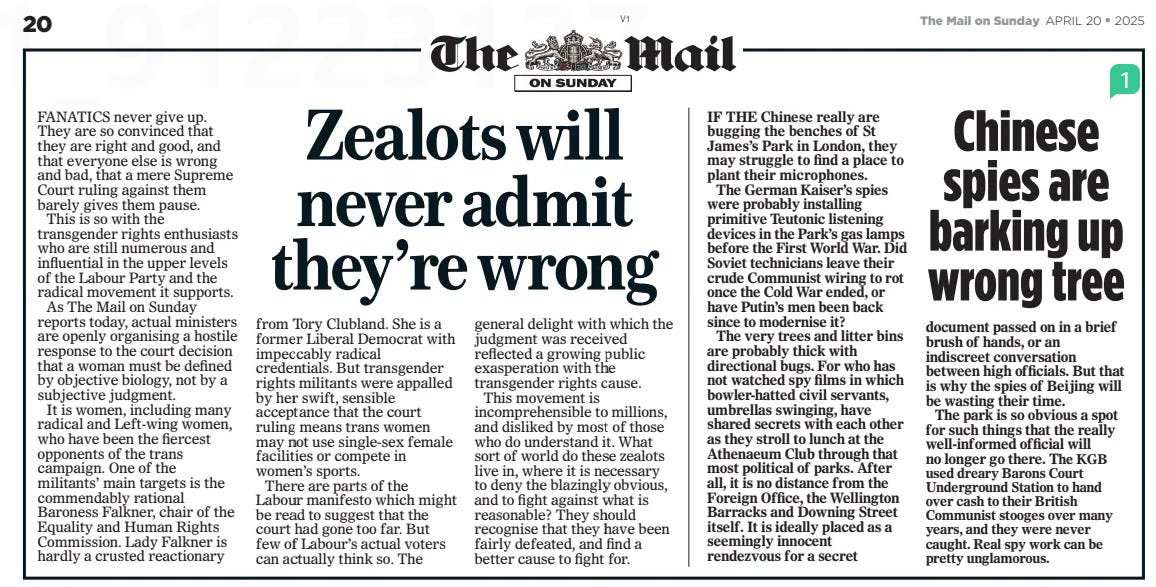
Sunday Telegraph [3]
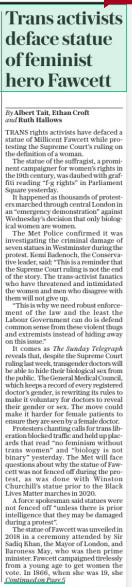

![Bridgerton star chides ‘new low’ Rowling The Sunday Telegraph20 Apr 2025By Ruth Hallows A BRIDGERTON actress has attacked JK Rowling over her views on the Supreme Court’s transgender ruling. Nicola Coughlan criticised the Harry Potter author and vocal gender-critical campaigner after she posted a celebratory photo on X on Wednesday following the landmark court decision, showing her smoking a cigar and holding up a drink. In response, Coughlan shared a post on Instagram linking to an article headlined: “This is a new low for JK Rowling.” Underneath, she referred to HBO’s new Harry Potter series, writing: “Keep your new Harry Potter lads. Wouldn’t touch it with a 10ft pole.” Coughlan, 38, who also starred in Derry Girls, later uploaded a video to her Instagram saying that she was “completely horrified” by the court ruling, and encouraged her followers to donate to her fundraiser for Not A Phase, a trans charity. The Irish actress added that she would match donations up to €10,000 (£8,565), and has since raised nearly £100,000. The Supreme Court’s ruling was hailed as a victory by gender-critical campaigners and politicians. It followed a years-long legal battle between the campaign group For Women Scotland and the Scottish Government over the definition of a woman, and has provided much greater clarity than many expected. Rowling, a financial supporter of For Women Scotland, wrote on X: “It took three extraordinary, tenacious Scottish women with an army behind them to get this case heard by the Supreme Court and, in winning, they’ve protected the rights of women and girls across the UK.” The announcement coincided with the news that Severus Snape, the professor played by Alan Rickman in the film series, would be played by Paapa Essiedu, the 34-year-old British actor, in the HBO adaption, of which Rowling is an executive producer. The series has been plagued with controversy as a result of Rowling’s gender-critical stance. In October, industry sources told The Times that some people were reluctant to work with the author because they did not support her views, or feared abuse from those who disagree with her. A month later, HBO was forced to defend its decision to work with the writer, reminding the public that the author had a right to her “personal views”. The company said: “[Warner Bros has] been working with JK Rowling and in the Harry Potter business for over 20 years and called her contribution ‘invaluable’. “We are proud to once again tell the story of Harry Potter – the heart-warming books that speak to the power of friendship, resolve and acceptance. “JK Rowling has a right to express her personal views. We will remain focused on the development of the new series, which will only benefit from her involvement.” Daniel Radcliffe, Emma Watson and Rupert Grint, who played the lead roles in the films, have all distanced themselves from the author’s beliefs following her 2020 essay in which she argued “transgender women are women”. Article Name:Bridgerton star chides ‘new low’ Rowling Publication:The Sunday Telegraph Author:By Ruth Hallows Start Page:5 End Page:5](https://substackcdn.com/image/fetch/$s_!FzQg!,f_auto,q_auto:good,fl_progressive:steep/https%3A%2F%2Fsubstack-post-media.s3.amazonaws.com%2Fpublic%2Fimages%2Fe0afe61a-d886-41aa-b598-880d6883a234_759x639.png "Bridgerton star chides ‘new low’ Rowling The Sunday Telegraph20 Apr 2025By Ruth Hallows A BRIDGERTON actress has attacked JK Rowling over her views on the Supreme Court’s transgender ruling. Nicola Coughlan criticised the Harry Potter author and vocal gender-critical campaigner after she posted a celebratory photo on X on Wednesday following the landmark court decision, showing her smoking a cigar and holding up a drink. In response, Coughlan shared a post on Instagram linking to an article headlined: “This is a new low for JK Rowling.” Underneath, she referred to HBO’s new Harry Potter series, writing: “Keep your new Harry Potter lads. Wouldn’t touch it with a 10ft pole.” Coughlan, 38, who also starred in Derry Girls, later uploaded a video to her Instagram saying that she was “completely horrified” by the court ruling, and encouraged her followers to donate to her fundraiser for Not A Phase, a trans charity. The Irish actress added that she would match donations up to €10,000 (£8,565), and has since raised nearly £100,000. The Supreme Court’s ruling was hailed as a victory by gender-critical campaigners and politicians. It followed a years-long legal battle between the campaign group For Women Scotland and the Scottish Government over the definition of a woman, and has provided much greater clarity than many expected. Rowling, a financial supporter of For Women Scotland, wrote on X: “It took three extraordinary, tenacious Scottish women with an army behind them to get this case heard by the Supreme Court and, in winning, they’ve protected the rights of women and girls across the UK.” The announcement coincided with the news that Severus Snape, the professor played by Alan Rickman in the film series, would be played by Paapa Essiedu, the 34-year-old British actor, in the HBO adaption, of which Rowling is an executive producer. The series has been plagued with controversy as a result of Rowling’s gender-critical stance. In October, industry sources told The Times that some people were reluctant to work with the author because they did not support her views, or feared abuse from those who disagree with her. A month later, HBO was forced to defend its decision to work with the writer, reminding the public that the author had a right to her “personal views”. The company said: “[Warner Bros has] been working with JK Rowling and in the Harry Potter business for over 20 years and called her contribution ‘invaluable’. “We are proud to once again tell the story of Harry Potter – the heart-warming books that speak to the power of friendship, resolve and acceptance. “JK Rowling has a right to express her personal views. We will remain focused on the development of the new series, which will only benefit from her involvement.” Daniel Radcliffe, Emma Watson and Rupert Grint, who played the lead roles in the films, have all distanced themselves from the author’s beliefs following her 2020 essay in which she argued “transgender women are women”. Article Name:Bridgerton star chides ‘new low’ Rowling Publication:The Sunday Telegraph Author:By Ruth Hallows Start Page:5 End Page:5")
TRANSWRITES YOU MIGHT HAVE MISSED
Judge Tinnion should be ashamed of allowing tribunal to become a circus of harassment, by Gemma Stone
Calls for boycott as Oxford Literary Festival continually promotes bigotry, by Gemma Stone
My doctor emailed me back, by Abigail Thorn
The Rainbow Laces campaign isn't enough, by Arthur Webber
How Erika Hilton - a Black travesti trans woman - is changing Brasil, by Lis Welch
When was the T added to LGBT? A quick history, by Sarah Clarke
Trans people are the greatest assault on women in JK Rowling’s life time, apparently, by Gemma Stone
NHS & puberty blockers: Former GIDS patients reflect on long wait times, invasive assessments, by Sasha Baker.
SUPPORT THE TRANS AGENDA
Tired of the same old news narratives? Get 'The Trans Agenda' delivered right to your inbox – news with the trans community at the forefront. Subscribe now!
The Trans Agenda also needs your help. Your donation powers my reporting efforts, amplifying trans voices and keeps you in the know. Support independent trans journalism. Help keep in-depth reporting in 'The Trans Agenda' available and accessible by donating today!
CALL FOR STORIES
Seen something newsworthy related to the trans community in the UK? Send me a tip! I’m always looking for leads and underreported stories.